
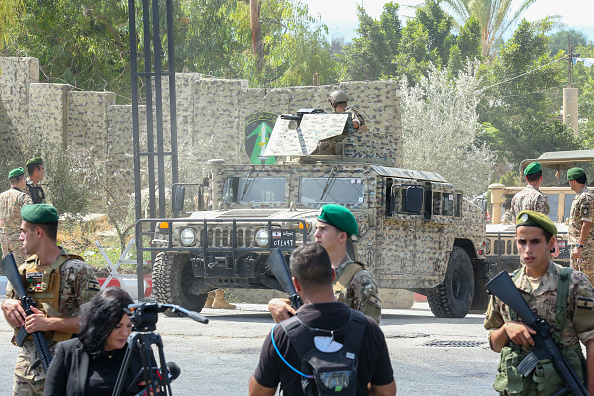
On January 8th, the Lebanese military announced that they have deployed fully in southern Lebanon and have “effectively and tangibly” disarmed non-state armed groups in the area. While the Lebanese military did not explicitly mention Hezbollah, it is the main non-state armed group in the region.
The Lebanese government had set a deadline by the end of 2025 to clear non-state weapons south of the Litani River, bordering Israel. Since the approval of the disarmament proposal and its enforcement in September last year, the Lebanese military has been clearing tunnels, rocket launch sites, and other facilities.
In a statement, the Lebanese military stated, “The military confirms that the plan to restrict weapons has entered its final stages, and the objectives of the first phase have been effectively and tangibly achieved.”
Israel has been carrying out almost daily strikes on Hezbollah targets in Lebanon since the end of 2025, occupying five strategic heights along the border, the only area south of the Litani River that Lebanon’s military has not fully controlled.
The military of Lebanon stated, “Work in the area is ongoing, including clearance of unexploded ordnance and tunnels…aimed at preventing armed groups from irreversibly rebuilding their capabilities.”
President Joseph Aoun’s office expressed strong support for the military’s statement and urged Israel to stop the attacks, withdraw from the occupied areas, and release Lebanese prisoners.
Aoun called on friendly countries not to supply weapons to Lebanon unless they are provided to state institutions, a statement seen as directed towards Iran, which has been supplying weapons and ammunition to Hezbollah for decades.
Lebanese government officials indicated that the next phase of the disarmament plan would take place in the southern region between the Litani and Awali Rivers, including the port city of Sidon, but a timetable has not been set.
Regular meetings between Lebanon and Israel, as well as with the United States, France, and the United Nations Interim Force in Lebanon (UNIFIL), are held to monitor progress after the ceasefire.
Lebanon’s army has been gradually deploying in a wide area between the Litani River and the UN-drawn “Blue Line” (borderline) in the southern region. Weapons are also slowly being confiscated from armed Palestinian factions in refugee camps.
Israel has accused Hezbollah of attempting to rebuild its military capabilities and stated that the efforts of the Lebanese military are insufficient. Meanwhile, Lebanon has argued that Israel’s attacks and control of the heights are obstacles to the disarmament effort.
Hezbollah stated that it is cooperating with the government’s military in the south, but will not discuss disarmament in other areas until Israel ceases its strikes and withdraws from Lebanese territory.
According to the 2024 ceasefire agreement, only Lebanon’s national security forces are allowed to carry weapons between the Litani River and the UN-drawn “Blue Line.”
Lebanon is facing increasing pressure from the United States and Israel to disarm Hezbollah. The leadership in Lebanon is concerned that Israel may escalate attacks on Hezbollah targets to prompt Lebanese leaders to more rapidly confiscate Hezbollah’s arsenal.
The Lebanese government hopes to advance the disarmament plan in the southern region to attract post-war reconstruction funds. However, progress is hindered due to Hezbollah’s political influence in the country. Hezbollah holds a significant number of seats in the Lebanese parliament, representing the Shia Muslim community, and has two cabinet ministers.
(This article references reports from the Associated Press and Reuters)