
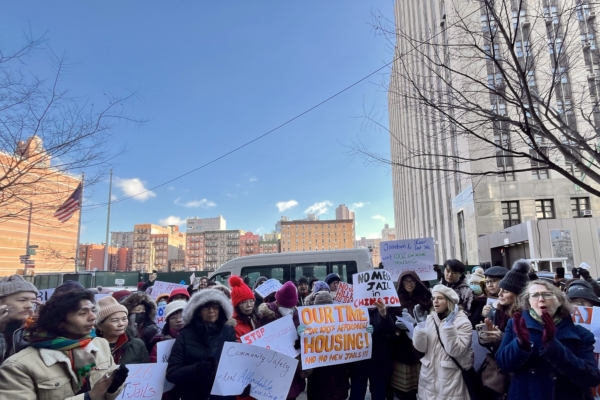
Several residents, community representatives, elected community leaders, and cultural figures in Manhattan’s Chinatown gathered at 111 Central Street on January 4th to hold a press conference opposing the city government’s plan to build a “giant prison” in Chinatown. They called on the newly elected mayor, Zohran Mamdani, to listen to the community’s voice, halt the continuation of the previous administration’s policies of “criminalization and displacement,” and repurpose relevant city-owned land for genuinely affordable housing to protect the existing residents and culture of the community. The protestors held up signs chanting slogans such as “Build affordable housing, not prisons! Protect Chinatown!”
One of the speakers representing tenants, Lin Nanzhen, a Chinese resident, shared her experiences of being harassed and pressured by landlords, emphasizing the need for low-income housing in Chinatown instead of a new prison. She stressed that Chinatown needs affordable housing and not a new prison, stating that “Chinatown is our street, we need houses we can afford, not prisons.”
Another Chinatown resident, Chen Liyi, criticized the past two mayors for their “irresponsible” handling of Chinatown issues, treating the community as if it were filled with criminals. She expressed her deep emotional connection to the community after living in Chinatown for eight years since immigrating, participating in the rally in hopes of a policy shift. She hoped that the new mayor would fulfill his promise to increase the construction of affordable housing, making New York more prosperous and beautiful while allowing Chinatown to remain intact.
Clara, a resident living near the Manhattan Bridge, pointed out the structural issues affecting her building due to nearby large construction projects, expressing concerns that the proposed “prison skyscraper” would further damage surrounding structures, impacting ordinary residents and community businesses rather than benefiting a few. She urged the new mayor not to follow in the footsteps of his predecessor and to allocate resources towards low-income and affordable housing rather than prisons.
Former City Council member and retired judge Kathryn Freed also spoke at the event, reminiscing about protesting alongside the Chinatown community when the prison was initially proposed. She noted that promises to Chinatown have repeatedly gone unfulfilled, construction causing damage to nearby facilities, affecting residents’ lives. She particularly highlighted the geological risk of the area, with deep groundwater levels and historical water retention zones, warning that significant water extraction could destabilize neighboring old buildings, potentially leading to more closures of residences, ultimately destroying existing affordable housing.
Jon Alpert, founder of the community media institution DCTV and a documentary filmmaker, criticized the prison project as a “huge waste” and “misplaced priority.” He questioned the allocation of government funds towards building and maintaining prisons when those resources could be invested in public transportation, education, healthcare, and housing to genuinely improve community safety and well-being. Alpert called for a dialogue between the mayor and the community to “stop this unjust plan.”
Representing the Bowery Alliance of Neighbors, David Wilkins, supplemented by highlighting the narrow streets and dense population of Chinatown, which have long faced traffic congestion issues. He emphasized that the giant prison would not only encroach on community space but also exacerbate the residents’ financial burdens. Wilkins called on the city government to replace the prison with 100% affordable housing and advocated for stricter construction site supervision to prevent new projects from destabilizing and damaging old buildings, leading to further displacements.
At the end of the event, the organizers invited the public to sign a letter urging the mayor to stand with the community, safeguarding Chinatown’s right to housing, culture, and quality of life.