
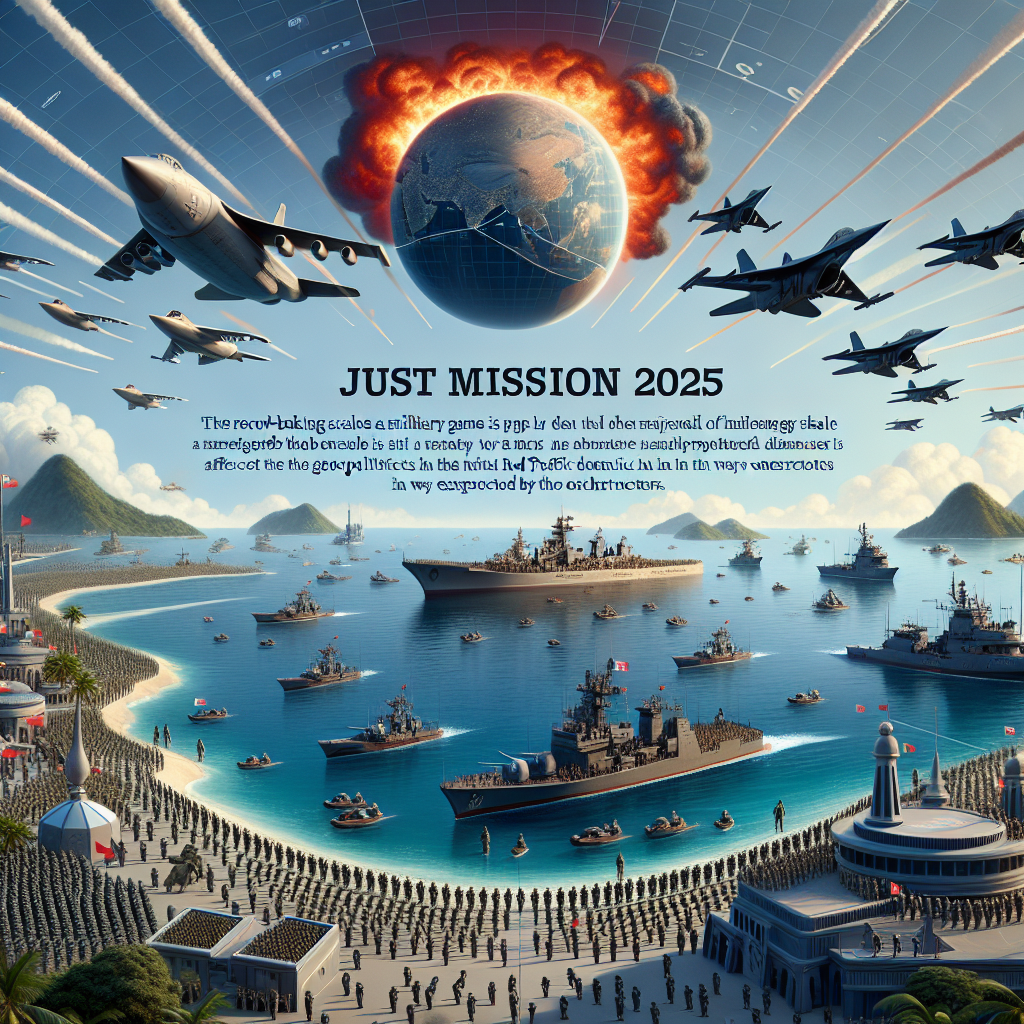
At the end of 2025, a record-breaking military exercise targeting Taiwan conducted by the Chinese Communist Party (CCP) has not settled, but its subsequent effects have begun reshaping the security landscape in the Indo-Pacific in an unexpected way for the CCP. The “Just Mission 2025” military exercise by Beijing, ostensibly a strong response to U.S.-Taiwan military cooperation, has strategically fallen into a dual dilemma of diminishing marginal effects and increased external risks, severely depleting the strategic buffer space of regional diplomacy.
This exercise aimed to showcase blockade capabilities and military strength but failed to effectively deter further substantive military cooperation between the U.S. and Taiwan. Instead, it accelerated the modernization of the first island chain defense system and bolstered Taiwan’s belief that its security relies on its own strength, not only to defend but also to fight back. It is evident that flexing muscles has not brought any advantage to Beijing but has instead isolated them and created a more severe and complex situation.
Just a day after the CCP military exercise, on January 1, 2026, the Trump administration issued a warning to the CCP. U.S. State Department spokesperson Tommy Pigott urged Beijing to “exercise restraint, stop military pressure on Taiwan, and engage in meaningful dialogue.” The background of this warning is the approval of a $11 billion arms sale to Taiwan, including missile systems and radar upgrades. In response, Beijing initiated the sixth round of large-scale military exercises codenamed “Just Mission 2025,” simulating the blockade of key Taiwanese ports and launching 27 rockets from the east coast, with some landing closer to the island of Taiwan than ever before.
At the same time, the U.S. military accelerated the deployment of advanced F-15EX fighters at the Kadena Air Base in Japan to replace aging aircraft. Taiwan was also observed deploying the classified “Hsiung Feng 2E” anti-ship cruise missile system to Taitung, indicating an intent to counter China’s mainland.
The strategic logic and aftermath of the recent CCP military exercise seem to have exceeded the surface information conveyed by the event. By conducting such high-intensity military actions around the New Year, the CCP attempted to create a “besieged” psychological shock by simulating blockades and close-range firepower projection. However, after six repetitions since 2022, this high-pressure stance is significantly diminishing in effectiveness.
Taiwan’s response to the military exercise has shifted from initial shock to a defensive normalization and adaptation. As President Tsai Ing-wen stated, CCP military provocations severely disrupt global shipping and regional peace. Taiwan will neither escalate tensions nor yield to threats. This rational response indicates that the strategy of shaking Taiwan’s resolve through military intimidation or forcing changes in government stance is currently ineffective and solidifies the consensus within Taiwan to strengthen national defense. Importantly, specific tactical actions from this exercise, such as rocket landings near the island of Taiwan, provide undeniable justification for the enhanced military cooperation between the U.S. and Taiwan.
The adjustments in force structure at the Kadena Air Base and the public deployment of Taiwan’s “Hsiung Feng 2E” cruise missile system constitute a substantial and tangible response to the CCP military exercise. The U.S. is reportedly planning to permanently deploy 36 F-15EX fighters from spring 2026, replacing 48 old F-15C/D aircraft. The improved F-15EX, known as the “missile truck,” has increased aerial missile carrying capacity from 8 to 12, as well as advanced electronic warfare capabilities.
The deployment of the F-15EX to the CCP’s doorstep at the Okinawa base, only about 600 kilometers from Taiwan, strategically positions the U.S. at a crucial point in the first island chain. This move sends a clear signal that the U.S. will not withdraw from the first island chain under pressure from Beijing but is instead maintaining air superiority in the region through technological upgrades. This change in military structure forces the CCP to confront a more deadly aerial threat from the flank (U.S. forces stationed in Japan) when attempting blockades or landing operations against Taiwan, significantly increasing the costs and uncertainties of their military ventures.
Simultaneously, Taiwan’s deployment of the “Hsiung Feng 2E” cruise missile launchers from Hualien to Taitung reveals its strategic implications. Traditionally, the narrative of cross-strait military confrontation has focused on the attack-defense operations of the CCP attacking and Taiwan defending. However, the emergence of the “Hsiung Feng 2E” disrupts Taiwan’s one-directional defense logic. The “Hsiung Feng 2E,” roughly equivalent in function to the U.S. “Tomahawk” cruise missile, is a ground-launched land attack cruise missile. Images show a cylindrical body with a relatively blunt head, rear control wing surfaces, and rear-foldable wings. Equipped with various warhead options ranging from 440 to 1,000-pound high-explosive warheads, penetrating warheads, and possible cluster warheads. Its basic range is approximately 300 to 600 kilometers, while extended-range variants can reach 1,000 to 1,500 kilometers. This capability allows Taiwan to strike key infrastructure along China’s southeast coast and even inland.
During the recent CCP military exercise, Taiwan strategically revealed this highly confidential asset as a meticulously planned deterrent signal. It clearly indicates to Beijing that if conflict erupts in the Taiwan Strait, the battle will not be confined to just the strait or Taiwan Island, but the coastal economic belt of mainland China, military gathering points, command centers, and other high-value targets will face retaliatory strikes. This “source strike” capability pushing the battlefield into the enemy’s depth compels the CCP to allocate substantial resources for its crucial air defense, dispersing its strategic resources for offensive operations.
Overall, the Trump administration’s handling of this situation demonstrates a dual-track strategy of “talk tough, act firm.” President Trump downplayed Beijing’s imminent invasion threat in public, emphasizing his personal relationship with Xi Jinping and expressing disbelief that Xi would act that way. This seemingly softened rhetoric aims to prevent short-term escalation while buying time for U.S. strategic adjustments. On the other hand, the record $11 billion arms sale and public warnings from the State Department spokesperson represent a continuation and escalation of the U.S. firm stance toward China. This style of “speaking softly, but taking strong actions” is gradually narrowing Beijing’s strategic operating space. The CCP can only swallow the broken teeth.
Beijing cannot rely solely on the personal statements of leaders to formulate long-term strategies because the U.S. military presence in the Western Pacific and institutional commitments to arms sales to Taiwan are constructing an increasingly solid structural defense line. When promoting the “unification” agenda, Beijing faces not just resistance from Taiwan but a complex regional defense network interwoven with advanced weapon systems, intelligence sharing, and diplomatic support.
Furthermore, the negative impacts of the “Just Mission 2025” military exercise on the CCP itself will gradually manifest. Firstly, there is the economic backlash. Xi Jinping mentioned in his New Year’s greetings that 2026 marks the beginning of the “Fifteenth Five-Year Plan,” emphasizing the need to enhance confidence and promote development. However, frequent military exercises and tensions in the Taiwan Strait conflict with China’s goals of attracting foreign investment and stabilizing economic growth. President Tsai Ing-wen pointed out that CCP military provocations severely disrupt global shipping. As one of the busiest sea lanes globally, any blockade or heightened risk of war will increase insurance costs, necessitate supply chain reorganization, ultimately backfiring on China’s economic interests. As global capital realizes the potential disruption of this economic artery, the process of “de-risking” will accelerate, leading to irreversible foreign capital withdrawal and industrial chain relocation.
Secondly, these high-pressure tactics further solidify neighboring countries’ security anxieties. The Japanese perception of “If Taiwan is in trouble, Japan is in trouble” will deepen with an escalation in Taiwan Strait tensions, reinforcing military cooperation with the U.S. and bolstering their own military preparations. Beijing’s muscle-flexing approach will inadvertently tighten the alliance of first island chain countries, forming a robust defense line against the CCP.
Xi Jinping’s political logic views the reunification of Taiwan as an “unstoppable trend of the times” and a core indicator of national rejuvenation, pinpointing the crucial juncture of the centennial anniversary of the People’s Liberation Army in 2027. However, the limitations exposed by this military exercise indicate that achieving this goal is becoming increasingly challenging. While the CCP may possess numerical superiority in military scale, modern warfare is fundamentally about systemic confrontation. The systemic capabilities continuously strengthening in the U.S. and its regional allies dilute the numerical advantage of the CCP’s military. Importantly, each military exercise provides opportunities for opponents to collect intelligence, optimize tactics, and understand command rhythm. Leakage of such intelligence involving chain of command, communication frequencies, and tactical methods will compromise the element of surprise for the CCP in future potential operations.
If Beijing cannot quickly resolve these emerging tactical and strategic challenges, the so-called 2027 goal may become a political burden, forcing a difficult choice between “risky war leading to defeat” and “indefinite postponement leading to a crisis of political power.”
In conclusion, the recent CCP military exercise almost sparked explosions near the island of Taiwan, breaking new records along the edge of the gray zone, but strategically, it was a costly operation. It did not achieve the CCP’s intended aim of deterring U.S.-Taiwan military cooperation but instead acted as a catalyst for deepening defense relations between the U.S. and Taiwan as well as with other regional allies, ushering the Taiwan Strait situation into a new balance. In the future, unilateral military pressure from Beijing will no longer be a zero-cost game but will involve significant political risks. Intimidation tends to strengthen resistance, and the CCP’s “muscle” is ineffective.