
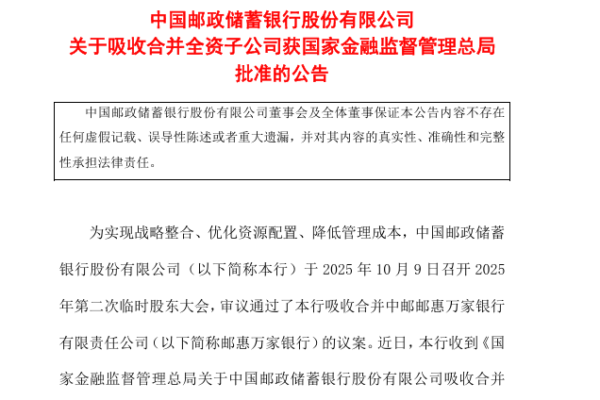
China Postal Savings Bank Co., Ltd. (Postal Savings Bank) announced on December 31 that it has obtained regulatory approval for the absorption and merger of China Postal Savings Bank Postal Huimanjia Bank Co., Ltd. (Huimanjia Bank), indicating Huimanjia Bank’s exit from the financial industry after operating at a loss of nearly 1 billion yuan for four years.
In an announcement titled “Notice on the Approval of the Absorption and Merger of Wholly-Owned Subsidiaries by the State Banking and Insurance Regulatory Commission” released on December 30, Postal Savings Bank stated that it has received regulatory approval stating, “The State Banking and Insurance Regulatory Commission has approved the bank’s absorption and merger of Huimanjia Bank and the takeover of its assets, liabilities, business, and employees after the asset assessment.”
The announcement further mentioned, “Huimanjia Bank, a wholly-owned subsidiary of the bank, has its financial statements included in the bank’s consolidated financial statements at a 100% ratio. This merger will not impact the bank’s financial condition and operating results and will not harm the interests of the bank and its shareholders.”
Public records show that Huimanjia Bank is an independent corporate direct bank wholly owned by China Postal Savings Bank, established in Shanghai on January 7, 2022. In July 2025, the bank was fined 4.25 million yuan by the Shanghai branch of the People’s Bank of China for violating clearing management regulations.
According to information released by the China Banking Regulatory Commission in 2013, a direct bank is defined as a bank that expands its business without relying on physical branches, breaking limitations such as time, geography, and network points, primarily offering financial products and services through electronic channels.
In response to this, the Faqun Institute of Financial Research analyzed in an official Weibo post that direct banks in China emerged as a response to the impact of internet finance on traditional banks.
In China, there are only two independent corporate direct banks: Huimanjia Bank and CITIC Baixin Bank, both facing pressure from declining profitability.
According to a report by “Caiwen,” a subsidiary of Zhejiang Caiwen Huxun Media Co., on December 31, Huimanjia Bank has been incurring continuous losses since its establishment, with losses of 162 million yuan, 263 million yuan, and 415 million yuan in 2022, 2023, and 2024 respectively, along with an additional 118 million yuan loss in the first half of 2025, totaling nearly 1 billion yuan in losses.
Another direct bank, CITIC Baixin Bank, is also experiencing losses. The bank operated at a loss in the initial years, turned profitable in 2021, but its profits declined by 23.74% in 2024.
Furthermore, in December 2020, China Merchants Bank and WhizzCo-opBank, a direct bank jointly established by China Merchants Bank and JD Digital Technology Group’s online (Beijing) business service Co., Ltd., obtained approval from the former CBIRC. However, in July 2022, China Merchants Bank announced the withdrawal of WhizzCo-opBank’s opening application and termination of preparatory work.