
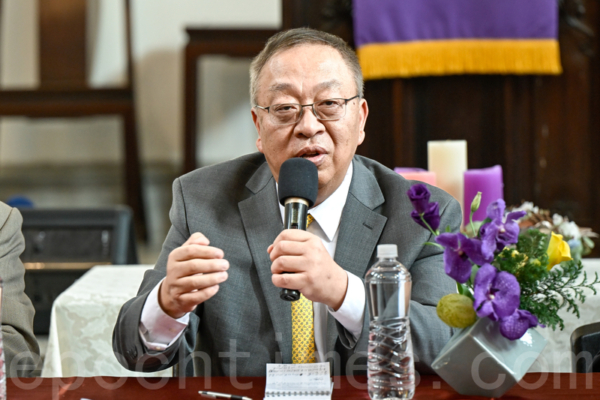
In a recent article published on The Washington Post, Yu Maochun, the director of the China Center at the Hudson Institute, issued a stark warning to Washington elites, urging them to see through the actions of the Chinese Communist Party (CCP) and not harbor unrealistic fantasies about it.
According to Yu, there are still individuals in Washington, Brussels, and other European capitals who stubbornly believe that through prolonged negotiations and a soft approach, Beijing can be persuaded to help resolve conflicts in Ukraine and the Middle East, stabilize global markets, and correct its decades-long trade imbalances and intellectual property theft.
Yu criticized this line of thought, stating that it is based on sentimentality rather than strategic thinking. He emphasized that believing the CCP can be swayed through dialogue is a fallacy, akin to inviting a wolf into the living room.
The key premise of international order is that laws can constrain power. However, Yu pointed out that the CCP fundamentally denies this premise by consistently, deliberately, and systematically violating international agreements.
Yu highlighted the CCP’s modus operandi, where it signs agreements for immediate gains but subsequently dilutes and ultimately reneges on its obligations. He provided examples such as China’s accession to the World Trade Organization in 2001, where it promised market openness and non-discrimination but later distorted industries with subsidies, imposed Party branches on enterprises, and engaged in forced technology transfers.
On the topic of Hong Kong, the CCP similarly disregarded the Sino-British Joint Declaration of 1984, which guaranteed high autonomy and civil liberties for Hong Kong until 2047. Once sovereignty was transferred, Beijing began dismantling Hong Kong’s autonomy, revealing a calculated strategic deception.
Regarding the South China Sea issue, while China pledged to abide by the United Nations Convention on the Law of the Sea, it later rejected an arbitral ruling refuting its claims. Yu emphasized the consistent pattern of selective compliance and perpetual evasion of responsibility by the CCP.
Yu stressed that the CCP’s behavior is not occasional but rather a systemic strategy of signing agreements, reaping benefits, and then avoiding accountability indefinitely.
In contrast to democracies where violations are challenged and corrected through judicial and legislative processes, Yu explained that under Marxist-Leninist rule, the CCP wields absolute power, subverting the law as a mere tool to advance its agenda. The Party does not adjust its behavior in response to international obligations but instead denies their authority or refuses to comply.
Yu concluded that the world should not take Beijing’s words at face value and must judge based on actions rather than declarations. He warned against trusting agreements forged on goodwill, as they ultimately serve as conduits for the CCP’s exploitation.
He underscored the need for realistic assessments of China’s role in the international system, asserting that admitting China to the WTO was based on illusions of reform rather than the CCP’s actual political-economic system. Yu argued that the international free trade system has been corroded by China’s behavior.
In response to these challenges, Yu advocated for withdrawal of privileges from non-compliant entities and risk management as essential measures in dealing with the CCP’s intentional breaches.
Yu emphasized the fundamental incompatibility between communism and rule-based international order, as the former undermines the sovereignty of rules. While various government types can coexist in the international system, the systematic bad faith of the CCP is intolerable.
Yu cautioned against engaging in diplomatic self-deception and stressed the importance of facing the reality of dealing with China from a position of clarity and conditions, rather than wishful thinking of CCP transformation. He concluded that the lessons of the Cold War remain relevant in handling China today.