
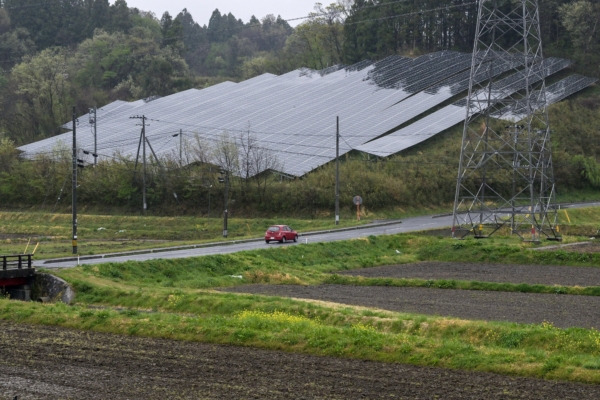
The Japanese government has announced tighter regulations and will end subsidies for large-scale solar power projects starting in 2027 in order to protect the natural environment, ensure safety, and preserve landscapes.
According to Reuters, this is one of the series of regulatory measures introduced by the Japanese government on Tuesday, December 23, targeting large solar power fields, aligning with Prime Minister Sanae Takai’s stance to limit large solar energy plans.
Takai believes that the majority of solar panels are produced overseas, especially in China. Moreover, large solar facilities pose risks to damaging Japan’s landscapes and natural environment.
Due to rising costs and developers withdrawing investments, offshore wind power projects are facing increasing uncertainty, potentially slowing down the pace of solar power field development in Japan.
Officials from the Japanese Ministry of Economy, Trade and Industry revealed that the government is considering ending the “Feed-In-Tariff” (FIT) and “Feed-In-Premium Subsidy” (FIP) systems for large commercial solar power installations on the ground starting from April 2027, the beginning of the new fiscal year.
Under these systems, renewable energy generators can either receive a fixed purchase price for electricity within a set timeframe or, while selling electricity in the market, receive additional premium subsidies above market prices.
The official mentioned that specific details such as the threshold for projects affected by subsidy terminations will be determined later.
Support for existing facilities and residential installation projects will continue, and the government will strengthen support for the development of perovskite solar cells, a new generation solar technology developed in Japan.
Another official from the Japanese Ministry of Environment disclosed that the government is considering expanding the scope of environmental assessments. Currently, solar projects below 30 megawatts do not require national-level assessments, but this requirement may be expanded.
This discussion stems from a series of controversies surrounding large-scale solar development projects near the Kushiro Wetland National Park in northern Hokkaido and other regions of Japan. Subsequently, under the leadership of the Ministry of Economy, Trade and Industry and the Ministry of Environment, the government initiated enhanced regulatory consultations in September.