
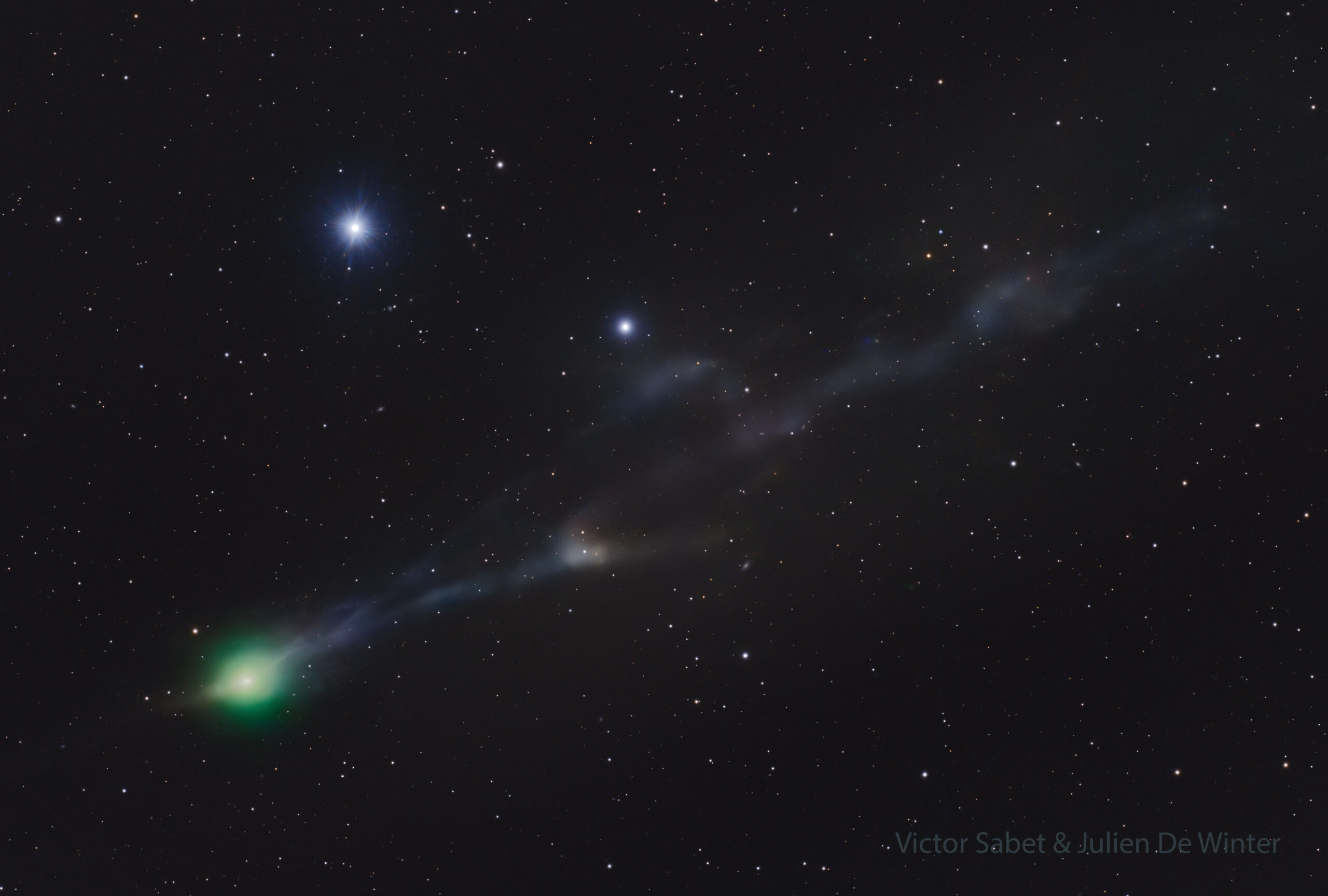
In a report dated December 25, 2025, as Comet 3I/ATLAS passed close to Earth on December 19, what was initially perceived as an unusual celestial event has escalated into a “survival warning.” Harvard University professor Avi Loeb made a startling statement on Wednesday, December 24, suggesting that this green-tinged celestial body may be emitting poisonous cyanide gas into space and planning a mysterious seeding mission upon reaching Jupiter.
Loeb pointed out in his latest article that the Atacama Large Millimeter/submillimeter Array (ALMA) in Chile detected high concentrations of hydrogen cyanide in 3I/ATLAS. He vividly likened it to a “interstellar serial killer spreading poison” or a giant “cyanide capsule.”
Concerns arose among the public about whether the toxic remnants of 3I/ATLAS would rain down on Earth like precipitation following its close encounter with the planet on December 19. Addressing this worry, Loeb conducted calculations based on data from the Webb Space Telescope.
He stated that in its natural state, harmful gases around 3I/ATLAS would be swept away by the solar wind at distances of millions of kilometers from the celestial body, therefore posing no threat to Earth. However, Loeb then posed a crucial hypothesis: if these projectiles possess the ability of “technological propulsion control,” the outcome will be entirely different from what the orbit suggests.
He emphasized that the green comet-like appearance produced by the celestial body when near the Sun is visual evidence of the presence of these deadly chemicals.
Loeb’s proposition of “technological propulsion control” is not unfounded, but rather based on the multiple anomalous dynamic features exhibited by the celestial body. Apart from its unsettling composition, scientists have observed extreme “orderliness” in the physical behavior of 3I/ATLAS:
Precise non-gravitational acceleration:
3I/ATLAS shows significant deviations from gravitational orbits, yet its core is unusually smooth and intact, with no observed material breakup (coma) typical of natural comets due to vigorous jet propulsion.
Extreme geometric shape:
Through analysis of its light curve, the celestial body exhibits an extremely high length-to-width ratio (resembling a pancake or long cigar shape), contrasting sharply with the random shapes resulting from natural celestial bodies colliding.
Anomalous jet direction:
It possesses an extremely rare “anti-tail” extending millions of kilometers directly towards the Sun, as if utilizing solar radiation as an energy source or navigational reference.
The most crucial hardcore data supporting the hypothesis that 3I/ATLAS is an “artificial artifact” comes from recent regularity discoveries. Studies indicate that the jet pointing towards the Sun does not erupt randomly but exhibits a regular “precession pattern” – swinging precisely every 7 hours and 45 minutes.
This pulsing, reminiscent of a “heartbeat,” suggests that its core (with a rotation period of approximately 15 hours and 30 minutes) may be equipped with a stable and controlled propulsion system, rather than natural ice fragments explosively disintegrating upon heating.
Despite 3I/ATLAS being associated with as many as 15 anomalous data points that have left scientists perplexed, NASA maintains that it is a “rare but natural interstellar iceberg.”
Loeb boldly speculates that the bizarre trajectory of 3I/ATLAS is no coincidence. It is predicted to reach Jupiter on March 16, 2026. He believes that by then, this interstellar visitor may utilize Jupiter’s gravitational field to release a series of “probe satellites” or seed probes towards the gas giant, collecting information for its civilization.
As 3I/ATLAS gradually moves away from Earth towards deep space, the debate over whether it is a “natural wonder” or an “alien weapon” intensifies with each regular pulsation, as observed by scientists and space enthusiasts worldwide.
*This article drew references from reports by “New York Post” and Space.com.*