
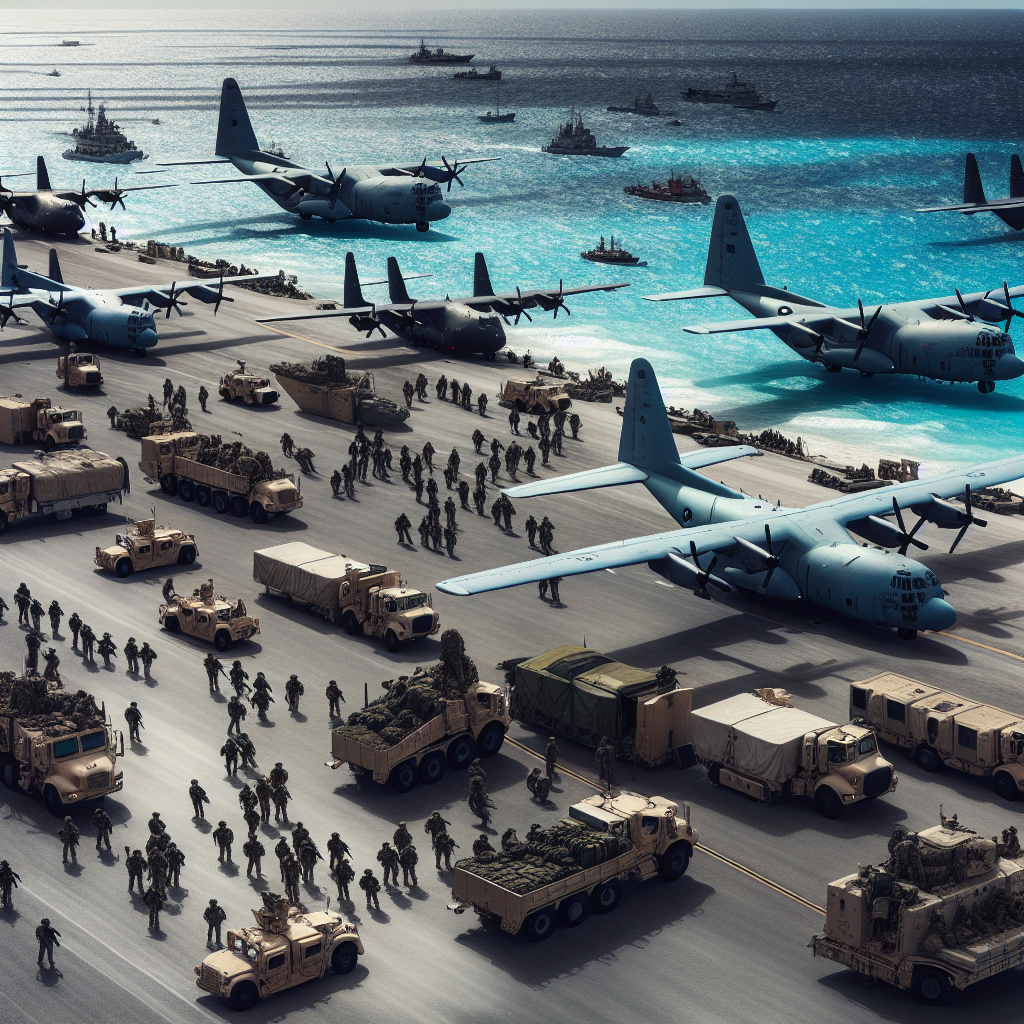
According to US officials and public flight tracking data, the United States has deployed a large number of special operations aircraft, troops, and equipment to the Caribbean region this week, providing the US government with more options for potential military actions against Venezuela.
The Wall Street Journal reported the above information. An official revealed that at least 10 CV-22 Osprey tilt-rotor aircraft used by special operations forces flew from Cannon Air Force Base in New Mexico to the region on Monday, December 22nd.
Flight tracking data shows that C-17 transport planes from Fort Stewart and Fort Campbell Army bases arrived in Puerto Rico on Monday. Another US official confirmed that these aircraft transported military personnel and equipment.
It is currently unclear which troops and equipment are being carried by these aircraft. The 27th Special Operations Wing is stationed at Cannon Air Force Base; the elite US special operations forces, the 160th Special Operations Aviation Regiment and the 101st Airborne Division, are based at Fort Campbell; and the 1st Battalion of the 75th Ranger Regiment is stationed at Hunter Army Airfield in Fort Stewart.
“They are pre-positioning forces to take action,” retired Air Force Lieutenant General David Deptula, director of the Mitchell Institute for Aerospace Studies, told The Wall Street Journal. The movement of such military assets indicates that the Trump administration has identified a course of action.
A spokesperson for US Southern Command, responsible for US military operations in Latin America, refused to answer specific questions about troop movements. The spokesperson stated that regularly rotating equipment and personnel to any military base is a routine practice.
“For operational security reasons, we typically do not disclose or comment on the movement and activities of US assets or personnel, nor disclose specific operations or routes,” the spokesperson said.
US President Trump has recently intensified pressure on Venezuelan President Maduro, ordering the blockade of Venezuela’s oil exports in an attempt to cut off the economic lifeline of the Maduro regime. For years, oil sales accounted for over 90% of Venezuela’s export revenue.
In recent months, the US military has launched several deadly strikes against drug smuggling ships from Venezuela to prevent drugs from entering the United States. In August this year, the US offered a $50 million reward for the capture of Maduro. President Trump also stated that Maduro’s presidency is “numbered”.
Trump has declared that the airspace around Venezuela should be considered closed and has not ruled out the possibility of an airstrike against the country.
“We have put together a massive fleet, it’s the largest fleet we’ve ever had and it’s the most powerful fleet we’ve ever had in South America to date,” Trump said to the media on Monday. When discussing the possibility of ground strikes in Venezuela, he said, “We’re going to start a similar move on the ground very soon.”
Trump also warned that if Maduro “plays tough”, it will be the last time he can do so.
The US has deployed a significant military presence in the Caribbean region, including a carrier strike group, an F-35A fighter squadron, multiple destroyers, and amphibious assault ships. Puerto Rico has become a military hub for the United States, reflecting the increasing importance the US places on the Caribbean region.