
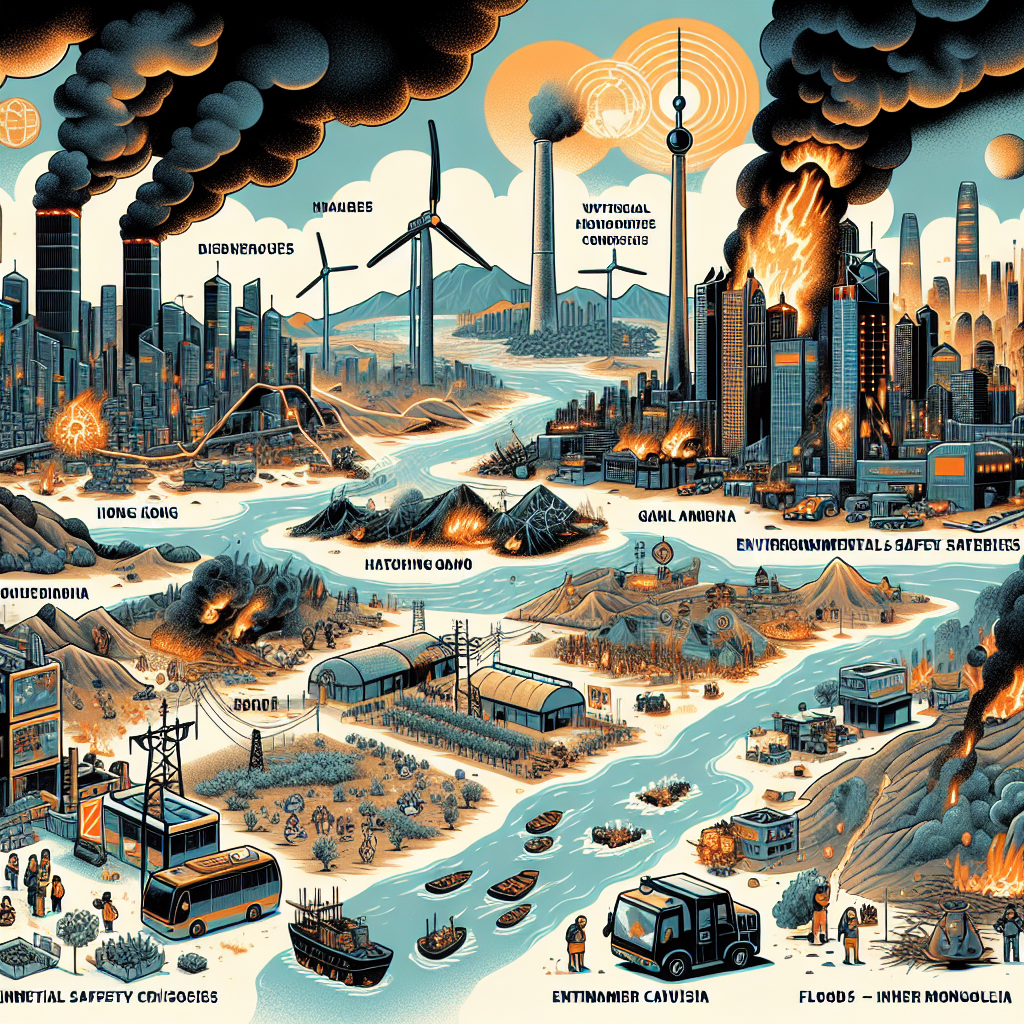
In 2025, China has been facing a series of disasters. From the worst five-alarm fire in decades in Hong Kong, to ongoing industrial and environmental safety crises in Gansu, Inner Mongolia, and other areas, to extreme floods and droughts sweeping across the country, a combination of accidents and natural disasters has resulted in significant casualties and incalculable economic losses.
These disasters are not isolated incidents but a concentrated eruption of systemic failures in safety regulation, accountability, and the depletion of ecosystems and public governance. Under the governing logic that prioritizes “political stability” above all else, truth has been obscured, livelihoods disregarded, and ecosystems depleted.
Since October 2025, mainland China has been experiencing a severe outbreak of H3N2 influenza, with a significant increase in severe cases and fatalities compared to previous years.
According to recent reports from the Chinese state media, the flu activity levels in many cities in China are rapidly rising, with a noticeable increase in infection cases. Beijing has entered a high incidence period, and Shanghai is also approaching a peak.
According to the latest monitoring data from the Chinese Center for Disease Control and Prevention, the H3N2 flu epidemic is rapidly spreading nationwide, with 17 provinces at high levels of prevalence. Over the past three months, severe cases and fatalities from the flu have increased by approximately 40.2% compared to the same period last year. Concerns are raised that the actual situation might be even worse.
Children are the most severely affected group. Schools have become hotspots, with large-scale cluster infections reported in Guangdong, Beijing, Zhejiang, Henan, and other places, leading to many classes being suspended due to half of the students taking sick leave. Beijing’s “Health Protection Guidelines” indicate that the susceptible population in the city has exceeded 12 million.
Several cases have shown rapid disease progression: a 3-year-old boy in Henan died within a day of developing a fever; a 12-year-old girl in Zhejiang showed “white lungs” in her left lung a day after having a fever; a 7-year-old girl in Zhengzhou, Henan, had her right lung completely whitened and fell into a prolonged coma within hours of infection. Pediatric emergency rooms in many hospitals are overwhelmed, with a doctor handling up to 700 blood routine tests in one night.
Doctors warn that the H3N2 subtype strain circulating in the current epidemic is highly pathogenic and can lead to complications such as pneumonia, myocarditis, and acute necrotizing encephalitis.
Dr. Liu, a professor at the Canadian College of Traditional Chinese Medicine and director of the Kangmei Traditional Chinese Medicine Clinic, told Dajiyuan that the severity of this outbreak may be related to the immune dysfunction caused by the previous COVID-19 epidemic.
Before the outbreak of the influenza epidemic, Dengue fever broke out in multiple locations in Guangdong, with over 25,000 confirmed cases in the province. Despite no severe cases or fatalities, the mass mosquito eradication campaign launched by local governments during the outbreak and even requiring windows to be closed during the super typhoon “Huajia Sha” sparked wide controversy.
A resident of Shantou, Guangdong, Mr. Wang, expressed his suspicion to Dajiyuan that the authorities were drawing blood from the public for organ matching. He claimed that the compulsory blood testing by the authorities was causing panic among the people.
This outbreak also extended to neighboring provinces and Hong Kong and Macau, prompting the Chinese authorities to convene a national conference requiring strict vigilance against the spillover of the epidemic.
On November 26, 2025, the worst five-alarm fire since 1948 occurred at the Fung Yat Court in Tai Po, Hong Kong. According to the police report on December 20, the death toll has risen to 161.
The fire originated from a large-scale exterior wall maintenance project being carried out on eight buildings in the estate. Investigations revealed that the contractor, “Hongyip Construction,” illegally used a large amount of highly flammable foam to seal windows during construction, and the fire protective net did not meet flame retardant standards.
Key evidence indicated that the contractor was suspected of using fraudulent quality inspection reports. The protective net was produced by a mainland Chinese manufacturer, and its quality inspection number could not be verified through official channels, possibly originating from online shopping platforms.
Residents had previously publicly warned of over a hundred irregularities in the construction and reported fire hazards to the Labour Department. However, the relevant authorities dismissed these concerns as “low risk” and failed to take effective intervention measures.
On December 1, the Democratic Party of Hong Kong and the Democratic Alliance for the Betterment and Progress of Hong Kong launched a “civil press conference” about the high-rise maintenance policies in Hong Kong following the Fung Yat Court fire. The press conference was canceled by the authorities, and the Chinese Liaison Office in Hong Kong subsequently issued a statement accusing “a small group of external hostile forces of taking advantage of the fire.”
On December 2, the Hong Kong Police National Security Department invited pro-democracy activists, including Wang On-yin, the deputy convenor of the Civil Human Rights Front, for a meeting at the police station. Subsequently, Wang On-yin admitted on Facebook that he had met with staff from the National Security Department. On December 6, Wang On-yin was arrested by the police for disclosing related content on social media, and his bail application was denied by the judge.
This case marked the first time in Hong Kong that an individual was charged with violating the National Security Law for disclosing content related to a national security investigation, which sparked discussions on freedom of speech in Hong Kong.
Amnesty International called on the Hong Kong government to “immediately conduct an open and transparent investigation into the cause of the Fung Yat Court fire, rather than ‘solving the problem by punishing those who raise concerns.'”
In the second half of 2025, China experienced two accidents at nursing homes in mainland China, resulting in dozens of disabled elderly people tragically losing their lives and exposing deficiencies in emergency response, facility construction, and staff deployment in the industry.
On the night of April 8, a fire broke out at the Guoen Nursing Home in Longhua County, Chengde City, Hebei Province. Many elderly residents were unable to care for themselves, and most of them were asleep when the fire broke out, making escape difficult, ultimately leading to the deaths of 20 elderly people.
The investigation revealed that narrow emergency exits were one of the main reasons for the casualties. The institution was rated as a first-class nursing home by the Hebei Provincial Civil Affairs Department in 2022, but the incident exposed serious shortcomings in fire prevention and emergency evacuation.
Similarly, on July 28, a nursing care center in Taishitun, Miyun District, Beijing, was surrounded by extreme flooding caused by heavy rain. Most of the 69 elderly residents, many of whom were disabled or semi-disabled, were only accompanied by eight staff members. The floodwaters quickly inundated the streets, reaching depths of up to 2 meters, causing 31 elderly residents inside the building to tragically lose their lives.
Relatives questioned why the institution was not evacuated before the reservoir discharged floodwaters and severe rainfall warnings were issued. During the incident, there was a severe imbalance between staff and residents, making it impossible to effectively respond to the emergency.
In the summer of 2025, historic heavy rainfall hit northern China, while traditional granaries like Henan were engulfed by extreme weather oscillating between drought and rainy periods.
In late July, the Beijing-Tianjin-Hebei region experienced record-breaking rainfall. Severe flash floods occurred in Beijing’s Miyun District and Chengde, Hebei, resulting in what the authorities described as disasters that claimed 64 lives.
Multiple monitoring stations in Hebei recorded heavy rainfalls, with villages in Tianjin being flooded for the first time in 70 years, and several reservoirs being forced to discharge water due to high levels.
By October during the harvest season, Henan faced persistent rains after the drought. Fields were waterlogged, preventing large-scale harvesters from entering, forcing farmers to hand-harvest moldy crops in the water.
This natural disaster not only devastated farmers’ livelihoods but also raised concerns about food security as the anticipation of reduced crop yields increased.
In 2025, several ship accidents occurred in Chinese waters, including the capsizing of inland passenger ships and pleasure boats, as well as the sinking of fishing vessels, resulting in significant casualties. These accidents exposed underlying issues in ship safety management, extreme weather responses, and fishery regulations, drawing broad social attention.
On February 25, a collision between a passenger ship and an oil pollution and garbage recovery ship in the Yuanshui Basin in Huaihua, Hunan Province, caused the passenger ship to capsize and sink. Until the official accident investigation report was released in November, the accident had resulted in 15 deaths and 1 missing person.
On May 4, in the Fairy River Source Hundred Miles Gallery Scenic Area in Xishui City, Qiannan City, Guizhou Province, four tourist boats capsized in a sudden strong wind. Despite a wind warning issued by the meteorological department, the scenic area insisted on operation, causing 10 deaths and over 70 injuries. Rescuers found that many deceased tourists were not wearing life jackets.
Regarding the capsizing of Chinese fishing vessels in Korean waters, according to the Liaoning Daily, Xu Fang, the Party Secretary and Director of the Beidaihe Ocean and Fishery Bureau in Bayuquan District, Yingkou City, organized no rescue efforts upon learning of the accident. Instead, staff colluded with shipowners, instructing them not to call for help, attempting to cover up the truth.
Highlighting the incident was the rare collision on August 11 between the Chinese coast guard ship “3104” and the Chinese navy’s “Guilin” destroyer near the Huangyan Island in the South China Sea. In the video, the Chinese coast guard vessel collided with the domestic warship while intercepting a Philippine patrol boat, severely deforming its bow and rendering it inoperable. The Philippine side claimed their boat was delivering supplies to local fishermen when it was pressured and attacked by the Chinese water cannons. The Philippine report stated at least two Chinese coast guard personnel died, but the Chinese officials did not release casualty information and blocked internal news.
On the eve of the Chinese New Year in 2025, an earthquake struck the Dingri County in Shigatse City, Tibet, on January 7. The earthquake’s shockwaves even reached neighboring Nepal, resulting in partial structural damage in the cross-border region.
The earthquake measured 6.8 on the Richter scale according to the China Earthquake Networks, with a shallow depth of 10 kilometers; the U.S. Geological Survey, however, measured it at 7.1.
Located in a high-altitude and cold plateau zone, the earthquake was extremely destructive. The earthquake severely impacted the approximately 800,000 population in the Shigatse area, leaving many homes reduced to rubble.
Official reports indicated at least 126 fatalities, with over 3,600 households having severe damage or collapse.
This sudden disaster left numerous people homeless, exacerbating their survival difficulties, especially in the harsh cold weather.
In the second half of 2025, two important bridges constructed by state-owned enterprises in western and southwestern China faced accidents, raising doubts about the quality of projects promoted by the Chinese official media as “infrastructure mania.”
On August 22, a steel cable broke at the construction site of the Huanghe Bridge in Jianzha, Qinghai Province, causing an accident that resulted in 12 fatalities and four missing persons. The bridge was promoted by the Chinese media as the “world’s largest span double-track railway continuous steel truss arch bridge” just days before the incident.
Authorities cited the direct cause of the accident as the fracture of a tension beam. According to reports, in a rush to meet deadlines, the construction company performed nighttime work for an extended period, possibly leading to operational errors due to construction fatigue.
The authorities attributed the accident to a landslip causing the bridge pier to shift. However, public opinion questioned whether the design phase adequately considered the terrain risks in a geologically hazardous area.
In the northwest of China, a massive lead poisoning incident broke out at the Haishepeixin Kindergarten in Maixi District, Tianshui City, Gansu Province, revealing environmental pollution hazards created by the region’s key industry.
From March to July 2025, a total of 247 children and several teachers at the Haishepeixin Kindergarten were diagnosed with severe blood lead levels exceeding regulations, with some exhibiting symptoms of chronic poisoning like “lead lines” on their gums.
Official reports attributed the incident to the kindergarten’s illicit addition of “industrial pigments” to food. However, parents and the public leaned towards suspecting pollution from nearby non-ferrous metal processing plants. The Maixi District in Tianshui City had a history of heavy metal pollution, with numerous lead smelting plants scattered in the vicinity.
Private investigations indicated that local hospitals had tampered with original test data multiple times, altering abnormal indicators to appear normal, attempting to cover up the situation. The provincial CDC’s re-inspection procedures were also chaotic.
Zhang Lan, an environmental activist in Lanzhou, told Dajiyuan that the handling of this incident was highly similar to the Wujiahe event years ago: “The government and hospitals are both concealing the over-limit blood lead levels of villagers, altering test reports, and industries are only superficially rectifying pollution issues. Under public pressure, hasty accountability was undertaken, with each villager only receiving a little over a thousand yuan in compensation.”
On July 23, 2025, six students from Northeastern University lost their lives when they visited the Wunugutu Mountain Copper-Molybdenum Ore Dressing Plant of China Gold Group in Wulanchabu, Inner Mongolia, learning about flotation processing. A grating board came off during their visit, causing them to fall into the flotation tank and perish.
This incident exposed serious safety deficiencies in large state-owned enterprises. Prior to the accident, the company had claimed to achieve a “zero-incident” goal; however, it had been penalized multiple times for safety hazards and unapproved construction. Following the incident, the promotional article was removed from the website.
The accident led to a sharp decline in China Gold Group’s share price, with its market value evaporating by billions of RMB.
Family members of the victims revealed to the media that the internship was a compulsory course required by the school. The school failed to conduct a rigorous evaluation of the safety measures in place when selecting the internship site.
A resident from Liaoning shared with Dajiyuan: “Over the years, Northeastern University has had issues with internships before, and the school should thoroughly investigate the selected enterprises. A few years ago, a friend of mine followed a graduate student supervisor from Northeastern University to work at a plant in Jinzhou and never returned.”
Tabbed as one of China’s “New Energy Automobile New Forces,” the Xiaomi SU7 was humorously dubbed “Mi Porsche” by netizens for its striking resemblance to the Porsche Taycan. However, on the first anniversary of the SU7’s release, a traffic accident involving the brand cast doubt on the safety performance of electric vehicles in China.
On March 29, 2025, a tragic incident occurred on the Chiqi section of the Deshang Expressway in Anhui Province, where a Xiaomi SU7 Standard Edition electric car collided with a guardrail and burst into flames. Three female college students inside, on their way to an exam, were trapped as the car doors locked and could not be opened, leading to their fatalities.
Xiaomi responded, stating that the vehicle was in NOA intelligent auxiliary driving mode at the time of the accident. However, although the system issued warnings, the front collision response function did not respond to certain obstacles.
Family members of the victims strongly questioned the non-triggering of the AEB (Automatic Emergency Braking) system in Xiaomi SU7, pointing out that the door opening switch was not obvious, making it difficult to open after the power failure, and claimed that Xiaomi did not reach out to them.
After the accident, Xiaomi Group’s stock price plummeted within two days, with a total market value evaporating over 120 billion HKD, intensifying market concerns about the safety of smart electric vehicles.
Meanwhile, Chinese regulatory authorities tightened control over online public opinion and prohibited speech deemed to “smear corporate images.”