
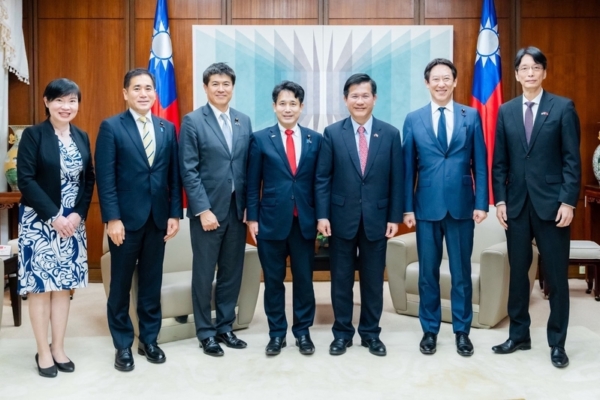
Taiwan’s Minister of Foreign Affairs, Joseph Wu, met with Japanese Senator Hirofumi Takinami, leading a delegation from the Japanese Senate TY Group during their visit. Wu expressed that Taiwan and Japan have complementary industrial structures and he hopes for cooperation to assist in the development of third countries. He also looks forward to Japan continuing to play a leading role in helping to expedite Taiwan’s negotiations to join the CPTPP.
The Ministry of Foreign Affairs of the Republic of China issued a press release today stating that Minister Wu met with the “Japanese Senate TY Group Taiwan Visit Delegation” on the 22nd. Led by Japanese Senator Hirofumi Takinami, the discussions between the two sides focused on promoting trilateral cooperation among Taiwan, Japan, and a third country, disaster prevention, and economic cooperation.
Minister Wu mentioned that Taiwan and Japan hold a strategic position in the first island chain, facing pressures from the Chinese Communist Party together. Not only do they share a close security relationship, but also a solid economic partnership. Their industries complement each other, paving the way for future collaboration to help the development of third countries. Additionally, both Taiwan and Japan are prone to natural disasters, making it crucial to strengthen cooperation in disaster prevention to enhance their societal resilience.
Regarding Taiwan’s accession to the Comprehensive and Progressive Agreement for Trans-Pacific Partnership (CPTPP), Minister Wu pointed out that Taiwan meets the membership standards of the CPTPP. He hopes that Japan will continue to demonstrate leadership to help kickstart the negotiations for Taiwan’s membership, creating a prosperous regional outlook.
Senator Takinami shared his experience as the head of the “Japan-Taiwan Legislators’ Meeting” task force responsible for residency registration issues. He successfully advocated for a change in the registration of Taiwanese nationality in Japan’s household registration documents, a process that marks a significant milestone in the friendly relations between the Japanese Senate and Taiwan. The delegation members also exchanged views on sports, cycling, and local exchanges between Taiwan and Japan.
According to the Central News Agency, Takinami, a former Vice Minister of Agriculture, Forestry, and Fisheries known as the “Son-in-law of Taiwan,” delivered a keynote speech on May 21st at the invitation of the Association of Friends of Lee Teng-hui in Japan. He revealed the amendment to Japan’s household registration law that finally allows individuals born in Taiwan to be registered as Taiwanese, a significant development that has been in progress for years.
After the implementation of the new system, Taiwanese individuals are no longer categorized as “China,” “People’s Republic of China,” or “Taiwan, China Province” when nationality or related fields need to be recorded in marriage registrations. Instead, they now have the option to be clearly listed as “Taiwan.” Furthermore, individuals previously recorded as “China” can apply for corrections to be registered as “Taiwan.”
Reflecting on his journey, Takinami recalled that his awareness of the household registration issue was sparked in 2002 when his Taiwanese wife’s nationality was erroneously listed as “China” during their marriage registration process. Upon bringing this to the attention of the municipal office, he was told that it was a national issue, leading him to feel a sense of denied identity and rights that still resonates with him.
Takinami led the “Household Registration Issue” task force at the Japan-Taiwan Legislators’ Meeting. He emphasized that a key factor in resolving the longstanding dispute over Taiwan’s registration was his experience working in the criminal bureau of the Ministry of Justice, which enabled him to understand the decision-making structure and key personnel within the ministry, facilitating the transformation of the issue into feasible institutional design.
After numerous discussions with the Ministry of Justice, the team determined a viable strategy. At that time, the Household Registration Law was undergoing significant revisions, including the addition of phonetic registration. The decision to include the “Taiwan notation” in this major revision was deemed strategic to minimize political resistance and external interference. Instead of directly amending the law, the strategy of utilizing a ministry decree was considered more suitable to avoid unnecessary political controversies.
Takinami revealed that once the direction was established, he sought political understanding and support, meeting with the then-Minister of Justice, as well as exchanging thoughts with the current Chief Cabinet Secretary, Minoru Kiwara, and several former colleagues from the Ministry of Justice. The subsequent operations were kept low-profile to prevent external interference before finalizing the decision.
Admitting to external skepticism during the process, Takinami believed that once a direction was set internally within the government bureaucracy, it becomes challenging to be overturned. The primary concern was to avoid external interventions before the final decision was made.
In January of this year, the draft ministry decree entered a public consultation phase. While the team initially planned to explain the process after completion, media disclosure prompted a decision to announce the availability of Taiwan as a registration option in household registrations. Ultimately, the decree was officially implemented on May 26th.
Takinami stressed that this accomplishment was not achieved overnight but was built upon years of institutional progress. Documents such as residence permits, driver’s licenses, and resident certificates had already gradually allowed for the “Taiwan” designation, culminating with the core household registration system. Although his wife has naturalized as a Japanese citizen and was not subject to the “nationality column,” her birthplace field in the registration previously read “Taipei, Taiwan, China” and has now been corrected to “Taipei, Taiwan.”
By diligently navigating the bureaucratic process and securing support, Takinami successfully advanced the inclusion of “Taiwan” in Japan’s household registrations, marking a significant symbolic breakthrough.