
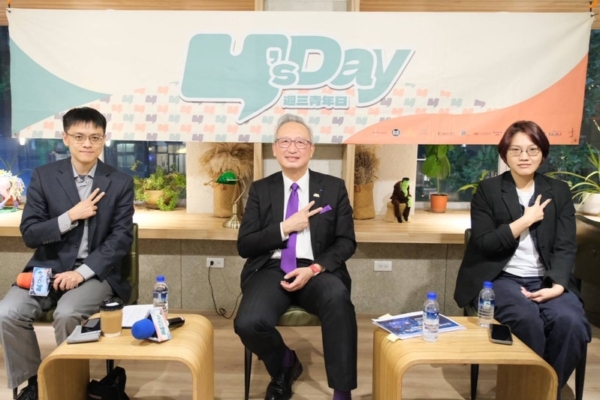
Taiwan’s Public Policy Institute, Taiwan Think Tank, and several other organizations held a seminar on the 17th to discuss the topic of “Advancing in the Geopolitical Gap: A New Model of International Support from the European Parliament.” Deputy Minister of Foreign Affairs of the Republic of China, Wu Zhizhong, shared that due to significant international changes, Taiwan’s image has been gradually elevated, making it a focal point of attention for countries around the world.
The event’s host, Chen Fangyu, an associate professor at Soochow University’s Department of Political Science, pointed out the challenging international situation Taiwan faces. Despite the difficulty, many individuals are working hard on the diplomatic front lines. During his tenure as Taiwan’s ambassador to France, Deputy Minister Wu Zhizhong significantly increased Taiwan’s visibility, garnering valuable exposure for the country.
Deputy Minister Wu Zhizhong remarked that over the past decade, there have been significant changes in the international environment. While ten years ago, France considered the Chinese Communist Party as a strategic partner, the image of the CCP globally has now shifted to that of a highly aggressive nation. In contrast, Taiwan enjoys a very positive international reputation. He emphasized the importance of portraying Taiwan positively to the world.
Comparing Taiwan’s approach to storytelling with the CCP’s narrative, Wu Zhizhong stated that while the CCP focuses on “telling the story of China well,” Taiwan is creating a legendary tale uniquely its own. Taiwan, once obscure and even misidentified, has now become a focus of attention for countries worldwide.
Despite Taiwan’s challenging international situation and ongoing oppression from the CCP, Deputy Minister Wu Zhizhong stressed that Taiwan has excelled in various fields such as economy, public health, semiconductor and technology industries, and democracy and freedom. Taiwan has become a source of admiration for countries worldwide, showcasing the country’s legendary status achieved through the joint efforts of the government, diplomatic personnel, and Taiwanese society.
Deputy Minister Wu Zhizhong highlighted that in the past, many countries refrained from interfering in the Taiwan Strait dispute due to economic ties with China. However, Taiwan now holds strategic importance not only for the CCP but also for the interests of the United States, Japan, Europe, and other global powers.
He further pointed out that while Taiwan was a taboo topic at the United Nations in the past, it has now become a crucial bastion against authoritarian systems. This shift is evidenced by Japan and New Zealand sending warships to the Taiwan Strait, and various countries conducting military exercises in Taiwan, signifying increased attention and importance placed on Taiwan globally.
Deputy Minister Wu Zhizhong stressed the significance of highlighting Taiwan’s presence in various international fields, emphasizing that Taiwan’s strength extends beyond military power. He emphasized the importance of elevating Taiwan to the global stage rather than a mere domestic issue for China.
Emphasizing the importance of gaining international attention for Taiwan’s security, Deputy Minister Wu Zhizhong underscored the need for alignment of interests between Taiwan and the world. Continuing to attract global interest in Taiwan serves as the most substantial international security guarantee.
Director of Taiwan Think Tank’s Polling and Public Opinion Center, Guo Meicen, highlighted the recent participation of Former Vice President Annette Lu along with Foreign Minister Joseph Wu in the “Inter-Parliamentary Alliance on China” (IPAC) summit at the European Parliament. Lu’s speech on “Taiwan: A Reliable Partner in a Turbulent World” holds significant symbolic and substantive value for Taiwan. It not only breaks the long-standing restrictions on high-ranking Taiwanese officials entering the core political arena of Europe but also signifies Europe’s reevaluation of Taiwan’s role.
Guo noted that during this critical diplomatic visit, Deputy Minister Wu Zhizhong and the current EU representative and former ambassador to Germany, Thomas Prusa, played crucial roles in coordination and communication. Wu Zhizhong, who served as Taiwan’s ambassador to France for six years, has deep connections in European politics and public opinions, advocating for Taiwan’s democracy and sovereignty on various international media platforms.
Guo pointed out that amidst the reshaping of European security perceptions due to the Russia-Ukraine conflict, ongoing CCP support for Russia, and rapid geopolitical realignments, Europe’s vigilance against authoritarian expansion has heightened. This has created new diplomatic opportunities for Taiwan. Furthermore, Taiwan’s Ministry of Foreign Affairs launched the “European-Taiwan Cultural Year” series of activities in 2025, aiming to deepen societal connections between Taiwan and Europe through cultural and public diplomacy exchanges, contributing to establishing a more stable and long-term support network for Taiwan in Europe.
Guo stressed that Taiwan’s diplomatic challenges extend beyond the international arena to how these breakthroughs are understood domestically. She emphasized that building a solid societal consensus around Taiwan’s real position and strategic choices in the rapidly changing geopolitical landscape is crucial for Taiwan’s democracy and international space.
Following the discussion, the host and young participants raised questions on “How to deal with China’s wolf warrior diplomacy,” “Explaining the One-China Principle and Policy to international partners,” and “Interesting anecdotes from overseas visits,” with panelists providing in-depth analyses and responses.