
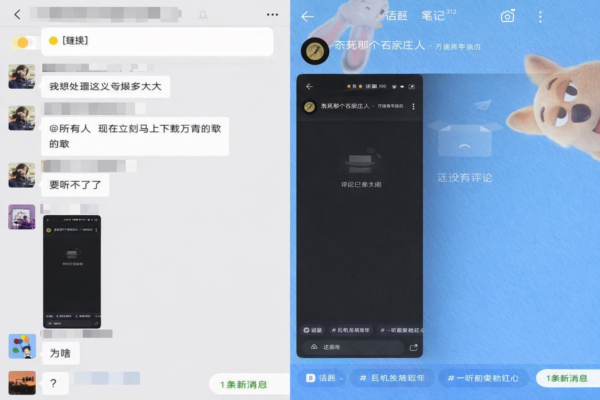
On December 17th, many music fans noticed that several representative works of the mainland independent band “Wanmei Qingnian Lvdian” had their comment sections closed or showing only a few old comments on NetEase Cloud Music. This phenomenon quickly sparked discussions on social media platforms such as Weibo and Douban, with some users expressing confusion over the platform’s handling and questioning the changes in the music comment space.
According to a netizen’s account in a fan group, some songs by “Wanmei Qingnian Lvdian” on NetEase Cloud Music could not be displayed normally in the comment section, with some advising others to quickly download the songs as they might become unavailable. Others mentioned that their accounts were banned for a long time after leaving comments in the section, sparking concerns and discussions within the group.
A netizen and fan of Wanmei Qingnian Lvdian from Guilin, Guangxi, who identified as Xiao Wei, noted abnormality in the comment sections of related songs on December 17th. “I also found the comment section closed yesterday, and this morning (December 18th) I still couldn’t access it. I’m not sure why the comment section suddenly closed. Many speculate it is related to the songs containing metaphors related to societal and historical events.”
Xiao Wei pointed out that several works by the band, especially “Kill that Shijiazhuang Person” and “In Every Tavern on This Planet,” have long been interpreted by fans as containing metaphors about the changes in Chinese society, the wave of layoffs in state-owned enterprises, and specific historical experiences. These discussions usually concentrated in the comment section.
Screenshots shared by users on social media platforms and the pages viewed by reporters indicate that songs such as “Kill that Shijiazhuang Person” and “Qinhuangdao,” when clicked on “comments,” show the comment section as closed or unable to be browsed normally. Users can still listen to the songs without any issues, as the works themselves have not been taken down, but the interactive commenting feature has been restricted. As of now, NetEase Cloud Music has not provided a public explanation regarding the situation.
Since its establishment, Wanmei Qingnian Lvdian has held a special position in the Chinese music scene for its presentation of social observations in its works. Their songs often revolve around industrial cities, ordinary families, and individual destinies, seen by some fans as emotional projections of a generation’s reality. “Kill that Shijiazhuang Person,” depicting the transformation experience of a northern industrial city in the 1990s, has long sparked discussions in the comment section about the wave of layoffs, urban changes, and personal disillusionment.
A netizen named Mr. Shang from Hunan expressed that recent societal events have been frequent, leading some songs to be considered “sensitive” due to their potential for extensive discussions. “I speculate that the platform may have chosen to close or freeze the comment sections of the most popular songs to reduce risks rather than handling the songs themselves.” These claims have not been confirmed by the platform at this time.
Music critic Chen Kun from Hunan mentioned that the comment section of Wanmei Qingnian Lvdian has long been regarded as one of the rare public discussion spaces on music platforms. “Many fans believe that these comments not only serve as emotional responses to the works but also carry the social memory of a generation. The closure of the comment section may be related to the management pressure the platform faces in a specific environment, which is also one of the most direct ways to tighten control over public opinions.”
Chen Kun added that similar situations are not confined to music platforms. “I recently saw some comment sections of cultural articles being closed on Zhihu. Usually, it’s not the authors who initiate this but a decision at the platform level. After the comments disappear, creators find it difficult to gauge the real reactions of readers.”
Various speculations still circulate online regarding the reasons for the restrictions on the comment sections of songs related to Wanmei Qingnian Lvdian. Some users point out that such actions are not the first to occur on large content platforms in China.
Geng Hao, an alias for a scholar from Taiyuan, Shanxi, stated that compared to the content of the works themselves, comments are more challenging to review in advance and can easily gather a large number of diverging opinions in a short period. “Limiting or closing comments is a way for platforms to reduce uncertain risks to avoid facing greater regulatory pressure once concentrated controversies arise.”
Geng Hao likened the current overall environment to “the calm before the storm,” believing that the shrinking of cultural and public discussion spaces has become a noteworthy phenomenon in recent years.
Some fans expressed that the disappearance of the comment section weakens the original communal sense of cultural works, while some believe that in the current environment, it is not surprising for platforms to tighten related discussions. To the external world, the changes in the comment section status of Wanmei Qingnian Lvdian songs may not only be about the relationship between a band and a platform but also reflect the ongoing adjustments in the boundaries among cultural expression, public discussion, and platform governance on the Chinese internet.