
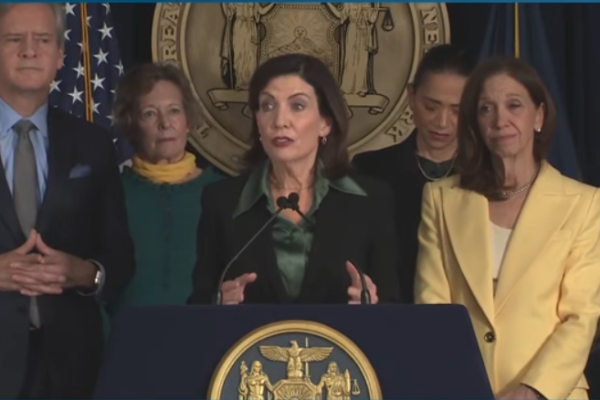
On December 18, 2025, Governor Kathy Hochul announced on Wednesday afternoon that she will sign a controversial bill allowing terminally ill patients to end their lives, known as the Medical Aid in Dying Act (MAID), making New York the 14th state to permit terminally ill patients to choose to end their lives. Many religious leaders and disability rights advocates have condemned Hochul’s approval of the assisted suicide bill.
The bill, proposed by State Assemblywoman Amy Paulin and State Senator Brad Hoylman-Sigal, was narrowly passed by the state legislature in June this year.
The legislation requires patients to be mentally sound adults diagnosed with a terminal illness and with a life expectancy of no more than 6 months. They must be able to self-administer lethal medication after making a voluntary request.
Additionally, the bill mandates a mandatory 5-day waiting period between the prescription and obtaining the medication; audio or video recording of the patient’s verbal request for assisted suicide; prohibition of anyone who could profit from the patient’s death to act as a witness or translator; as well as allowing individual doctors and religious-affiliated medical institutions to refuse to provide assisted suicide services while offering protection for family members, caregivers, and physicians.
The bill also requires mandatory mental health evaluations for patients making assisted suicide requests, as well as in-person consultations with doctors.
Hochul stated that the effective date of the bill has been extended to 6 months after she signs it to allow time for the development of related regulations and training.
Opponents of the bill include religious groups like the New York State Catholic Conference, which strongly expressed opposition to the legislation.
“We are extremely troubled by Governor Hochul’s announcement of signing the chilling bill passed earlier this year by the state legislature allowing for doctor-assisted suicide. This new law signals the abandonment of the most vulnerable citizens by our government, telling those who are sick or disabled that suicide is not only acceptable but encouraged by our elected leaders,” said Cardinal Timothy Dolan and other bishops in a joint statement. “This directly conflicts with Catholic teachings on the sanctity and dignity of all human life from conception to natural death, a grave moral evil comparable to other direct assaults on human life.”
The New York Association on Independent Living (NYAIL), supporting individuals with disabilities, also strongly opposed the bill.
“This dangerous bill threatens the lives and civil rights of people with disabilities under the guise of compassion,” said Alex Thompson, the organization’s advocacy director. “It allows doctors to prescribe lethal medication based on subjective predictions of terminal illness — predictions that are often inaccurate.”
The organization pointed out that 82.4% of doctors believe that the quality of life for severely disabled individuals is lower. This bias reflects deep-rooted societal fears equating disabilities with a fate worse than death.
Thompson highlighted that experiences from other states show that so-called “safeguards” quickly erode, leading to an expanded pool of eligible individuals and a normalization of suicide when these individuals could have lived meaningful lives with appropriate support.
In addition, opponents raised concerns about the “immorality” and “devaluation of the worth of life” of this legislation, conflicting with the sacredness of life and the duty of doctors to save lives and alleviate suffering.
New York Republican Congresswoman Elise Stefanik has strongly opposed the bill, calling it a “disgusting assisted suicide bill.”
“This is an attack on the sanctity of life,” Stefanik said. “(This bill) sends a chilling message to our elderly and disabled communities that their lives can be sacrificed, undermining the fundamental principle that all life is sacred and inviolable.”