
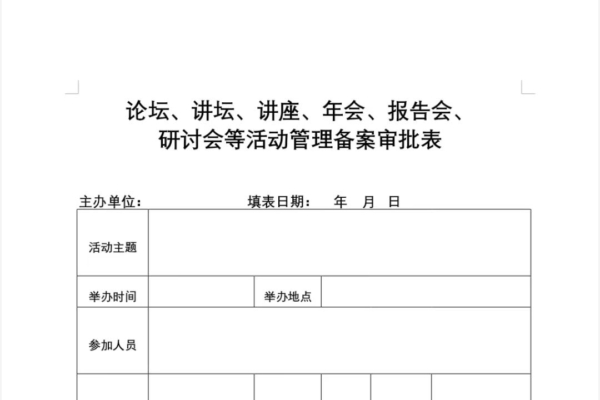
In recent years, China has been tightening its supervision of public communication activities in various regions. A recent document titled “Management Filing and Approval Form for Forums, Lectures, Seminars, Annual Meetings, Report Meetings, and Workshops” obtained by reporters shows that the scrutiny of activities has shifted from procedural management to include background checks on the personal political affiliations and attitudes of participants.
The requirements outlined in the document indicate that any event such as forums, lectures, annual meetings, report meetings, or workshops must undergo pre-filing and approval procedures. In addition to providing basic information such as event name, time, location, organizer, and participating scope, the form explicitly demands the registration of each invited speaker’s name, gender, date of birth, education level, political status, job title, and whether their unit agrees to their participation. Speech content must also be submitted in advance, along with a draft or outline.
This tightening of supervision of public communication activities has been ongoing in many parts of China in recent years. In an interview, Tang Ying from Beijing, who has experience with similar approval processes, revealed to reporters that these forms are not merely for event management; their focus is on the dual pre-check of “individuals” and “content.” She stated, “Unlike the usual administrative filings, these requirements are not just routine, or arrangements made to maintain order during events. The new requirement includes scrutiny of personal political backgrounds and unit attitudes as part of the approval conditions.”
Tang Ying explained that such activities fall under the jurisdiction of the Municipal Party Committee’s Propaganda Department, and large-scale speeches require reporting to the Central Propaganda Department: “Behind this form, there is the need to report to the Municipal Party Committee’s Propaganda Department for approval, file with the (Public Security) sub-bureau, and report cultural activities to the Ministry of Culture and Tourism. The process is quite complex.”
It is noteworthy that this document did not originate from a university or academic institution but was transferred by a media reporter privately. The reporter stated that their media outlet was recently required to complete filings in the above format when participating or organizing external exchange activities, and relevant materials had to be submitted for superior approval before proceeding. The reporter’s role was solely to gather information and follow procedural steps, without having the final decision-making authority.
Media practitioner Zhang Li, familiar with mainland media operations, noted that in recent years, media’s external exchanges, participation in forums, or organization of lectures have gradually fallen under a management system similar to that of universities and research institutions. The approval of activities is not only dependent on the topic itself but also closely related to the backgrounds of participants and endorsements from their units.
He stated, “Nowadays, the responsibility for such approvals has been decentralized. Previously, approval from the District Propaganda Department was sufficient, but now it needs to be reported to the Municipal Committee for review. You know, there are many restrictions on activities like seminars and lectures now. Jack Ma criticized the financial system during a speech, and ultimately, the organizers got into trouble, leading to the event being canceled.”
Zhang Li emphasized that authorities have implemented a series of measures such as risk control for media and universities organizing lectures and seminars related to the current environment and economy. “In short: it’s better not to hold such events. If someone says something wrong and offends someone, the trouble will be significant, and mid-level leaders also fear taking responsibility.”
It is currently unclear whether the above form is a uniformly distributed document. The document does not indicate the issuing agency or number. Zhang Li suggested that this review form is “closer to a template for local or internal execution within the system, belonging to the typical ideological management document of local Party committees’ Propaganda Departments, with the police generally cooperating in reviewing.”
Several interviewees mentioned that versions used in different regions are highly similar in practical operations, and the related requirements have become a normalized part of management.
Some analysts believe that the core goal of such filing and approval mechanisms is to reduce uncertainty by pre-screening individuals and content, minimizing the possibility of “uncontrollable expressions” in public settings. As the scope widens, the public communication spaces of media, academic institutions, and various organizations are subject to more detailed and pre-installed institutional constraints.