
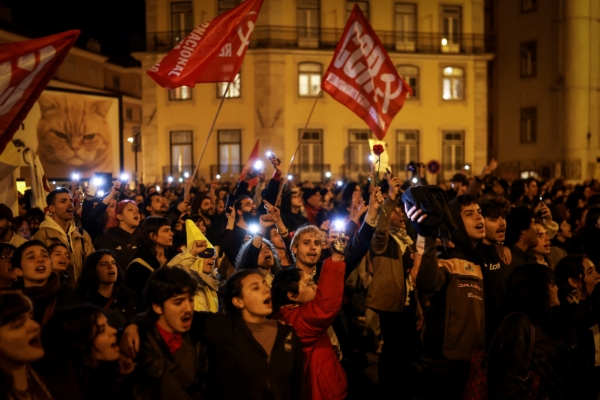
Portugal witnessed its first nationwide general strike since 2013 on Thursday (December 11), leading to a near-complete halt of railway services, hundreds of flights being canceled, and widespread school closures. Thousands of workers took to the streets of Lisbon to protest against the government’s proposed labor law reform.
The center-right minority government stated that the bill would revise over a hundred provisions in labor laws, aiming to boost productivity, stimulate economic growth, and ultimately benefit all Portuguese citizens.
Prime Minister Luis Montenegro emphasized that the government “will not abandon its determination for reform and transformation.” Cabinet Minister Antonio Leitao Amaro downplayed the impact of the strike, noting that the chaos was mainly concentrated in the public sector as about 80% of private sector employees did not participate in the strike.
The proposed reforms include easing the threshold for “fair dismissals” in small and medium-sized enterprises, adjusting current outsourcing restrictions, and setting a two-year limit on flexible work arrangements for breastfeeding mothers. While the bill has not yet been submitted for parliamentary debate, it is expected to pass with the support of the right-wing Vox party.
The strike was jointly organized by Portugal’s two major union federations – the General Confederation of Portuguese Workers (CGTP) and the General Workers’ Union (UGT). The unions harshly criticized the reform proposal for favoring employers and damaging workers’ rights, arguing that implementing such reforms during a period of robust economic growth and low unemployment rates is inappropriate.
The strike caused nearly a complete paralysis of public transportation. Despite authorities enforcing minimum service standards, some buses continued to operate, but the streets of Lisbon were notably quiet. Hospitals remained open, but due to some healthcare workers participating in the strike, many surgeries and outpatient appointments had to be postponed.
The state-owned airline TAP maintained only about a third of its flights, while the railway company warned that the disruptions could last until the following day. The unions pointed out that several major private enterprises, including the Volkswagen Autoeuropa factory, also experienced shutdowns, indicating that the strike had spread to the private sector.
Portugal’s last nationwide general strike occurred in 2013 when the country was under an EU and IMF bailout program and implementing harsh austerity measures. In contrast, the Portuguese economy has now recovered, with low unemployment rates and significantly improved fiscal conditions, even achieving a rare fiscal surplus in the EU in 2023.
*This article is based on reporting from Reuters.*