
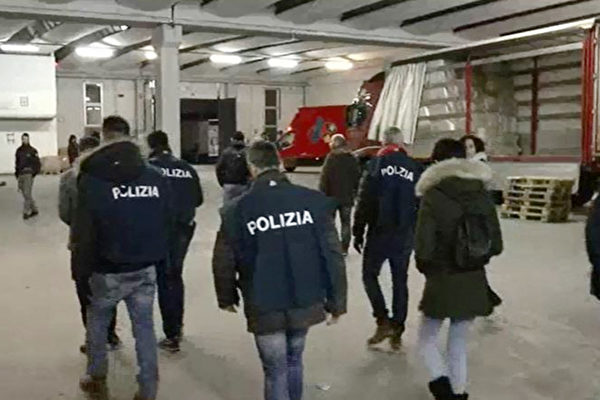
In a milestone trial in Italy regarding Chinese criminal gangs, progress has been slow due to continuous obstacles. From crucial documents going missing to Chinese translators suddenly resigning or disappearing, senior prosecutors have been forced to suspect organized sabotage in the trial, aimed at protecting these criminal networks’ control over the European fashion industry.
The case, known as “China Truck,” focuses on dismantling an illegal network accused of controlling the logistics of the multi-billion euro fashion industry in Europe from the city of Prato in the Tuscan region.
Chief Prosecutor Luca Tescaroli of Prato is leading the war against the “Mafia gang.” He openly told Reuters that the case faces numerous hindrances, leading to suspicions.
“We suspect there is intervention from the Chinese community and authorities (Chinese Communist Party) on this issue,” he said.
He revealed that in a court session at the end of September, the newly hired translator did not show up and was found to have returned to China, with her previous court records deemed “incomprehensible and unusable.” This is the second translator to resign midway, and there are no other Chinese translators in the Tuscan region willing to take on the case.
Tescaroli has initiated an investigation to ascertain if someone is attempting to obstruct the trial.
Prato is Europe’s largest textile manufacturing center, with over 4,400 Chinese companies, considered a global hub for fast fashion production and a hotspot for violent crime networks.
The “China Truck case” originated from the 2010 incident where two Chinese men were killed by machetes, leading to the revelation of the Zhejiang and Fujian gangs – two rival gangs engaging in bloody conflicts to seize control over European territories and logistics.
The criminal gangs are accused of monopolizing clothing rack production and fast fashion transportation through violent means to gain massive profits. Tescaroli pointed out that the rack wars have resulted in at least 16 bomb and arson attacks in Italy, France, and Spain.
These Chinese companies have long been involved in tax evasion, customs fraud, and illegally funneling profits back to China through illicit channels, with prosecutors stating that millions of euros are unlawfully transferred out every week.
The “China Truck” investigation concluded in 2018, indicting 58 suspects, but seven years later, none of the defendants or witnesses have been summoned to testify in court.
Zhang Naizhong, referred to as the “boss of bosses” by investigators, was released during pre-trial detention in 2018 and has since fled back to China, with prosecutors suspecting he will never return to Italy.
Tescaroli is attempting to have the court classify these Chinese criminal gangs as “Mafia gangs,” which would lead to harsher sentences and greater investigative powers. However, National Anti-Mafia Prosecutor Barbara Sargenti pointed out that achieving this would require mapping out organizational charts through internal informants or cooperation from Chinese judicial and law enforcement authorities.
Sargenti explicitly stated that cooperation with the Chinese side has been “extremely difficult.” While the Chinese side has expressed willingness to dispatch officers for collaboration, there have been no follow-up actions thus far.
Due to the lack of Mafia classification or Chinese cooperation, the progress of this trial heavily depends on the fragile Italian domestic procedures and whether translators are willing to appear in court. The next hearing is scheduled for May 15, 2026.