
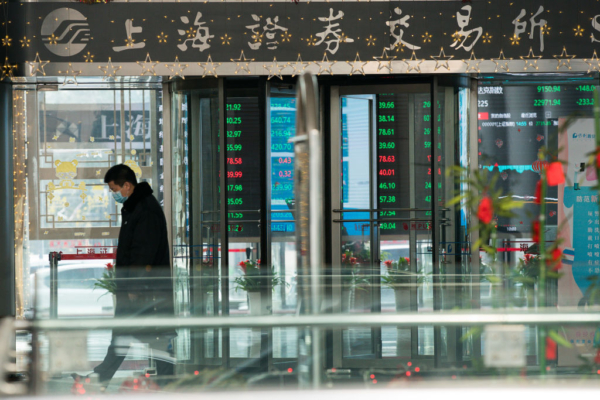
On December 11, the A-share market experienced a general decline with nearly 4400 stocks trading in the green, as all three major indexes collectively fell, with the Shanghai Composite Index dropping by almost 1%, breaking below the 3900-point mark, attracting the market’s attention.
By the close of trading, the Shanghai Composite Index fell by 0.7% to close at 3873.32 points, breaking the 3900-point support; the Shenzhen Component Index dropped by 1.27% to close at 13147.39 points; the ChiNext Index fell by 1.41% to close at 3163.67 points, dropping below the 3200-point level.
The total turnover on the Shanghai and Shenzhen stock exchanges was approximately 1857.13 billion yuan (RMB), an increase of around 78.608 billion yuan compared to the previous trading day. Out of the entire market, 1032 stocks rose while 4378 stocks declined, making up 80.45% of the total.
Real-time monitoring data from Wind showed that the electronic industry experienced a net outflow of over 8.5 billion yuan in main funds, while the computer sector had a net outflow of over 6 billion yuan, and the telecommunication sector experienced a net outflow of over 5.5 billion yuan. Other industries such as media, non-bank financials, transportation, real estate also saw net outflows of over 2 billion yuan. On the other hand, the electrical equipment sector had a net inflow of over 5 billion yuan, the national defense industry had a net inflow exceeding 1.4 billion yuan, and sectors like machinery, banks, construction materials, agriculture, forestry, animal husbandry, and fishing received net inflows exceeding a billion yuan each.
Financial media personality “Tiger Brother Chat” analyzed the situation in a post, stating, “Dealing with the weak downward trend in A-shares today is quite a headache. The trend of luring long positions first and then trapping investors is risky. As influential funds target small-cap stocks, the widening decline in these stocks has raised market concerns. This is a typical case of walking the market downwards gradually, making it hard for retail investors not to lose money!”
“Tiger Brother Chat” predicted that A-shares will continue to decline tomorrow (12th) for three reasons:
1. The current style of A-shares is “stable indexes, falling individual stocks,” aiming for adjustment and releasing selling pressure within the market. There is a need for adjustment without causing significant volatility while ensuring the market does not panic. With enormous funds supporting it, A-shares are likely to undergo a general decline tomorrow.
2. The Shanghai Composite Index has exhibited a negative technical trend, signaling a downturn today, which many technically inclined investors may flee from. Looking at broader market index charts, a decline tomorrow is normal due to the downward shift in trend momentum and the spreading out of moving averages, creating short-term pressures leading to a steady decline in the market.
3. Bearish forces were strong today, with increasing selling pressure and a deepening sense of pessimism. For instance, during mid-day trading, a one-sided downward trend emerged, especially in the final trading hours where the losses expanded further, intensifying the loss effect. This downward momentum is expected to continue into Friday, suppressing further market decline.
Analysis from Guolonghui mentioned that on December 11, the A-share market continued its adjustment, with most sectors showing weak downward trends. Currently, the ChiNext Index, symbolizing growth in the tech sector, has undergone a weak adjustment for over two months, and the Sci-Tech 50 Index has retraced more than 15% from its peak. Clearly, as 2025 approaches its final month, some investors have started seeking safety or exiting the market to wait for the next year, leading to a weakening and differentiating trend in the primary market directions.
Statistics from Futu Market Data indicated that in the past 20 days, over 4200 stocks in the A-share market have registered declines, representing nearly 80% of all A-shares, with over 3200 companies seeing drops exceeding 5%. Among the 131 specific industries within the A-share market, more than 110 have recorded declines in the recent 20-day period, with half of them experiencing drops of over 5%.
Furthermore, since reaching its peak in August at 3.17 trillion yuan, the total turnover of A-shares has been steadily decreasing and currently stands at less than 1.9 trillion yuan, showing a considerable decline.
Even in highly popular sectors like AI computing power, robotics, consumer electronics, and aerospace military industries, significant fluctuations in valuations have started to occur despite being at high levels, indicating the beginning of a secondary trend adjustment.
Guolonghui explained that the situation arises from the simple logic that the macroeconomic conditions are still undergoing weak adjustments, combined with the absence of strong supportive policies. With this double impact, it’s challenging for the stock market to regain strength in the short term.