
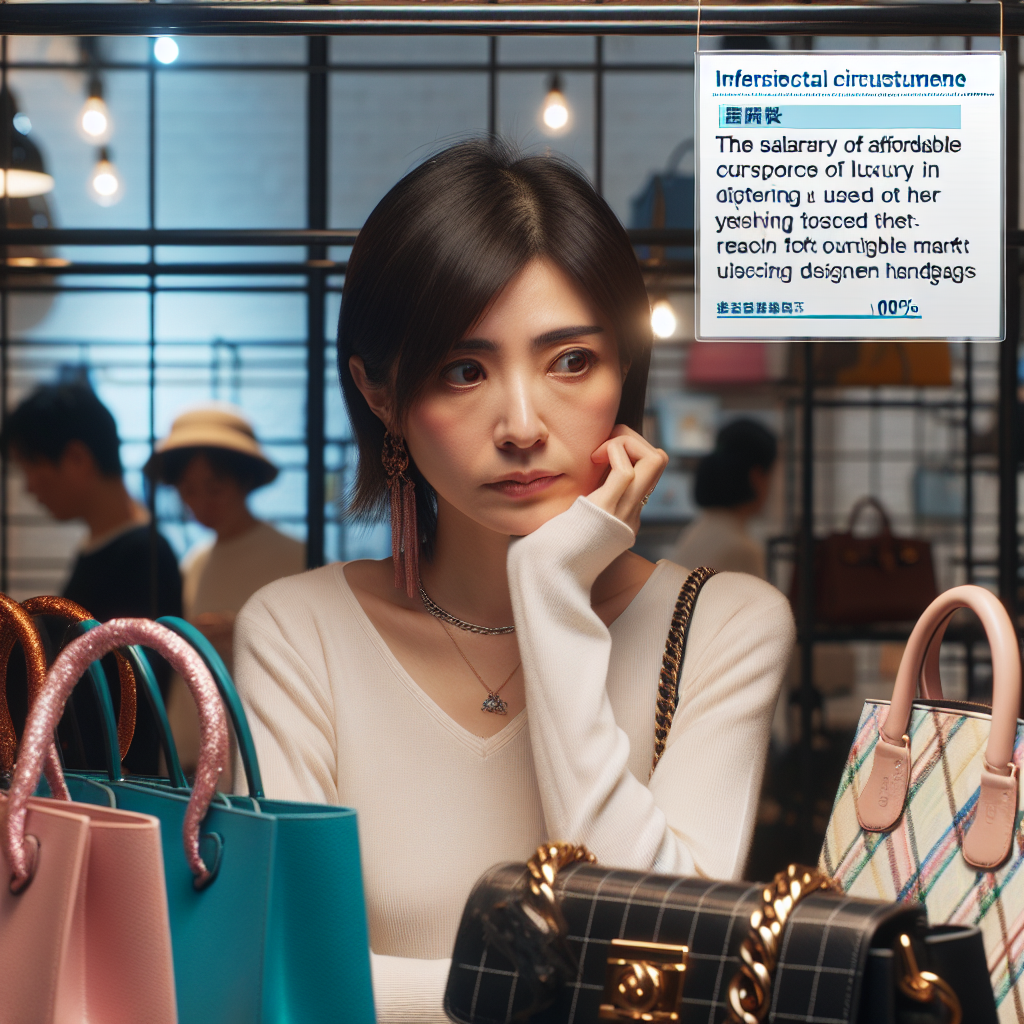
28-year-old Chinese energy industry employee Mandy Li used to occasionally treat herself to a designer handbag, but now she can only look for affordable luxury items in the second-hand market. The state-owned enterprise she works for has cut her salary by ten percent, and the value of the properties she owns at her home has been halved due to the downturn in the real estate market.
“I am cutting back on big expenses,” she told Reuters inside a second-hand luxury store called “Super Zhuanzhuan,” which opened in Beijing in May. “The economy is indeed declining, and my family’s wealth has greatly shrunk due to the real estate crisis.”
Reuters reports that China has been facing a real estate crisis since 2021, and now it is also facing increasing deflationary pressures. In May, the Consumer Price Index (CPI) decreased by 0.1%, reflecting weak household demand and structural economic issues of overcapacity. Price wars are raging across various industries from automobiles, e-commerce to coffee.
“We still believe that the persistent overcapacity will keep China in deflationary territory this year and next,” Capital Economics stated in their research report.
In the environment of weak consumer spending, businesses of all kinds are shifting their focus to emphasize “value for money”: offering 3 yuan (about 0.4 US dollars) breakfasts, and daily flash sales happening four times a day. Economists warn that these price wars may lead to business closures and a wave of unemployment, exacerbating a vicious cycle of deflation.
This trend of frugality is also driving rapid growth in China’s second-hand luxury goods market. According to a report by Zhiyan Consulting, this market saw an annual growth rate of over 20% in 2023. However, the surge in supply has also led to increased discounts. Stores like “Super Zhuanzhuan” are selling some items at prices as low as ten percent of the original price, significantly lower than the common discount range of three to four percent in the industry.
On other major platforms such as “Xianyu,” “Panghu,” “Feiyu,” and “Hongbulin,” discounts of up to 30% or even lower are now very common.
Zhang Lisa, an expert from Daxue Consulting, points out that “an increasing number of consumers who used to buy authentic products are turning to the second-hand market.” She added that with intensifying competition, the scope of discounts offered by sellers continues to expand.
Inside “Super Zhuanzhuan,” a Coach Christie green handbag originally priced at 3,260 yuan (about 454 US dollars) is now selling for only 219 yuan (about 30 US dollars); and a Givenchy G Cube necklace originally priced at 2,200 yuan is now available for 187 yuan.
An anonymous founder of a second-hand luxury goods store revealed that the number of sellers is increasing by 20% each year, but the number of buyers remains relatively stable. He said, “The income of China’s middle class is indeed shrinking, and the economy is the root cause of it all.”
He believes that the demand in first-tier cities like Beijing and Shanghai can still support new entrants, but the markets in other regions are saturated. “Most of these newly opened stores may not last long.”
University professor Riley Chang also visited “Super Zhuanzhuan,” not to buy a bag, but to see how much her luxury items could sell for. She was disappointed with the results, saying, “I have visited several larger second-hand luxury goods stores in Beijing and Shanghai, and they all try to push down your pricing.”