
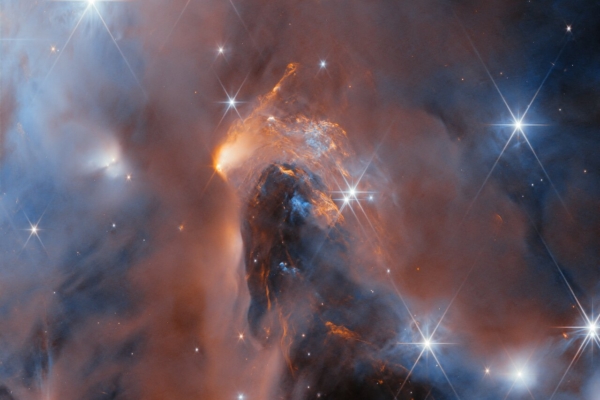
In a surprising discovery, scientists have found an invisible giant molecular cloud in our cosmic “backyard,” a location extremely close to Earth, offering new insights into the formation of stars and planets.
According to CNN, this gas cloud has been named “Eos,” after the Greek goddess of dawn in mythology. Researchers revealed in a report published in the journal “Nature Astronomy” on Monday, April 28th, that if visible to the naked eye, this cloud would appear extremely massive in the night sky, with an angular width equivalent to about 40 full moons and a mass approximately 3,400 times that of the Sun.
Scientists typically use radio waves and infrared observations to detect molecular clouds by identifying the chemical characteristics of carbon monoxide. However, despite “Eos” being only 300 light-years away from Earth, making it the closest known molecular cloud to date, it had gone unnoticed in the past.
Thomas Haworth, an astrophysicist at Queen Mary University of London and a co-author of the study, explained that this was due to its extremely low carbon monoxide content, making it undetectable through conventional methods.
Subsequently, Haworth and colleagues discovered “Eos” in the data collected by the Far ultraviolet IMaging Spectrograph-Satellite Pour l’Etude des Emissions Residuelles (FIMS-SPEAR) instrument onboard the Korean STSAT-1 satellite. This data was made public in 2023 and caught the attention of Blakesley Burkhart, the first author of the current research and an associate professor in the Department of Physics and Astronomy at Rutgers University.
The far ultraviolet spectrometer is capable of breaking down the far ultraviolet light emitted by substances into various wavelengths, forming spectroscopic data for analysis by scientists.
“This is the first time in history that we have directly detected molecular clouds through the far ultraviolet emission of hydrogen molecules,” Burkhart stated in a press release. “This cloud is truly shining in the darkness.”
Burkhart pointed out that due to the unusually close proximity of “Eos” to Earth, it provides a rare opportunity for “directly measuring how molecular clouds form and dissipate, thereby understanding how the Milky Way galaxy transforms interstellar gas and dust into stars and planets.”