
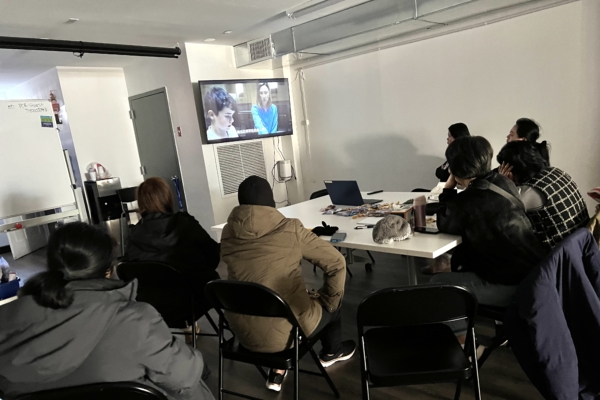
New York Parent-Child Mutual Aid Association continued its film screening and discussion event on April 8th, featuring the Netflix British drama “Adolescence,” with the screening of the third and fourth episodes attracting numerous parents to participate in viewing and engage in in-depth discussions.
The English title of the series is literally translated as “Adolescence,” focusing on teenage crime and exploring how factors such as pressures of growing up, the influence of the internet, relationships with classmates, and family interactions intertwine to lead to tragic events. The series does not rely on suspense as a packaging element; it immediately reveals the teenage protagonist Jimmy as the perpetrator, gradually allowing the audience to understand his inner world and the psychological and social contexts behind the events as the plot unfolds.
The plot advances through four time points: the day of the incident, the police’s campus investigation, a psychological evaluation seven months later, and a guilty plea one year and one month later, gradually revealing changes in the teenager’s psyche and the breakdown of his connections with family and society.
Following the screening, the President of the Parent-Child Mutual Aid Association, Nicole Huang, guided parents to initiate conversations using the following questions: Is Jimmy a bad kid? Does he understand his mistakes? What do you think is Jimmy’s biggest issue? What is the gap between his expectations and the reality of his family? Does the lack of emotional connection between him and his father contribute to his deviant behavior? Do we really understand our children? When they exhibit emotional or behavioral abnormalities, do we recognize that as a “cry for help”?
Many parents pointed out that the core issue with Jimmy lies in his low self-worth. He has always yearned to prove his value, to be acknowledged and loved, yet has never received clear support and affirmation. His father, consumed by daily life, has overlooked his child’s most basic emotional needs. This scenario resonates with many Chinese families.
Parents generally agree that the series resonates strongly because it touches upon common contemporary social issues such as out-of-control social media, emotional education deficiencies, and familial alienation. “The father in the series believes the child is safe in the room, but fails to realize the child may be experiencing violence and humiliation online.”
One parent shared, “Many of us have also experienced a lack of emotional connection in our own childhoods, making it challenging for us to naturally express care and encouragement when raising the next generation.” This prompts us to reflect: Should family education start with ‘understanding the child’s emotions’?
Another parent pointed out, “When our child looks at us after missing a goal in soccer, they are actually seeking words of encouragement, yet sometimes we are engrossed in our phones.” Many believe that the lack of emotional connection between parents and children is a crack that urgently needs mending in modern families.
In concluding the discussion, Nicole Huang emphasized, “Families are not perfect, but a child’s behavioral problems are not necessarily the fault of the parents. Both parents and children are independent individuals who inevitably make mistakes during the growing process. We need to learn to accept, forgive, and grow together.”
She mentioned that the Parent-Child Mutual Aid Association will continue to roll out a series of emotional management and parent-child education seminars, inviting more parents to engage in dialogue and collaborate in creating a more understanding and supportive family environment.