
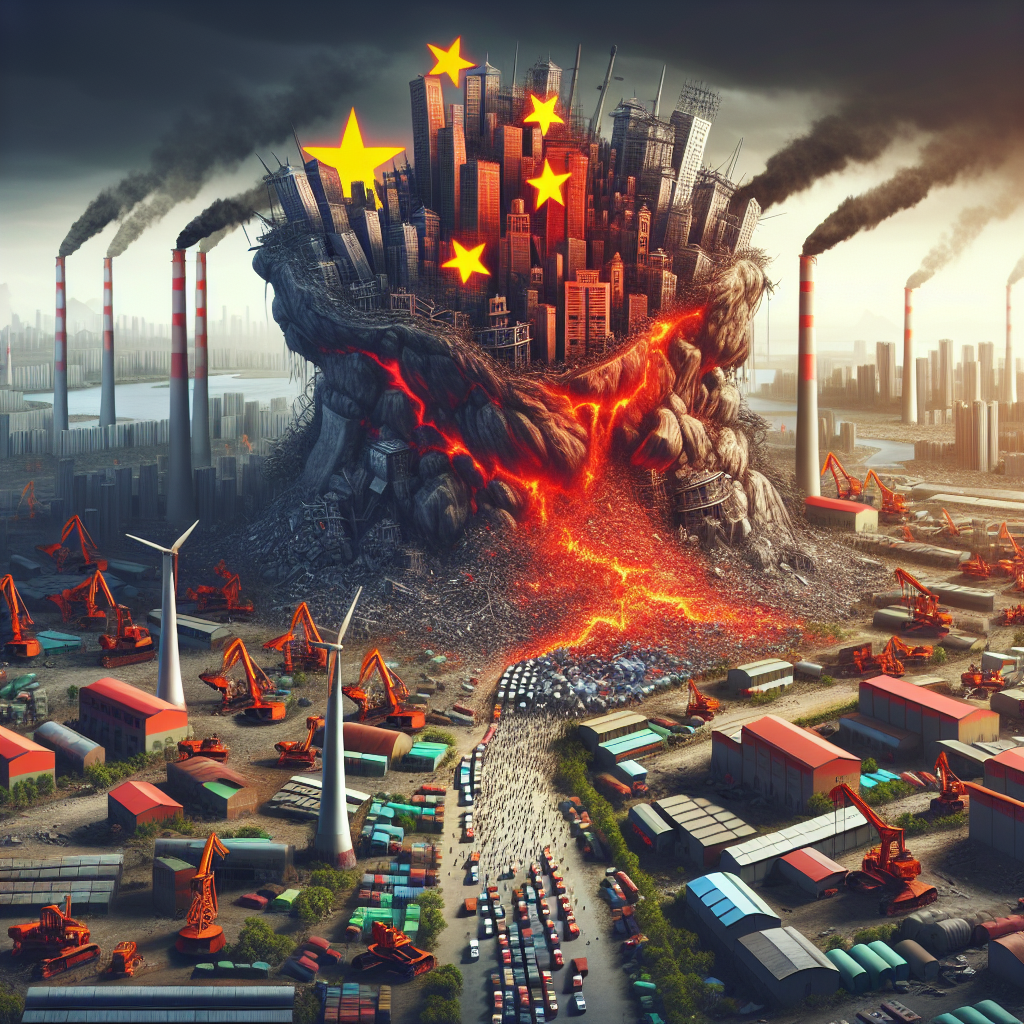
In mainland China, many industries often engage in cutthroat competition following the government’s push for “leaping forward,” leading to the demise of industries. During this year’s annual “Two Sessions” of the Chinese Communist Party (CCP), the authorities proposed to crack down on “internal competition.” But at the same time, the official hint of establishing a national venture capital guidance fund focusing on industries such as artificial intelligence (AI) sparked a new frenzy of domestic investment.
Experts believe that the CCP’s assertion to crack down on “internal competition” is more of a political gesture, acknowledging that the current economic model is unsustainable. It seems like using a new idle hand to restrain the previously restless hand, leading to a logical confusion. The nationwide drive to establish venture capital guidance fund or similar initiatives often end up being futile, akin to the large-scale promotion of the chip industry.
The government work report released during the CCP’s annual sessions for the first time emphasized the comprehensive crackdown on “internal competition,” with mainland media mostly pointing to the phenomenon within various industries. Recently, several private entrepreneurs who attended the Two Sessions criticized the destructive nature of disorderly competition in the country, as “internal competition” leads to decreased profits, burdened business operations, and even substantial losses.
In recent years, severe “internal competition” has plagued various industries in China. For instance, the country’s photovoltaic industry saw a 33.9% year-on-year decline in exports in 2024, leading to expanded losses and entrapment in a scenario of both domestic and international competition woes.
In the field of autonomous driving, a prominent “unicorn” company in China, ZoomTech, faced a scandal last month. Even after President Xi Jinping spoke about reducing the number of unicorn companies last year, Shanghai Communist Party Secretary Chen Jining personally visited ZoomTech, with CCTV later covering the company in its report.
The internal competition prevailing in the Chinese industry appears to be a result of government initiatives. According to analysts, under the dual drives of government policies and the market, the autonomous driving industry in China has seen rapid development in recent years. However, the rush for IPOs has left many autonomous driving companies grappling with financial losses. An industry insider noted that the industry’s significant capital expenditure, coupled with nearly a decade of intense capital injections and promotions in China, has contributed to the current immature and unhealthy state of the industry, spiraling into a vicious cycle.
American economist David Huang pointed out that the CCP’s current claim to curb internal competition signifies an acknowledgment that the current economic model is unsustainable, reflecting Beijing’s anxiety about its economic control capabilities.
“We see the photovoltaic industry embroiled in a vicious cycle of price wars and overcapacity, where companies no longer focus on the market but on defeating domestic rivals. This internal turmoil is not spontaneous but a result of long-standing strategies of the CCP high ranks, from the era of Mao Zedong to the present, characterized by policies like ‘fast, good, and cheap,’ creating a herd mentality – a consequence of the ‘leaping forward’ model,” said Huang.
Huang highlighted that relying on impulsive decisions, rather than market logic, and pushing industries forward solely based on leadership will inevitably lead to excessive competition, wasting vast resources. This approach has hampered the original goal of achieving high-quality development that the authorities initially promoted. Now the management has to step in to rectify the aftermath.
He emphasized that the CCP’s recent rhetoric about rectifying internal competition is primarily a political gesture, showing the promise of government intervention to businesses and the electorate.
“The government’s hands are excessively involved in the economy. Now, by using another idle hand to suppress the previous idle hand, it creates a logical confusion and paradox: while it aims to maintain industries under the Party’s guidance, it is challenging to break free from economic norms. It wants to defy economic norms but faces continuous setbacks, making it difficult to alter its predicament,” Huang remarked.
Following the fervor for DeepSeek and humanoid robots, Zheng Zhangejie, the director of China’s National Development and Reform Commission, announced recently at the Two Sessions press conference the establishment of a national venture capital guidance fund. This fund aims to mobilize nearly 1 trillion yuan of local and social capital, focusing on industries like artificial intelligence and quantum technology.
Additionally, Wang Guoren, a Chinese People’s Political Consultative Conference (CPPCC) member and the dean of the School of Computer Science at Beijing Institute of Technology, suggested that provinces consider establishing funds to drive industries related to artificial intelligence.
Many regions in China are rolling out plans to boost the artificial intelligence industry. According to local media reports, Guangzhou is setting up an industry office to promote the application of “AI+” in the city, aiming to drive the industrialization of AI technology and smart industry development through encouraging application demonstrations.
In Beijing, the Municipal Education Commission announced that, starting from the upcoming fall semester, all primary and secondary schools in the city will introduce AI general education courses with a minimum of 8 lessons per academic year. Recently, several top universities, including Tsinghua and Peking University, announced an expansion of undergraduate admissions this year. Beijing Youth Daily reported that most of these additional student enrollments will be directed towards AI and related disciplines.
Official reports from China indicated that during the Two Sessions, numerous industry professionals were enthusiastic about investing in the artificial intelligence industry.
However, under the centrally planned structure, the massive chip fund previously launched by the CCP has been largely ineffective.
Against the backdrop of the escalating U.S. restrictions on China’s chip and artificial intelligence industries, the CCP set up the largest semiconductor investment fund in history in the first half of last year – the China National Integrated Circuit Industry Investment Fund III Co., with a registered capital of 344 billion yuan.
Earlier, the CCP established the first phase of the national chip fund in 2014 with a registered capital of 138.7 billion yuan; the second phase was set up in 2019 with a registered capital of 204 billion yuan. However, in July 2022, Ding Wenwu, the general manager of the first and second phases of the chip fund, was investigated. During an internal anti-corruption campaign from July to September 2022, seven high-level executives were scrutinized, including Lu Jun, the president of Huaxin Investment, and Gao Songtao, the general manager of the National Development Bank’s National Industrial Transformation and Upgrading Fund.
On July 25, 2022, Zhao Weiguo, chairman of Tsinghua Unigroup, was also placed under investigation. Shortly after the establishment of the National Chip Fund, the first significant investment was made into Tsinghua Unigroup’s businesses amounting to 10 billion yuan, nearly 10% of the first phase of the fund. However, starting in November 2020, Tsinghua Unigroup began facing debt defaults.
Huang commented that the CCP’s move to establish a national venture capital guidance fund is akin to diverting funds that could resolve corporate financial difficulties back to vested interest groups, resulting in wasteful investments, similar to the previous large-scale chip promotion efforts that ultimately led to numerous failures.
He noted that this approach mirrors the typical centralized decision-making style of Beijing, initiating a 1 trillion yuan national venture capital fund. Such grand narratives, akin to those in “Made in China 2025,” high-tech projects, and the rise of a great country, involve massive blind investments without effective third-party supervision. While there may be some minor technological advancements, genuine competitiveness becomes challenging to achieve.
On March 9, People’s Daily, the CCP’s official media outlet, published an article highlighting the current AI enthusiasm and cautioning against the rapid investment push, indicating a sense of urgency for innovative outcomes. In the midst of transitioning from old energy sources to new ones, addressing this “star-chasing innovation” fever becomes crucial. The article cited instances where the initial fervor for metaverse concepts led to the establishment of multiple metaverse industrial parks in various mid-sized cities, now lying vacant, termed as “digital ghost towns.”
Huang reiterated that attempting to curtail the so-called “star-chasing innovation fever” through official administrative means is impractical. Since innovation necessitates openness, stringent monitoring and restrictions from the CCP hinder genuine progress, highlighting a critical challenge posed by the existing institutional limitations.
Xu Zhen, a seasoned capital market expert in mainland China, concurred, saying that the CCP’s economic management system cannot resolve the issue of “star-chasing innovation fever.”
“Characterized by rigid control, the CCP sees chaos once restrictions are loosened. Various regions hastily launched AI projects, leading to overcapacity, disorderly competition, and ultimately unproductive results. The lack of original technology, with most being copied from others, appears to be their forte in this aspect,” Xu noted.