
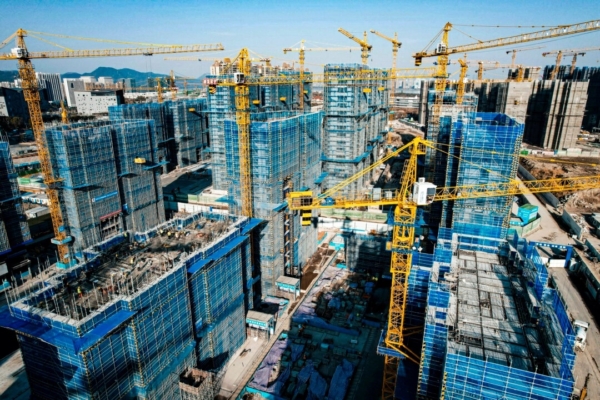
China’s mainland is experiencing a wave of “land return” – real estate giants are returning previously purchased but undeveloped land to local authorities. Industry experts anticipate that in 2025, there will be an increasing number of real estate developers “returning land,” putting greater pressure on local governments’ land financial revenue. The rules of the mainland property market are undergoing profound changes.
According to a report by “China Real Estate News” on January 8, a widespread “land return” trend is sweeping across first-tier and second-tier cities such as Guangzhou, Beijing, Shenzhen, Chengdu, and Ningbo.
In this wave of land returns, major real estate companies like Vanke, Yuexiu, and China Resources are returning some land bought in earlier years but never developed. Local governments are adjusting land use and development requirements to “unwind” the situation, while actively promoting the relisting of land to attract developers back into the market.
Simultaneously, local governments are exploring compensation policies such as the issuance of land compensation vouchers.
By the end of August 2024, Yuexiu Properties returned four land parcels worth over 12 billion yuan within four days. These plots were acquired three years ago but remained undeveloped. The compensation from the Guangzhou government was in the form of equivalent payable notes, which Yuexiu Properties could use to continue purchasing land in Guangzhou.
In December 2024, Vanke acquired three plots in the Guangzhou Panyu Nanzhan Business District at a base price of 2.88 billion yuan. These plots were previously owned by Vanke but had stalled due to rail transit construction reasons. After being reclaimed and re-planned by the government at the end of 2023, they were relisted.
On the last day of 2024, Poly Development acquired two land parcels in the Guangzhou Tianhe District at a base price of 7.022 billion yuan, equivalent to a floor area price of 51,000 yuan per square meter.
Huang Zhengxue, the Director of the Land Economic Division of the Institute of Land Development and Regional Economy of the National Development and Reform Commission of the Communist Party of China, stated that the main reason for real estate developers returning land is the change in the commercial property environment, where the original development nature of the land no longer meets the requirements of the changing situation. This reflects the active revitalization of idle land by the government on the one hand and the financial pressure faced by enterprises in the market environment changes on the other.
Experts interviewed all foresee more real estate developers returning land in 2025. From hoarding land to returning land, the rules of the Chinese property market are undergoing profound changes.
Apart from real estate companies in crisis, central enterprises, state-owned enterprises, and local state-owned platforms are also experiencing land returns.
In Beijing, Vanke returned a plot acquired eight years ago, which the government reclaimed and changed the land transfer conditions. For example, the land no longer requires enterprise retention; and the listing price and reasonable upper limit price have significantly increased. The plot was later purchased by Poly Build at 8.9 billion yuan upon re-entering the market. In Wuhan, Huaguangcheng returned a 105-mu plot in the Yangchunhu High-speed Railway Business District directly to the government.
In November 2024, after the Nanjing Residential Forest plot was returned for several months, it was re-planned with a reduced plot ratio of 1.5 and a reduced building height of 60 meters, transforming into a low-density residential area. Additionally, cities such as Xi’an and Changsha have also seen real estate developers returning land.
The main reasons behind this wave of land returns include: 1. Market changes after acquiring land at high prices: many plots were acquired at market peaks, and as the market cools down, the development of these plots faces greater risks; 2. Strict development conditions: some plots come with stringent development requirements, making it difficult to implement the original plans due to changes in the market environment; 3. Financial pressure: the contraction of real estate companies’ cash flow and financing channels leading to projects not progressing as planned.
This wave of “land return” is developers cutting losses, which, for local governments, brings pressure on land financial revenue.
Behind the “land return,” developers’ market expectations are not optimistic.
Data from the National Bureau of Statistics of the Communist Party of China shows that from January to November 2024, national real estate development investment decreased by 10.4% year-on-year, with the decline expanding by 0.1 percentage points compared to the previous ten months. This index has been at a double-digit decline for seven consecutive months, and the decline is still gradually widening.
Looking at several key indicators affecting investment, from January to November, the newly started area of houses decreased by 23% year-on-year, with the decline widening by 0.4 percentage points compared to the previous ten months; the construction area of houses decreased by 12.7% year-on-year, with the decline expanding by 0.3 percentage points.
Ke Real Estate conducted a statistical analysis of the residential land construction and opening situation in 23 key cities from 2023 to the first half of 2024. The overall start rate in the 23 cities was 46%, with first-tier cities reaching 84.6% and second-tier cities significantly dropping to 36.9%.
In other words, the post-transaction construction status of land in places outside first-tier cities more tha…