
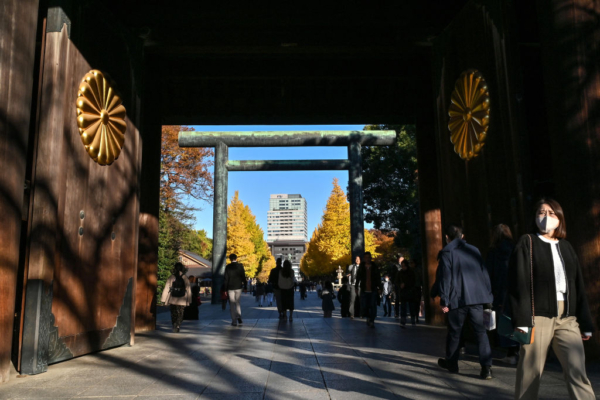
Tokyo High Court on Wednesday (December 25) sentenced a Chinese citizen living in Japan to eight months in prison for his involvement in a graffiti incident at the Yasukuni Shrine in May.
The 29-year-old Jiang Zhuojun was charged with “damaging property” and “showing disrespect to a place of worship” at the Tokyo District Court, as reported by Kyodo News.
According to the ruling, on May 31, Jiang Zhuojun, along with two other Chinese men, vandalized a stone pillar at the Yasukuni Shrine by spraying red paint to write the word “Toilet,” consequently damaging the pillar.
Prosecutors had previously sought a one-year prison term for him.
In delivering the verdict, Judge Yasushi Fuke stated that Jiang Zhuojun purchased the spray paint, playing a crucial role in the case. He said that “expressing one’s views through illegal actions is unforgivable.”
The court deemed imprisonment appropriate as the defendant was unable to compensate for the damages. The court dismissed Jiang Zhuojun’s argument that his actions were a protest against Japan’s decision to discharge treated water from the Fukushima nuclear accident into the Pacific Ocean starting in 2023.
On the evening of May 31, Dong Guangming (online alias Tie Tou) urinated on the stone pillar at the entrance of the Yasukuni Shrine inscribed with the shrine’s name and spray-painted “Toilet” in red. The process was suspected to be recorded by a photographer named Xu Laiyu and uploaded to social media platforms in China.
On July 9, the Public Security Bureau of the Tokyo Metropolitan Police Department arrested the Chinese citizen Jiang Zhuojun residing in Saitama Prefecture, Japan, on charges of damaging property and showing disrespect to a place of worship by participating in the graffiti on the stone pillar at the Yasukuni Shrine. Arrest warrants were also issued for the other two Chinese suspects, Dong Guangming (36 years old) and Xu Laiyu (25 years old), who have already left Japan and are on the wanted list.
The actions of the three individuals caused strong anger among the Japanese public after being exposed. Following the incident, the then Japanese Foreign Minister Yoichi Takahashi expressed concerns to the Chinese government through diplomatic channels during a press conference on June 4.