
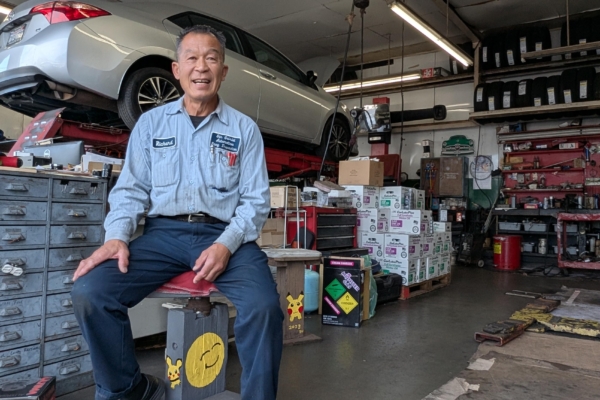
In the bustling streets of Las Tunas Dr. in San Gabriel, the Fu Hua Auto Repair Center stands quietly, preserving nearly forty years of history amidst the hustle and bustle of cars and people. Inside the shop, amidst the pungent smell of motor oil and the clanging of metal tools, there is a sense of whimsy and greenery.
The owner, Mr. Fu You, who immigrated to the United States in the 1980s and is now in his senior years, still works tirelessly between the car lifts and engine hoods. Despite being a typical “grease monkey,” Mr. Fu possesses a unique finesse and keen observation akin to that of an artist.
While many children’s toys are purchased by their grandparents at stores, the toys owned by Fu You’s grandchildren are handcrafted by Fu You himself.
In Fu You’s shop, discarded refrigerant cans are cut and shaped into uniquely styled decorative items; scrapped car exhaust pipes become the legs of his envisioned “robots”; and old tires, having fulfilled their duty, are transformed into flower pots filled with drought-resistant succulent plants, adding a touch of greenery to the metal roofed auto repair shop.
On the rooftop, a windmill constructed by Fu You using a disassembled fan and painted in red, blue, and white to resemble the American flag stands as a masterpiece. The various creations handcrafted by this elderly immigrant from Northeast China who has rooted himself in Los Angeles for nearly four decades can be found scattered throughout the shop, embodying the creative spirit, passion, and unwavering legacy of Chinese immigrants.
Handcrafted metal art pieces like dragons, dust bunnies, and Pikachu, created by Fu You during his leisure time, adorn the corners of the shop, captivating waiting customers. “Creating things with your hands and mind can bring joy,” Fu You remarked, as his simple creative philosophy revolves around doing what makes him happy whenever there is time.
Despite frequent customer inquiries about purchasing his works, Fu You resolutely refuses to sell them, as each piece is considered a priceless treasure in his eyes. With a keen eye, he repurposes returned paint from Home Depot, transforming seemingly insignificant discarded materials into intricate works, embodying both frugality and the enrichment of his own life. For Fu You, the auto repair shop serves not only as a place to fix cars but also as a medium for releasing his creative passion and nurturing the steadfastness and perseverance of immigrant life.
In 1992, Fu You opened his repair shop on a busy street in San Gabriel.
Reflecting on his arrival in the United States in his thirties, Fu You reminisces about fixing old gasoline cars from the 1950s and 1960s based on experience and manual labor. Over the past forty years, the most significant change has been the advancement of technology: cars have become increasingly electronic, requiring technicians like him to adapt by learning computer and electronic control systems. Despite the rapid changes in the industry, Fu You still treasures his most valuable asset – the trust of his loyal customers.
“It’s fate for three generations of a family to come here for car repairs,” Fu You remarked nostalgically. Many sons and grandsons of his original customers are now regulars at his shop. Adorning the walls of his shop are Christmas cards drawn by young customers from the past, who have grown into young adults capable of driving. This continuity spanning decades not only sustains business but also forms emotional bonds among people within the community.
However, in today’s era where electric vehicles (EVs) are profoundly impacting the traditional automotive industry, Fu You’s repair shop is confronted with two inevitable challenges – electrification and the succession to the next generation.
Fu You holds a tolerant attitude towards the issue of succession: “Whether or not to take over this business is up to the children’s fate.” He observes with regret that many peers in the industry have had to sell their shops as their descendants were unwilling to continue the legacy, expressing, “I have an interest in machinery, an interest in fixing cars, but not everyone likes this.”
His daughter, Fu Jiani, admits she had never consciously planned to join the auto repair business but gradually developed an interest and sense of duty after assisting the family for an extended period. “If my family trusts me and wishes for me to take over, I am willing to continue,” she said.
Fu Jiani has a clear insight into the changes in the industry, noting that electric vehicles led by Tesla have significantly raised the barrier of entry for independent repair shops with their proprietary repair systems. Data and information are locked within official platforms, unlike traditional gasoline cars that can be freely repaired and modified, making it challenging for many repair shops to keep up with the pace of electrification.
Nevertheless, Fu Jiani believes that there is still a vast market for gasoline-powered cars. Many consumers still prefer the power and convenience of long-distance travel offered by gasoline vehicles, ensuring a stable demand for repair services at traditional shops. “Some people simply prefer the power of gasoline cars and feel more secure on long trips.” In addition, the charging infrastructure for electric vehicles in most regions of the United States, apart from California, is still insufficient to support long-distance travel.
Fu You’s repair shop epitomizes the struggles of Chinese immigrants in America. It is not only a place for mechanical repairs but also a space for artistic creation, representing a legacy of resilience. Facing the uncertainties of the future, though the two generations hold different viewpoints and plans, they both maintain a practical attitude – supporting their family, running a stable business, and constantly pondering how this longstanding auto repair shop can sustain its unique vitality in the era of electric vehicles. ◇