
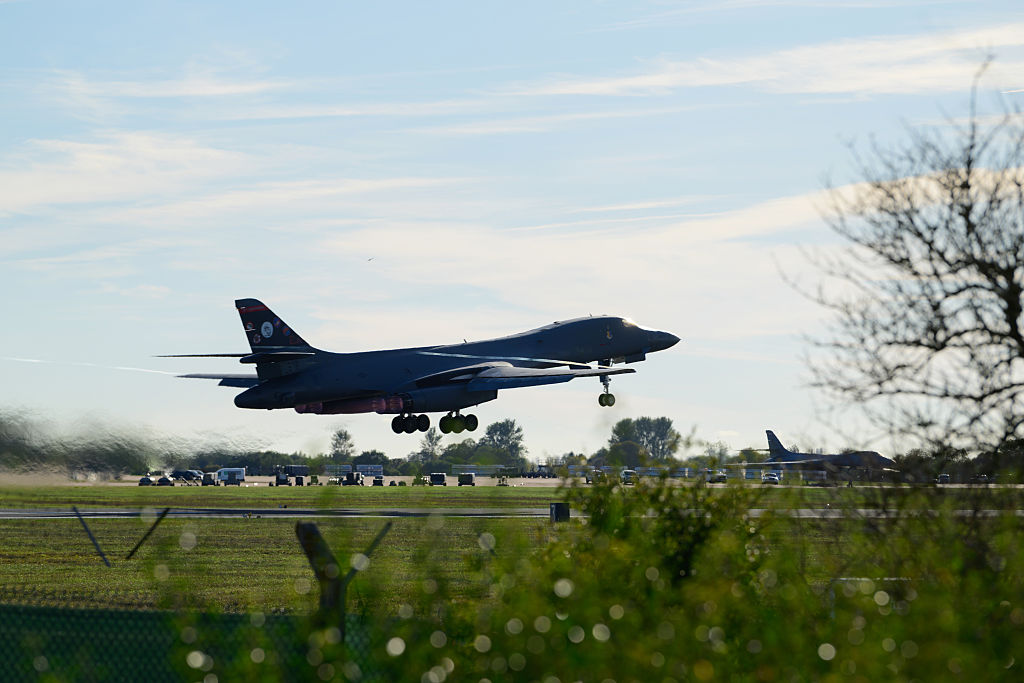
A recent investigation has revealed an alleged plot by Iran to attack the United States at the RAF Fairford airbase in the United Kingdom. This incident has raised significant concerns regarding Tehran’s utilization of overseas criminal proxies for orchestrating attacks, as uncovered by the latest details from ongoing legal proceedings in the United States and the UK.
According to reports, on the night of September 27, five men entered a white van and headed towards the RAF Fairford, a crucial facility for the United States Air Force in the UK, known for being home to B-1 strategic bombers capable of long-range strike missions.
In this intricate scheme, investigators disclosed that a sixth individual, located in Iran, was remotely directing the operation. As the men drove towards the airbase on winding rural roads, this mastermind communicated incessantly through encrypted messaging software, providing them with instructions. The van was equipped with a two-way dash cam, allowing the mastermind to monitor their route and conditions inside the vehicle in real-time, thus overseeing these amateur “new recruits” who were allegedly selected to execute this terror plot.
Security officials have identified the remote commander as 35-year-old Mohammed Ali al-Hassani, an Iraqi national who had lived in the UK for several years. A newly unsealed indictment from the U.S. Department of Justice links al-Hassani to coordinating nearly 20 knife attacks, arsons, and other terrorist plots that unfolded across Europe earlier this year. He is accused of working closely with an operative in Iraq with ties to the Iranian Revolutionary Guard Corps (IRGC), who is currently in U.S. custody.
The indictment and additional disclosures from British prosecutors suggest that the plan targeting the Fairford base aimed to expand the scope of the aforementioned retaliatory acts, in line with the IRGC’s threats made in July to consider any U.S. military base as a legitimate target for attacks.
Matthew Levitt, director of the Counterterrorism and Intelligence Program at the Washington Institute for Near East Policy, emphasized that the failed attack on the Fairford base illustrates a troubling escalation in Tehran’s clandestine operations utilizing expendable criminal proxies throughout Europe.
Levitt noted that the IRGC’s target range has expanded dramatically, now encompassing not only dissidents, Jewish communities, and other civilians but also heavily fortified military sites.
Officials and experts noted that the Fairford plot ultimately unraveled when the five suspects engaged in a process of “surrender” after being intercepted by military checkpoints and fled their vehicle, leading to their arrest. This incident highlights both Iran’s ambitions in planning high-risk operations and the limitations faced by criminal proxies tasked with executing such strategies.
The conspiracy against the Fairford base completely collapsed amid a series of errors and puzzling developments. Notably, the individuals involved in the attack appeared completely unprepared for the possibility of encountering military checkpoints as they approached the highly secure facility late at night.
Reports from British prosecutors indicate that the suspects were stopped by guards at a security line near the base and, upon being turned back, abandoned their vehicle and contacted the police. This occurred because mastermind al-Hassani had deceived them into believing that explosives were planted in their van.
Nouman Essghir, 25, the last of the suspects to be arrested before the police arrived, was texting al-Hassani frantically. Captured in Fairford and charged with violating British national security laws, he inquired in his messages: “What on earth is going on here?”
Despite the authorities discovering two barrels of gasoline inside the van, they found no explosives.
It remains unclear why the individuals involved decided to use only three out of the five vans they had originally purchased for the journey to Fairford on the night of September 26. Many of the suspected bomb components they had procured were left behind at their initial location and were not transported with them.
All five suspects arrested that night were subsequently granted bail.
Authorities from both the U.S. and the UK have conducted a thorough investigation into the Fairford incident, but there remains a lack of consensus regarding the conspiracy’s intentions and the actual threat posed to the base. The facility, which has a lengthy history dating back to World War II and the Normandy landings, is considered a critical asset.
In response to the incident, the Pentagon promptly withdrew all 12 B-1 bombers stationed at Fairford back to bases in the United States, highlighting the seriousness of the threat.
Moreover, U.S. officials have expressed concern over the potential for drone attacks involving explosives. On November 13, approximately six drones were spotted near RAF Lakenheath in Suffolk, prompting swift countermeasures from U.S. forces. This base is home to the U.S. Air Force’s 48th Fighter Wing.
In light of worries about potential drone attacks utilizing explosives, the Royal Air Force has ordered night-time storage of its aircraft in hangars for enhanced protection against drone threats.
However, British authorities currently perceive the RAF Fairford base and its fleet of U.S. bombers, valued at $300 million, as not facing any imminent danger.
Months have passed since the incident, and security officials continue to seek clarity on whether the suspects were fabricating a ruse, conducting a test run meant to incite panic with the gasoline, or were unknowingly involved in a more sinister plot orchestrated by al-Hassani.
U.S. officials have revealed that just two days before the white van’s departure, a senior IRGC operative, currently in U.S. custody, made covert phone contact with al-Hassani, inquiring about his situation and suggesting his relatives send money for him to accomplish his mission.
This operative, Mohammad Baqer Saad Dawood al-Saadi, is reported to have ties as a leader of an Iranian-backed militia.
The U.S. indictment indicates that al-Saadi maintained lasting connections with senior ranks of the IRGC and includes photographic evidence of him with Qasem Soleimani, the deceased commander of Iran’s elite Quds Force, who was killed in a U.S. drone strike in 2020.
In March and April following the U.S. invasion of Iraq, al-Saadi and al-Hassani allegedly conspired in Iraq to plan further terrorist attacks against Europe.
As a result, both men have been charged with conspiring to provide material support to foreign terrorist organizations.
Officials have confirmed that al-Hassani has been stripped of his British citizenship and is presently at large, believed to be hiding in Iran or Iraq. However, a higher-ranking official, al-Saadi, was apprehended earlier in Turkey and subsequently extradited to the United States.