
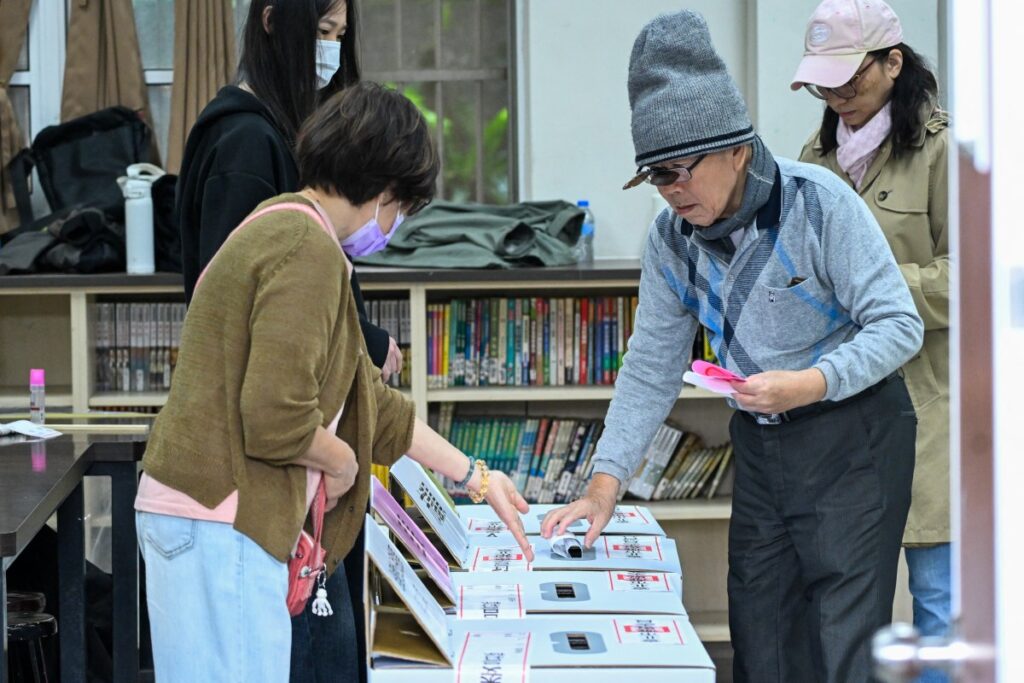
On the evening of November 28, Taiwan announced the results of its local elections, which included voting for leaders in nine major administrative regions. The ruling Democratic Progressive Party (DPP) secured victories in 10 counties and cities, doubling its tally compared to the previous elections in 2022. In response to the election results, the Taiwan Affairs Office of the Chinese Communist Party (CCP) reiterated its stance on unification with Taiwan, while Taiwan’s Mainland Affairs Council firmly countered Beijing’s claims, demanding respect for the democratic choices made by the people of Taiwan.
These local elections involved positions for leadership and public representation in 22 counties and cities across Taiwan. The DPP won 10 seats, while the Kuomintang (KMT) achieved 11 seats. One additional seat was claimed by either other political parties or independent candidates. A significant outcome of this election was the DPP’s reclaiming of Taichung, Taiwan’s second-largest city, marking a major achievement in the party’s electoral strategy.
In the Taipei City mayoral race, the incumbent KMT mayor, Chiang Wan-an, successfully defeated his DPP opponent, Shen Bo-yang, thus securing another term in office. Shen Bo-yang, a lawmaker from the DPP with a scholarly background, has previously focused on issues related to the CCP’s information warfare and has been one of the Taiwanese political figures sanctioned by Beijing.
In his concession speech, Shen remarked that the election results reflected the operation of Taiwan’s democratic system, asserting that regardless of who won, it was a victory for Taipei City and for democracy itself. Chiang expressed gratitude towards his opponent for participating in the election and emphasized that both candidates had contributed to a fair democratic process.
These elections were held against a backdrop of rising tensions across the Taiwan Strait. In the lead-up to voting day, Beijing has been consistently exerting military pressure on Taiwan and launching attacks against DPP candidates through state-run media, raising concerns about the CCP’s interference in Taiwan’s electoral processes.
Data released by Taiwan’s Ministry of National Defense on November 28 indicated that within the 24 hours leading up to 6 a.m. that morning, 33 Chinese military aircraft, along with 8 naval vessels and 4 government ships, were detected operating around Taiwan. Notably, 27 military aircraft crossed the median line of the Taiwan Strait, entering Taiwan’s air defense identification zone in northern, central, southwestern, and eastern regions.
On the eve of the elections, Reuters reported that Chinese state media launched another series of attacks against DPP’s Taipei City mayoral candidate Shen Bo-yang, accusing him of accepting funding from the United States and claiming that the U.S. was covertly intervening in Taiwan’s elections. Prior to this, Beijing had already sanctioned Shen and had pursued him on accusations of “splitting the country.”
Moreover, a report by The Washington Post on November 26 alerted that Taiwanese officials and researchers were closely monitoring online disinformation campaigns prior to the elections. They pointed out that numerous contentious materials and AI-generated videos were circulating online, portraying Taiwan as a corrupt and hopeless place while targeting politicians and the DPP with negative propaganda.
On November 29, the Taiwan Affairs Office of the State Council of China issued a statement regarding the election results, asserting that no matter how Taiwan votes or how its political landscape may change, it would not alter Beijing’s objective of promoting unification. Beijing vowed to continue its crackdown on what it labeled “independence” forces and to oppose foreign interference in Taiwan’s affairs.
In response, Taiwan’s Mainland Affairs Council urged Beijing to respect Taiwan’s democratic system and its people’s choices, calling for a pragmatic approach to the election results and encouraging dialogue with Taiwan’s democratically elected government.
The Council emphasized that Beijing should engage in communication and dialogue with Taiwan’s legitimate government based on principles of equality and respect, and without any political preconditions, thus addressing the cross-strait divergences pragmatically.
Beijing has long refused to engage in official dialogue with Taiwan’s government under President Lai Ching-te, labeling him as an “independence activist.” Lai has repeatedly stated that Taiwan’s future can only be determined by the people of Taiwan.
With the conclusion of the local elections, the focus in Taiwan’s political landscape is gradually shifting toward the presidential and legislative elections set to take place in early 2028. There is widespread expectation that the current president, Lai Ching-te, will seek re-election for a second term.
As for the KMT, the party has yet to confirm its presidential candidate. KMT Chairwoman Cheng Li-wen stated on the evening of November 28 that there remains much work to be done and that preparations must begin immediately for the 2028 elections. Earlier this year, she had met with CCP leader Xi Jinping in Beijing.
Chiang Wan-an, who successfully secured a second term as Taipei City mayor, is considered a potential presidential candidate for the KMT in the future. However, he has indicated that he will concentrate on Taipei City governance over the next four years and has not signaled any intention to run for president. He affirmed his commitment to supporting the KMT’s preparations for the 2028 elections.
On the other hand, although the DPP did not win the Taipei mayor’s race, Shen Bo-yang gained significant attention during the campaign, raising his political profile. He stated that he would return to his teaching duties and continue serving as a legislator in the meantime.