
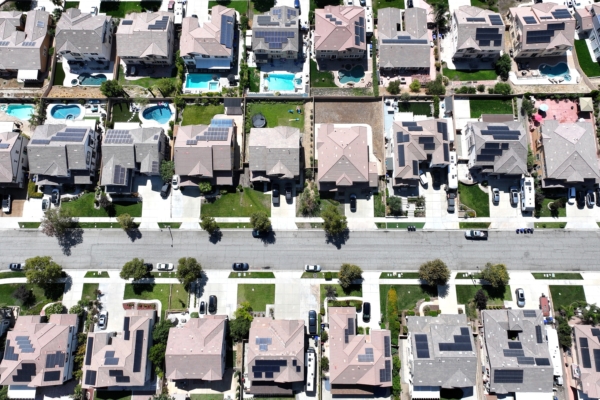
The United States is currently experiencing a notable slowdown in home sales, particularly evident in California, which reflects a broader trend across the nation during this season traditionally recognized as a low period for housing transactions. Recent reports from California indicate that the annualized sales volume of detached homes in October has plummeted to the lowest level in three years. Industry experts have identified high mortgage rates and insufficient buyer affordability as significant obstacles for potential homebuyers at this time.
According to data from the California Association of Realtors (C.A.R.), the seasonally adjusted annualized sales volume of existing single-family homes in California was recorded at 246,830 units for October, representing a 5.2% decrease from September’s 260,410 units, and a year-over-year decline of 12.7%. This marks the 49th consecutive month that home sales in the state have fallen below the 300,000 unit threshold, with current sales figures reflecting the lowest level in nearly three years. Notably, this October witnessed the largest year-over-year drop since September 2023.
In terms of pricing, six out of seven price ranges saw double-digit declines compared to the same month last year, especially pronounced for homes in the mid-range category. The price bracket of $750,000 to $999,999 experienced the most significant drop at 20.7%, followed by a decline of 19.7% for homes priced between $1 million and $1.99 million, and a 16.2% decrease for homes priced between $500,000 and $750,000. Conversely, the only segment to report an increase was homes priced at $2 million and above, which experienced a slight rise of 0.7% compared to the previous year.
Regionally, all five major areas in California reported a decrease in sales volume compared to the same time last year, with Southern California facing the most substantial drop at 18.9%. Following this were the Central Valley (-14.9%), Far North (-14.8%), San Francisco Bay Area (-12.1%), and the Central Coast (-4.6%). In a month-over-month comparison, the San Francisco Bay Area was the only region to see a sales increase of 1.9%. Among Southern California counties, San Diego County reported the most significant decrease at 22.2%, while Riverside County (-21.4%), Orange County (-20.7%), and Los Angeles County (-17.5%) also experienced notable declines.
The median price for existing single-family homes has dropped to $886,760, a decline of 1.4% from September, and nearly consistent with last year’s figure of $887,330 (approximately -0.1%), marking an end to a five-month streak of year-over-year price increases. The median price in Southern California stands at $870,000, down 0.6% from the same period last year.
Among the seven counties in Southern California, Orange County boasts the highest median price at $1.5 million, followed by San Diego County ($1.037 million), Los Angeles County ($955,000), Ventura County ($900,000), Riverside County ($610,000), San Bernardino County ($501,000), and Imperial County ($482,000).
As sales continue to slow, inventory levels are rising. Data from C.A.R. shows that the Unsold Inventory Index in California rose to 3.8 months in October, up from 3.7 in September and higher than the 3.2 months reported last year. This increase indicates that, given the current pace of sales, it will take longer to absorb the existing housing stock. Although the number of active listings seasonally decreased by 1.4% from September, it remains 6.6% higher than the same month last year.
Interestingly, despite the rising inventory, the speed at which homes are being sold has slightly accelerated. The median number of days for the sale of detached homes in California was 29 days in October, down from 32 days in the same month last year. Additionally, the sale price to list price ratio was 98.5%, which is a slight increase from 98.3% a year ago, showcasing some continued leverage in negotiation for buyers, while indicating a slight enhancement in overall buyer advantages. The statewide median price per square foot stands at $434, reflecting a marginal year-over-year increase of 0.7%.
In line with California’s trend, the National Association of Realtors (NAR) has also reported that sales of existing homes across the country have reached their lowest levels since 2010, with an annualized sales volume of 3.75 million units.
In a report released last month by C.A.R. predicting the California housing market for 2027, it is expected that sales of existing single-family homes will increase by 3.7% next year, reaching 277,900 units, above the anticipated 268,100 units for 2026. The median home price in California is projected to rise slightly by 1.4% to $894,400. The report suggests that an ongoing supply-demand imbalance will support price increases, albeit it may also constrain the overall growth rate of the market.
However, the broader economic landscape in the U.S., particularly concerning interest rates, appears unfavorable for the real estate market in the coming year. Recently, the average 30-year fixed mortgage rate recorded by Mortgage News Daily was 7.29%. Since mid-September, this rate has consistently exceeded 7.0% (with C.A.R. reporting an average of 7.33% for October), significantly impacting buyer affordability and causing many prospective buyers to delay their purchases. This has also led some sellers to postpone listing their properties to avoid the uncertainty of entering the market at higher rates.
Tom Hainlin, a national investment strategist with Bank of America Asset Management, remarked, “Many homeowners remain hesitant to relinquish their lower mortgage rates, which limits housing inventory in some segments and results in uneven adjustments to interest rates.”
According to data released on the 17th by the National Association of Home Builders (NAHB), builder confidence in the new single-family home market dropped four points to 25 in November, marking the lowest level since April 2012. Nonetheless, due to builders offering incentives, U.S. new home sales surged to their highest levels for the year in October.
Bill Owens, the chairman of NAHB, stated that the current economic conditions pose multiple challenges for builders: increased enforcement of immigration laws aggravating labor shortages and raising costs; rising fuel prices forcing subcontractors to significantly hike their charges; and a decrease in buyers leading many builders to scale back their operations.
Furthermore, NAHB’s chief economist, Robert Dietz, pointed out that the housing market faces a series of supply-side challenges, including tariffs driving up building material costs, a persistent shortage of construction workers, and the burden of excessive regulations increasing housing costs. Additionally, mortgage rates exceeding 7%, weak consumer confidence, and an uncertain economic outlook are all contributing factors hampering buyer activity.
Recent surveys from the NAHB Housing Market Index (HMI) revealed that in November, 46% of builders across the nation reduced their home prices, a record high since the pandemic began, and 68% of builders offered sales incentives.