
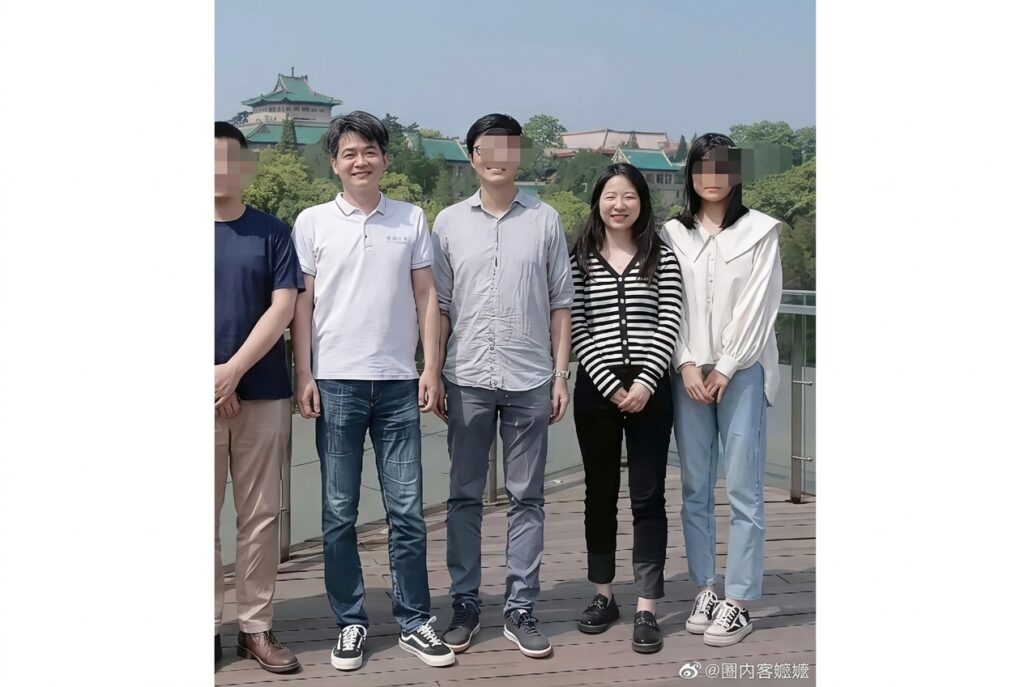
On November 26, Wuhan University released the results of an investigation into a female professor, following an 86-page formal complaint against her. The findings confirm that both the professor, identified as Zeng, and Fu, a former professor at Wuhan University and currently the Vice President of Anhui University, improperly used research funds. As a consequence, both individuals received a serious warning from the party and were dismissed from their respective positions. The university’s response has sparked public criticism, with some commentators arguing that the institution is downplaying the seriousness of the accusations. One blogger explicitly stated that the matter extends beyond personal ethics to touch on academic fairness and called for a thorough investigation by a third party.
The controversy first emerged on August 19, when Fu’s two daughters submitted a formal complaint to the discipline inspection commission at Wuhan University. They accused Professor Zeng of meddling in their parents’ marriage, along with allegations of academic fraud, misappropriating students’ research achievements, and misusing research funds.
This incident has drawn considerable attention, revealing a scandal involving both a female professor and a vice president, and consequently turning into a public topic of discussion. The allegations and the ensuing public uproar have highlighted potentially serious breaches within the academic community.
According to the university’s report, an investigative team was established on August 21, with the formal acceptance of the complaint occurring on August 25. Following the widespread circulation of the 86-page complaint online on September 3, the university publicly announced the initiation of an investigation.
The results of the investigation, announced on November 26, revealed that Professor Zeng withdrew some of the labor fees that were supposed to be allocated to students in research projects. Instead, she directed the funds to be managed by students for collective expenses within the research group, which included funding for team dinners.
Furthermore, similar issues were found in the research projects overseen by Fu. Both individuals were found guilty of misusing research funds and subsequently received a serious warning from the party; Professor Zeng was also removed from her position as the deputy director of the Institute of Physical Chemistry at Wuhan University, while Fu was dismissed from his roles as a member of the party committee and Vice President of Anhui University. The university did not disclose specific amounts of money involved or the number of students affected.
Regarding allegations in the complaint that suggested Professor Zeng received professional advancement through her relationship with Fu, Wuhan University stated that an internal review of the relevant employment and evaluation materials did not reveal any violations. The university also claimed that the assertions of academic misconduct were either inaccurate or unsupported by evidence.
Following the publication of the investigation results, netizens expressed skepticism regarding Professor Zeng’s professional background. A comment from a Weibo user highlighted the unusual speed of her career progression: “It took her only three years to rise from graduation to professor—a truly astonishing resume.”
Reports have indicated that numerous users are questioning the logic behind the accusations, suggesting that it is improbable that a daughter would file complaints regarding her own mother under such circumstances.
On the night of the announcement, Hu Xijin posted that the complaint materials “were fundamentally baseless,” asserting that aside from the two individuals’ misuse of research funds, the other allegations were largely unfounded, while urging that the complainants should face condemnation and punishment.
However, his statements stirred significant backlash in the comments section. Some users noted, “Clearly, they handled the matter with the lightest possible consequences; issues of educator ethics were not thoroughly investigated.” Others questioned the integrity of an internal investigation, asking, “Does Wuhan University really consider the ramifications of self-examination? Are they avoiding certain topics?”
Further skepticism arose regarding the father-daughter relationship, with one poster remarking, “Could normal familial ties really deteriorate to this level? I find it hard to believe the father is innocent.” Others demanded greater transparency, asking, “How can fairness be guaranteed when the investigation is conducted internally?”
Blogger “圈內容嬤嬤” raised three critical points of concern. Firstly, while the investigative team was established on August 21, the public announcement came only after the complaint gained traction online on September 3, raising questions about whether the timing of the disclosure was influenced by public pressure.
Secondly, the investigation should not focus solely on the female professor. Fu’s previous roles as a professor and head of the human resources department, along with his position as Zeng’s doctoral advisor, should also be scrutinized due to their significant relationship.
Lastly, the incident should not be simplified as a mere familial dispute or personal scandal. The blogger emphasized that if the teacher-student relationship pertained to degree conferral, research result ownership, or professional promotion, it extends beyond just personal matters, impacting academic integrity and student rights.
The Anhui University administration did not provide a direct response to media inquiries, leading to the belief that an in-depth examination necessitates cooperation between both Wuhan University and Anhui University, alongside intervention from educational authorities.