
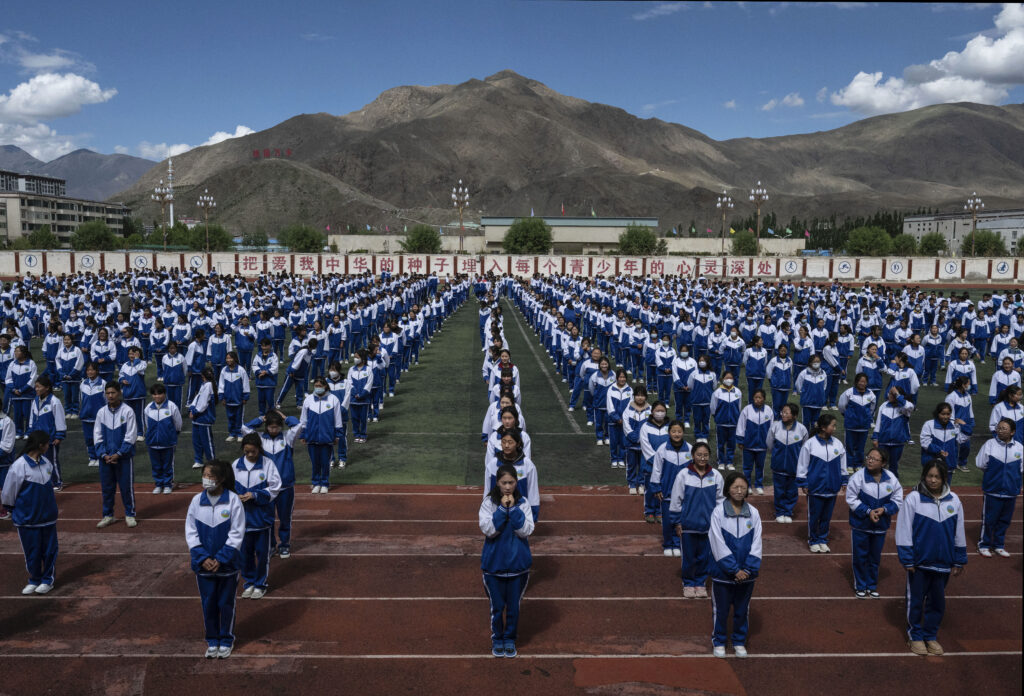
In Yibin City, Sichuan Province, a recent incident at a local school has sparked significant controversy online. The school has classified the use of the Sichuan dialect by students during break times as a disciplinary violation. This decision has led to students being required to write reflections and participate in moral education activities.
Reports from various mainland media sources indicate that the situation came to light when a student filed a complaint through the Sichuan People’s Voice platform. The student shared that at Tanghu School in the Cuiping District of Yibin, fellow students conversing in Sichuan dialect during breaks were photographed by a teacher as evidence of misconduct. Consequently, these students were mandated to write a 500-word self-reflection and attend a session labeled “Moral Education Classroom.”
In responding to the school’s disciplinary action, the student questioned the school’s abuse of its disciplinary authority, asking, “Is speaking in Sichuan dialect a violation of the law of nature for Sichuan people?”
The complaints regarding this policy sparked considerable attention on social media platforms, with numerous media outlets commenting on the school’s decision to categorize the use of dialects during breaks as a disciplinary issue. Critics argue that this confuses the management boundaries between classroom instruction and break times. Promoting the use of Mandarin does not equate to forbidding students from using their native dialects.
Economic Observer commented that students speaking Sichuan dialect during breaks should not be viewed as a violation of school rules. Advocacy for Mandarin does not imply the elimination of local dialects. Dialects represent the most natural means of expression among local people and form the roots of regional culture. Embracing Mandarin when appropriate, while allowing for the casual use of hometown dialects, contributes to a balanced educational approach.
The Beijing Evening News emphasized the connection between local language and local culture. Growing up in an area and communicating with one’s community in the local dialect is a completely natural phenomenon. Dialects are not only a cultural heritage accrued over generations but also encapsulate the spiritual traits of the local populace, serving as a crucial link for cultural transmission. The rising popularity of dialects and the introduction of various policies aimed at their protection reflect society’s heightened awareness of the importance of preserving this linguistic heritage. In this context, schools should refrain from penalizing students for using dialects during breaks and should instead focus on fostering an inclusive environment.
The commentary also critiques the school’s management approach. The act of photographing students who spoke a few lines of their dialect, labeling it as a disciplinary violation, and mandating them to write reflections and participate in moral education sessions could give the impression that the school associates dialect use with moral deficiencies.
Even in cases where students may behave inappropriately in their verbal exchanges, it is suggested that teachers should guide them in a way that is acceptable and understandable, rather than resorting to punitive measures. Treating uniformity as a standard for management and interpreting compliance as a behavioral virtue may not only fail to improve students’ proficiency in Mandarin but could also instill feelings of shame regarding their native dialects.
As such, the commentary underscores that promoting Mandarin and preserving dialects are not mutually exclusive endeavors. Schools ought not to view normal dialect communication as a disciplinary issue and should avoid rigid management tactics that restrict students from using their native language freely.
Comment sections on related Sohu reports have seen a flurry of dissenting voices. Some netizens expressed concern over the gradual extinction of dialects, with comments like, “Dialects are disappearing, and in fifty years, local dialects will surely become rare species.”
Others pointed out, “I don’t oppose Mandarin. However, the essence of regional dialects cannot be expressed in Mandarin.”
Some critics have called out the narrow-mindedness of the school’s management philosophy, stating, “Dialect is also a form of cultural expression; the school’s leadership has a too-limited cultural perspective.”
Many netizens expressed confusion over the school’s decisions, exclaiming, “It has been said before that bizarre occurrences in China’s education sector are endless.”
In light of the public uproar triggered by this incident, local education authorities have mandated the school to abolish the controversial policy and undertake corrective measures.