
**Urgent Warning from California Public Health Department: Increased Risk of Mushroom Poisoning Due to El Niño**
The California Department of Public Health (CDPH) has issued an urgent alert in response to the effects of the El Niño phenomenon, which has led to significant rainfall across the state. This meteorological event is conducive to the rapid growth of various types of toxic mushrooms, resulting in an increased risk of accidental poisoning. Officials are cautioning the public to refrain from foraging, as these toxic mushrooms can closely resemble edible varieties but contain lethal toxins.
On Wednesday, a health department official warned that following heavy rains, poisonous mushrooms such as the Death Cap (Amanita phalloides) and the Western Destroying Angel (Amanita ocreata) have proliferated. California had previously experienced numerous severe poisoning cases from toxic mushrooms last year, resulting in liver failure and, in some instances, death.
These two highly toxic mushrooms are notably deceptive, both in their appearance and taste, mirroring several edible mushroom types. Officials state that even seasoned mushroom foragers may struggle to differentiate between the toxic and edible varieties; relying merely on the color of mushrooms is insufficient for identification. Consuming even a small quantity can lead to severe illness, liver failure, and potentially fatal outcomes. Furthermore, timely medical intervention may still result in significant liver damage.
According to the CDPH, the Death Cap mushroom is commonly found throughout California, usually starting to grow after the first significant autumn rainfall and continuing into the spring months. The Western Destroying Angel typically appears from late winter into the spring.
These toxic mushrooms grow at ground level and are prevalent in the wild, particularly around oak and other broadleaf trees, as well as in pine forests. They can also be found in residential yards, community areas, and parks.
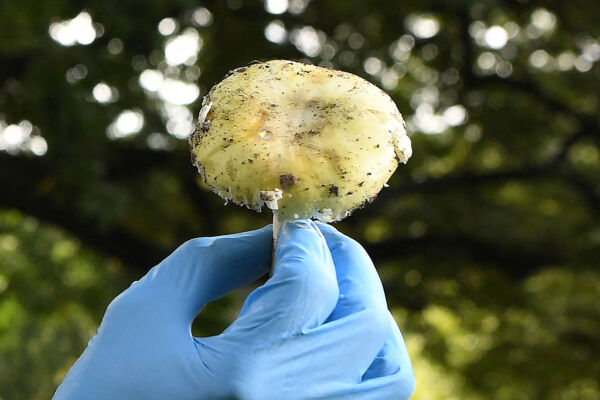
The Death Cap mushroom is a highly poisonous fungus belonging to the Amanita family, characterized by a pale yellow-green or olive-green cap, a white skirt-like membrane around the stalk, and a white cup-shaped bulb at the buried root. Many individuals mistakenly identify the Death Cap as the edible straw mushroom or white button mushroom.
The Western Destroying Angel contains potent amatoxins, which are extremely harmful. It is primarily white or off-white, with a sometimes light brown center on the cap. The gills are white, and the stem features a white skirt and cup-like base.
No cooking, drying, or freezing methods can eliminate the toxins found in these mushrooms to render them safe for consumption. Ingesting these mushrooms can cause immediate severe toxicity, leading to irreversible damage to the liver and kidneys, and in severe cases, necessitating a liver transplant or resulting in death.
Since last year, California has faced a serious toxic mushroom outbreak. Data from the health department indicates that from November 2025 to May of this year, 50 individuals were hospitalized after mistakenly foraging and consuming the Death Cap or Western Destroying Angel. Among these cases, four individuals required liver transplants, and unfortunately, four others lost their lives.
Health officials emphasize that the safest choice is to avoid foraging for and consuming wild mushrooms altogether, recommending that people purchase mushrooms directly from supermarkets or trusted vendors. If considering roadside vendors, it is crucial to exercise extreme caution. Additional recommendations from officials include:
– Refrain from consuming wild mushrooms foraged by friends or relatives.
– Closely supervise children when playing outdoors, especially in areas where mushrooms are present.
– Keep pets away from wild mushrooms.
– Do not rely on mushroom identification apps, social media, internet photos, or AI tools to determine the safety of mushrooms for consumption.
– If there is a suspicion of having ingested toxic mushrooms, seek medical attention immediately, as symptoms may complicate treatment.
For consultation, individuals are encouraged to contact the California Poison Control Center. Erica Pan, the CDPH director and state public health officer, stated, “This is the time to remain vigilant and we aim to assist Californians in ensuring their safety.”
This article serves as a general reference, with authoritative information coming from the California Department of Public Health and other official agencies.