
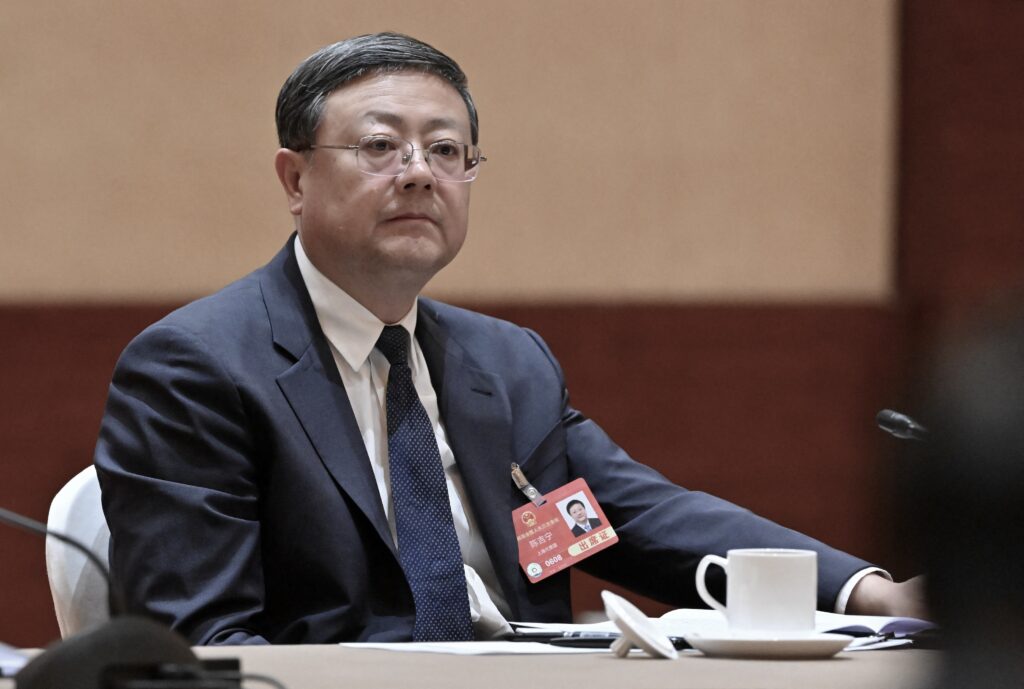
On November 24, Chen Jining, a member of the Political Bureau of the Communist Party of China and the Secretary of the Shanghai Municipal Committee, was dismissed, shocking both domestic and international observers.
Chen, who previously served as the President of Tsinghua University, saw the official Tsinghua website swiftly delete his information from the “Previous Leadership” section, effectively erasing any trace of his tenure. In the past two years, several senior officials affiliated with Tsinghua have faced similar misfortunes, leading analysts to declare that associations with Tsinghua have increasingly become a political taboo.
Public records indicate that Chen had a long connection with Tsinghua University, where he studied and worked for many years. He held the position of president from January 2012 to March 2015. Shortly after his dismissal, it was noted that the official university website no longer included any mention of him, while other recent presidents such as Gu Binglin, Qiu Yong, and Wang Xiqin were still listed. A search for “Chen Jining” on the Tsinghua website yielded no results whatsoever.
Li Linyi, a Chinese affairs expert, commented that Chen’s downfall sent shockwaves through Tsinghua University, prompting the institution to distance itself from him. The main reason behind this reaction seems to be the perception of “the Tsinghua clique” within the Xi Jinping faction, which has now become politically sensitive.
In an article published by Hong Kong’s Ming Pao, Liu Shi pointed out that in the last two years, a series of high-ranking officials dubbed as part of the “Tsinghua faction” have encountered difficulties, suggesting that their prominence has reached a significant decline.
The article noted that prominent figures such as former Premier Zhu Rongji, former President Hu Jintao, and former Politburo Standing Committee members including Wu Bangguo and Huang Ju all graduated from Tsinghua University but were never associated with a “Tsinghua clique” during their time. This situation changed when Chen Xi, known as the “father of Tsinghua,” took on influential roles after the 18th National Congress of the Communist Party, holding the position of Minister of the Organization Department for ten years. The decline of the Tsinghua faction might be connected to Xi Jinping’s repeated insistence on not allowing cliques to form.
Chen Xi, hailing from Fuzhou, dedicated 33 years to studying and working at Tsinghua, serving as the Deputy Secretary and Secretary of the Party Committee for 15 years. After he consolidated power over high-ranking official evaluations, two of his successors, Hu Heping and Chen Xu, were appointed to key positions. Hu Heping previously served as the Governor of Shaanxi Province, following which he held the role of Minister of Culture and Tourism. In 2023, he became the Executive Deputy Minister of the Propaganda Department, while Chen Xu is currently serving as the Deputy Minister of the United Front Work Department and the Director of the State Council’s Overseas Chinese Affairs Office.
Following the Party’s 20th National Congress in 2022, members of the Tsinghua faction, such as Shandong Provincial Party Secretary Li Ganjie and Beijing Mayor Chen Jining, entered the Political Bureau. They later took on positions as Minister of the Organization Department and Secretary of the Shanghai Municipal Committee, respectively. Chen Xi’s protégé, the 70s-born Shenzhen Mayor Qin Weizhong, also became a candidate member of the Central Committee.
However, the landscape shifted dramatically last year.
In April 2025, Li Ganjie was reassigned with the former Minister of the United Front Work Department, Shi Taifeng, amidst allegations of untrustworthiness. In September of the same year, Shen Ying, a candidate member of the Central Committee and Secretary of the All-China Federation of Industry and Commerce, was promoted to the Executive Deputy Minister of the United Front Work Department instead of the higher-ranked Central Committee member Chen Xu.
Wang Xiqin, who graduated from Tsinghua and worked there for a long time, only held the position of university president for a little over a year before resigning from his post on the National People’s Congress standing committee in October of last year, leaving his whereabouts uncertain.
At the end of May this year, Politburo Standing Committee member Cai Qi replaced Chen Xi as the head of the Central Party School. In July, 61-year-old Tsinghua PhD Ni Yuefeng stepped down as Secretary of the Hebei Provincial Committee to become the Deputy Chairman of the Social Construction Committee of the National People’s Congress. August saw the premature departure of Shenzhen Mayor Qin Weizhong, who was officially announced as dismissed in September. In October, another Central Committee candidate and Beijing’s Executive Deputy Mayor, Xia Linmao, also faced dismissal.
On the same day that Chen Jining’s dismissal was announced, former Central Committee candidate and Xi’an Municipal Committee Secretary Fang Hongwei was indicted for alleged bribery; Fang graduated from the automotive engineering department of Tsinghua University.
According to Li Linyi, Xi Jinping’s apprehension regarding “cliques” stems from worries about maintaining his own power. Ironically, the faction known as the “Xi family army” has itself become a clique. Previously, Xi sought to eliminate factions associated with Jiang Zemin and the Tuanpai, and now he appears to be targeting factions within his own ranks, suggesting that other groups, such as the Fujian and Zhejiang cliques, may also face further scrutiny in the future.