
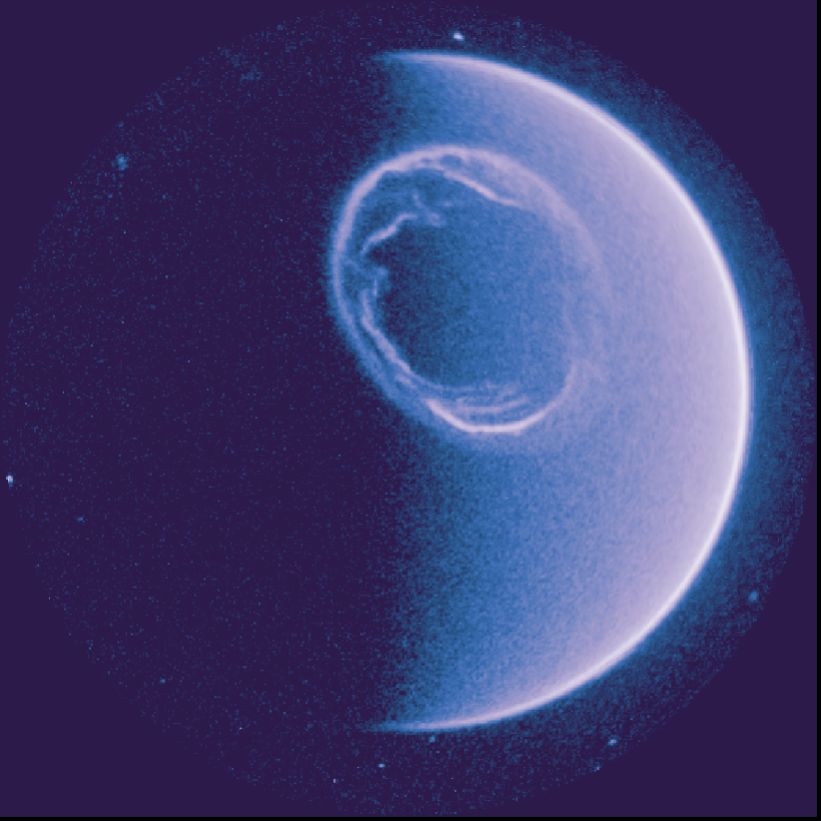
A remarkable new space mission has enabled scientists to observe the spectacular phenomenon of auroras in unprecedented detail, not just from Earth, but also from the vantage point of space. Though auroras are primarily visible during the dark hours of the night, they continue to occur even during the day. However, the faint light emitted during daytime is typically overshadowed by the intense sunlight and atmospheric scattering, making them nearly undetectable from the ground.
The mission, named the Solar Wind Magnetosphere Ionosphere Link Explorer (SMILE), aims to explore how Earth’s magnetic field interacts with solar wind—the stream of charged particles released continuously from the Sun. This spacecraft is equipped with four scientific instruments, one of which is the Ultraviolet Imager (UVI), responsible for capturing images of auroras in the ultraviolet wavelength.
Notably, SMILE is the first space camera since NASA’s Polar satellite was retired in 2008 that can photograph the entire auroral oval of the northern hemisphere using ultraviolet imaging. In this wavelength, the contrast between the auroras and the daytime background is markedly different, allowing for a comprehensive view of the auroras stretching across both day and night sides of the Earth.
In addition to this capability, traditional weather satellites operate at altitudes of only a few hundred kilometers above the Earth’s surface and can only capture localized segments of the auroras. Conversely, SMILE orbits at an altitude of approximately 120,000 kilometers (about 75,000 miles), enabling it to frame the entire auroral region over the polar areas, which encompasses about one-third of the visible disk of the Earth.
According to information released by the European Space Agency (ESA) on September 30, 2026, initial images were captured on July 24, during the mission’s in-orbit testing phase and merely two weeks after the Ultraviolet Imager was activated. The images reveal a complete auroral ring encircling the North Pole, simultaneously spanning the night and day hemispheres of the Earth, showcasing the dynamic changes in the auroral ring during magnetosphere disturbances and substorms. Another image taken on August 2 further illustrated the full auroral ring above the North Pole.
The phenomenon of auroral illumination is fundamentally driven by the energy from solar wind, which propels charged particles along Earth’s magnetic field lines into the upper atmosphere, primarily at ionospheric heights. These particles collide with atmospheric constituents such as oxygen atoms and nitrogen molecules, causing them to become excited. When these particles return to low-energy states, they emit photons, which manifest as visible light or ultraviolet radiation, thus forming the beautiful display of auroras.
The origins of this process begin much farther out in space, specifically in the region where solar wind interacts with the Earth’s magnetosphere—a vast area dominated by Earth’s magnetic field. The magnetic field deflects and blocks most of the solar wind, allowing energy and particles to enter the magnetosphere only in specific regions, such as polar cusps or through mechanisms like magnetic reconnection and magnetotail acceleration, directing energy toward high-latitude polar areas.
Thanks to SMILE’s ability to observe the entirety of the auroral oval in one go, scientists can now directly link variations in the energy accumulation and release within the magnetosphere to the brightness and shape changes of the auroral ring below. Moreover, the Ultraviolet Imager is capable of continuous observations lasting up to 45 hours, recording the complete evolution of the auroral oval in response to changing solar wind conditions, rather than capturing just a single moment in time.
In tandem with SMILE’s other instruments, these observations provide a fresh perspective that will help scientists clarify how solar wind energy and particles enter and affect Earth’s magnetic environment. Ultimately, this knowledge will contribute to our understanding of how dazzling auroras are lit up in the high polar skies.