
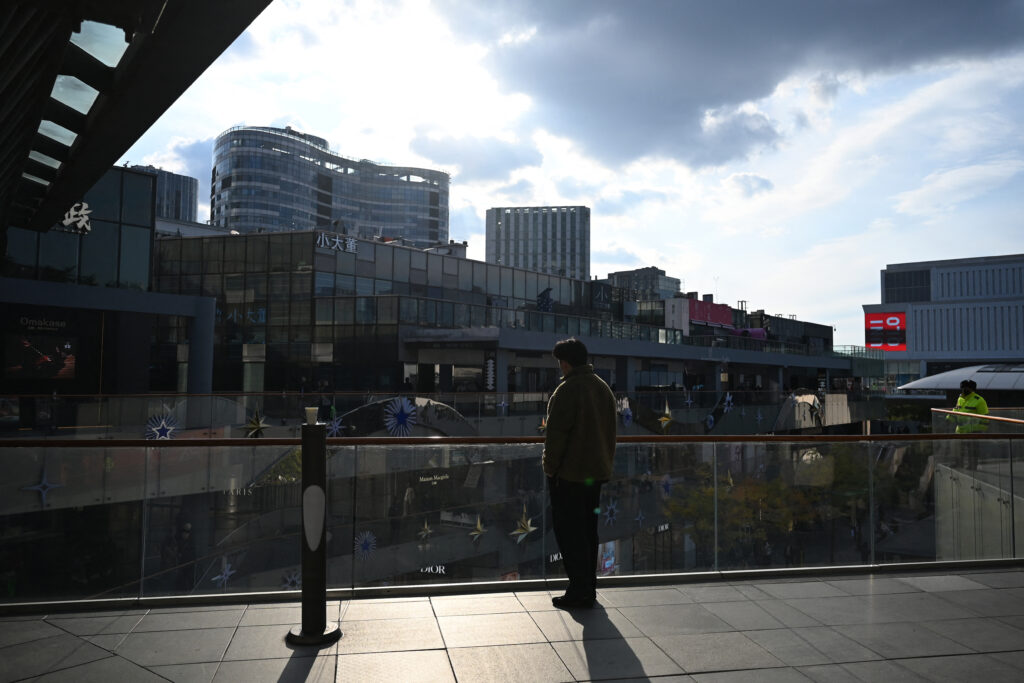
In a significant turn of events, the consumer markets in Beijing and Shanghai have experienced considerable contractions in October, with Beijing seeing a staggering decrease of 12.1% and Shanghai facing a reduction of 4.5%. These figures contrast sharply with the slight national increase of 0.4%, underscoring the fact that these two major cities, often regarded as bellwethers for China’s economic health, are currently “dragging down” the overall consumer market.
Experts argue that the downturn in these cities reflects a wider trend among the middle class, who appear to be tightening their purse strings and are increasingly skeptical of the Chinese government’s optimistic economic rhetoric.
Data recently released by both Beijing and Shanghai’s official statistics departments reveal alarming trends in social consumer goods retail figures. For October, Beijing registered a total year-on-year decrease of 12.1%, the largest decline since January 2025. In Shanghai, the year-on-year figures indicate a 4.5% reduction, marking a continuous decline for seven months since April. Cumulatively, from January to October this year, Beijing’s retail figures decreased by 2.1%, while Shanghai’s declined by 1.5%.
When comparing these figures to the national retail data released by China’s National Bureau of Statistics, which show a year-on-year increase of 0.4% in October and 1.0% from January to October, the performances of Beijing and Shanghai stand out starkly. These cities, known for having the highest income levels and the most concentrated economic activities in the nation, are paradoxically hindering the national consumer market’s growth.
A detailed analysis showcases the performance disparity between the consumer markets in Beijing, Shanghai, and the nation as a whole. While there remains a slight positive growth nationally, the rate has notably slowed. Shanghai, which had previously rebounded in 2025, has now returned to negative growth, and Beijing has faced consistent declines for several years. This situation suggests that both cities may be facing unique structural issues that could continue to hamper the national consumer market.
As for specific sectors of consumer goods, recent statistics indicate that residents in Beijing and Shanghai have lowered their expectations for high-level consumption and are becoming increasingly cautious about significant, non-essential purchases. Instead, there is a noticeable shift towards prioritizing everyday needs and fundamental living expenses.
The weak consumer activity in Beijing and Shanghai signals that the economic strain extends beyond just low-income demographics, affecting even the middle class, who are now adjusting their spending habits to a more frugal lifestyle, aimed at weathering what appears to be an economic winter.
Economic scholar David Huang noted that, as cities with the highest per capita incomes in China, Beijing and Shanghai were expected to display resilience in their consumer markets. However, the evident contraction seen in both cities indicates the emergence of defensive consumption patterns. Items such as staple foods and basic clothing are now experiencing the most growth, revealing that the middle class is indeed tightening their belts as a reaction to the economic climate.
With regard to the drops in retail sales for automobiles and appliances, Huang pointed out that these categories had previously relied heavily on government subsidy programs aimed at encouraging consumers to trade in old products for new ones. The current decline in these sectors signifies a substantial reduction in policy stimulus effectiveness, leading to an observable fall in market demand.
Huang further elaborated that with the inability of the populace to afford housing or upgrade vehicles, many are resorting to lower-priced consumer goods to meet their limited needs and emotional desires. He emphasized that the contraction in the consumer markets of Beijing and Shanghai is not merely a short-term fluctuation but reflects a persistent structural decline, which has been ongoing in Beijing since 2024 and has now been sustained in Shanghai for seven consecutive months.
Expressing surprise at Beijing’s steep decline of 12.1%, Professor Xie Tian from the University of South Carolina stated that this figure indicates a severe state within the Chinese economy. He described the situation as a full-blown economic retreat characterized by rising unemployment and diminished consumer confidence, predicting no improvement by the end of the year or in the first quarter of the following year.
This data from Beijing and Shanghai paints a bleak picture compared to national figures. Xie expressed that the Chinese Communist Party (CCP) is increasingly struggling to conceal the reality strapped in these statistics, stating that they represent the ongoing economic downturn facing the nation.
In response to the concerning data, state media have continued to propagate an optimistic narrative about China’s economy, claiming that it remains stable and retains momentum toward structural improvements. However, commentators like Xie have criticized these statements as mere attempts to “polish illusions,” labeling them as impractical and essentially delusional efforts to mislead both the public and the international community.
Huang argued that such rhetoric exemplifies the typical internal stability discourse employed by the CCP to downplay political responsibility while laying the groundwork for anticipated economic pressures.
Over the past month, the Chinese A-share market has seen a significant drop, resulting in a continually fluctuating and disappointing performance. Chinese state media attributed this downturn to “external forces,” accusing them of “singing bearish about the Chinese economy.” However, netizens refuted this claim, stating that the downturn was self-induced, reflecting the waning effectiveness of the CCP’s narrative.
On November 20, the three major indices of the Mainland stock market (Shanghai, Shenzhen, and ChiNext) all experienced declines, with the Shanghai index nearing the critical level of 3500 points, marking the lowest point since July 2025.
The following day, state-run media released an article titled “Those Singing Bearish on China’s Economy Will End Up Disappointed,” which criticized “foreign media and agencies” for frequently attacking the economy and propagating rumors about “deflationary traps” and “spillover from China’s economic crisis.”
In response, stock exchanges in Shanghai, Shenzhen, and Beijing implemented measures to stabilize the market, including reducing the financing margin ratio from 100% down to 80%, effective November 30.
Despite attempts to recover, the Shanghai index continued to decline, briefly falling below 3500 points before closing at 3538.95 points.
User-generated comments directed toward state media expressed a desire for rising stock prices to lead to the financial ruin of those creating bearish sentiments around the Chinese economy, reflecting frustrations towards the failures in the ongoing economic environment.
Reports from Reuters on November 22 highlighted that major indices in the A-share market continued to decline, with the Shanghai index falling nearly 3% in the previous week, reaching a 16-month low.
October proved to be particularly challenging for the Chinese A-share market, with the Shanghai index experiencing a drop of approximately 6.33% over the month, while the Shenzhen Component and the ChiNext indices fell by 15.94% and 23.02%, respectively. The month saw over 4500 stocks decline, with technology, telecommunications, and electronics sectors driving the market down.
Huang emphasized that the article published by state media on November 21 serves only to divert attention from pressing concerns, attempting to shift market anger and public discontent away from the CCP’s governance.
He further noted that there is a profound disconnection between the government’s portrayal of the economy and the actual sentiments of the populace, with online ridicule effectively puncturing the hollow narrative presented by the CCP.
The current economic conditions are marred not only by fundamental weaknesses but also by an emerging distrust crisis. Both the financial and consumer markets hinge on confidence, and as investors and consumers lose faith in official narratives, prospects for recovery remain bleak.
Xie sharply criticized the CCP’s outward blame, suggesting it reflects “extreme disappointment in a desperate situation” and is more a release of frustration than a constructive policy response, highlighting the regime’s ineffectiveness in addressing the deep-seated economic issues at hand. As the economy falters, we witness a government issuing only soft lamentations in reaction to an escalating crisis.