
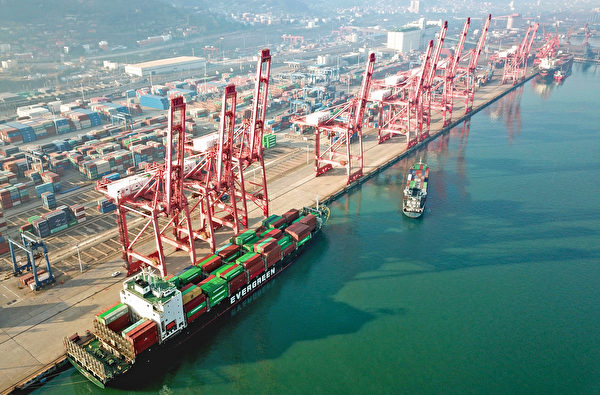
The Indonesian Navy has recently revealed a significant case of maritime smuggling involving a cargo ship that reportedly departed from Lianyungang, China, and was en route to Bangladesh. This vessel, identified as the “MV Star Line,” was intercepted while carrying a staggering 405 tons of sodium perchlorate, a chemical that can be utilized in the production of missile propellants, as well as millions of blank SIM cards. Authorities are currently investigating both the intended use of this cargo and the identity of its expected recipients.
According to data from Bangladesh’s National Board of Revenue (NBR) reported by The Daily Star, the amount of sodium perchlorate seized is equivalent to approximately 591 times the total quantity imported by Bangladesh in the past 17 years.
The Indian news outlet, India Today, cited a commander of the Indonesian Navy who estimated that the materials aboard the ship could potentially be sufficient to manufacture around 100 missiles.
However, the Bangladeshi customs authorities have stated that they did not receive any import declaration documents for the cargo ship and cannot verify the identity of its local shipping agent. To date, Indonesian officials have yet to disclose the identities of the cargo owner, the shipping company, or the intended recipient.
Sodium perchlorate is known as a strong oxidizer and has various industrial, pharmaceutical, and military applications. While it is not an explosive or fuel in itself, it has the capability to support combustion and can be used in producing rocket and missile propellants.
Data from the National Board of Revenue obtained by The Daily Star indicates that from January 2010 to November 22, 2026, Bangladesh imported only 685 kilograms of sodium perchlorate over 50 separate shipments, involving 20 different importers. Among these shipments, 30 did not exceed 2 kilograms in weight, with the largest single shipment being only 99 kilograms. The majority of these importers are pharmaceutical companies.
Md Safiqul Islam, a professor in the Chemistry Department at Dhaka University, mentioned to The Daily Star, “Some pharmaceutical research and other industries in Bangladesh do use this chemical, but in very small quantities. The annual demand is unlikely to exceed 30 to 40 kilograms.”
Despite having a domestic military industry capable of producing ammunition and light weapons, Bangladesh reportedly lacks the infrastructure necessary to manufacture rockets and missiles that would utilize sodium perchlorate.
MarineTraffic, an international vessel tracking platform, reported that the “MV Star Line” departed from Lianyungang, China, on September 12. Another vessel tracking service, VesselFinder, identified Mongla Port, Bangladesh’s second-largest seaport, as its destination, with an estimated arrival time of November 8.
However, two press releases issued by the Indonesian Navy on November 20 did not mention the ship’s departure or destination.
MD Gias Kamal, the head of customs at Mongla Custom House, told The Daily Star, “We have no record of this ship, and no one has submitted an Import General Manifest (IGM) to the National Board of Revenue’s system. We cannot confirm the identity of its local shipping agent.”
Customs records indicate that neither Mongla Port nor Chittagong Port received the Import General Manifest for this vessel. According to the customs declaration regulations issued by the Bangladeshi government in 2025, cargo ships are required to submit preliminary cargo declaration data to customs before leaving the last foreign port, with specific exceptions.
Khairul Alam Suzan, former vice-chairman of the Bangladesh Freight Forwarders Association, highlighted that the information provided on vessel tracking sites is often sourced from shipowners or operational companies and may lack sufficient evidence for verification. However, he also pointed out that the absence of customs declaration records does not inherently prove that the ship was not originally destined for Bangladesh.
The Indonesian Navy noted that on November 7, military personnel observed the “MV Star Line” displaying the flag of Comoros in the waters near Belawan, North Sumatra, exhibiting suspicious behavior and failing to respond to radio communications. Consequently, the navy intercepted and detained the vessel.
As reported by The Jakarta Post, Rear Admiral Deny Septiana, commander of the First Naval District Command, alleged during a press conference that the ship had attempted to evade naval tracking by posing as a fuel stop at Belawan Port.
Upon inspection, the authorities discovered that out of 36 containers aboard, 15 contained sodium perchlorate, in addition to millions of blank 4G LTE SIM cards packed on 54 cargo pallets.
The Indonesian Navy is currently conducting an investigation in collaboration with customs, police, immigration authorities, and prosecutorial agencies, focusing on navigation safety, chemical security, and the legality of customs and trade activities.
Septiana stated, “We are still investigating this hazardous chemical.” He further mentioned, “We have yet to determine who is responsible, so we must collaborate with relevant agencies.”
According to The Daily Star, Indonesian officials found that the registration status of the vessel had been suspended and that its shipping documents appear to be forged.
The report also remarked that the journey from Lianyungang, China, to Belawan, Indonesia, typically takes about 17 days. However, vessel tracking data indicate that this cargo ship took nearly two months to reach its destination in Belawan, raising further questions about its activities and intentions.