
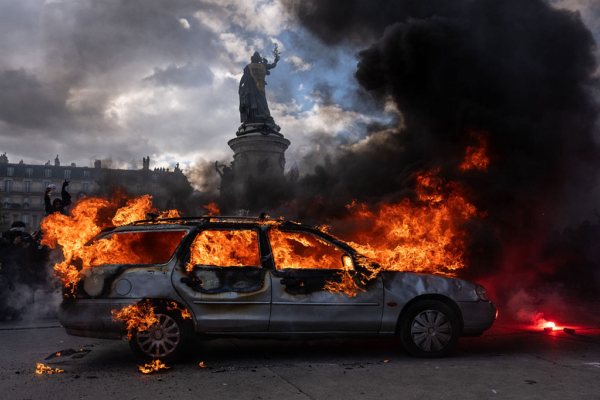
On November 20, the United States embassies in France and Belgium issued a new travel advisory to U.S. citizens, highlighting the potential for demonstrations in both countries over the next few days. The advisory urged American travelers to exercise caution and avoid areas where protests are expected to take place.
In France, various groups have planned nationwide demonstrations on November 21 and 22. The U.S. Embassy in France, through a statement on its official website, noted that previous protests had witnessed instances of violence, theft, and damage to property. Additionally, the police had utilized non-lethal crowd control measures during these events.
The embassy also pointed out that recent demonstrations have largely been peaceful, but travelers should remain vigilant.
According to the travel advisory, subway stations in areas where protests occur may close unexpectedly, resulting in delays in service. Roadblocks may be erected, causing travel disruptions, and protests could occur beyond planned routes.
In recent weeks, France has experienced a series of nationwide protests. A significant strike on November 5 saw students, retirees, and leftist unions join forces to demand higher wages and pensions, resulting in hundreds of thousands of individuals taking to the streets. The French government reported that hundreds were arrested that day, and many police officers sustained injuries.
Participation in protests on November 17 was lower, with the French Ministry of the Interior estimating about 146,000 demonstrators nationwide. On November 21, expected attendance significantly decreased, with statistics indicating roughly 82,500 participants.
Unions and activists in France have called for more protests to occur in the forthcoming weeks. The U.S. Embassy’s advisory advised American citizens in France to exercise caution if they find themselves near large gatherings unexpectedly.
The U.S. consulates also recommended that individuals consult local services for updates on train and subway disruptions and plan alternate routes ahead of time while allowing for extra travel time.
The embassy also noted the importance of staying informed through media and local information sources to understand the evolving situation.
In a separate alert regarding Belgium, American citizens were cautioned about a public transportation strike and union demonstrations scheduled for Monday, November 23. The U.S. Embassy in Belgium stated that union protests and demonstrations are expected to begin at 10 a.m., launching from near Brussels North Station, passing through key areas en route to Brussels South Station, including in front of the U.S. Embassy.
The embassy anticipates that law enforcement will be deployed throughout the events to monitor developments, manage crowd movements, and maintain public order.
Significant disruptions to traffic and travel are expected throughout the day on Monday, particularly along and around the protest routes. Road closures and traffic restrictions may take place, and several subway stations in affected areas might be closed, with public transport services likely experiencing interruptions.
The public transportation operator in Brussels, STIB/MIVB, has already issued warnings indicating that this nationwide strike will affect its metro, tram, and bus services.
Due to the strike, the U.S. consulate is not expected to provide regular services in the afternoon on Monday. These regular services include passports, consular reports of birth abroad, and access to federal benefits like Social Security.
The embassy advised individuals to remain aware of their surroundings, keep mobile phones handy, and store local emergency phone numbers in advance. Following the authorities’ instructions and road signs regarding detours and closures is also recommended.
The European Economic and Social Committee (EESC), a key advisory body to the European Union, included a statement on October 28 asserting that Belgian unions FGTB-ABVV, CSC-ACV, and SYNOVA would be participating in the protests, expressing solidarity with these organizations.
In earlier travel warnings issued by the U.S. State Department, both France and Belgium were designated as “Level 2 – Exercise Increased Caution.” The State Department categorizes travel advisories into four levels: Level 1 advises exercising normal precautions, Level 2 urges exercising increased caution, Level 3 suggests reconsidering travel, and Level 4 strongly advises against travel.
A travel advisory update on Belgium from July 23 pointed out that peaceful demonstrations related to the political situation in the country might disrupt transportation and other essential services. Meanwhile, an advisory update regarding France on October 21 warned that protest activities could interfere with transportation services, and the police might respond to demonstrations using force, including tear gas and water cannons.