
At the beginning of Harper Lee’s novel “To Kill a Mockingbird,” the lawyer Atticus Finch offers his first-grade daughter, Scout, this piece of advice: “You never really understand a person until you consider things from his point of view… until you climb into his skin and walk around in it.”
Atticus aims to encourage Scout to look at the world from her teacher’s perspective, a new addition to her school. This wise approach to understanding others also applies when analyzing historical figures. When we take the time to imagine George Washington making the critical decision to attack the British at Trenton or picture Dwight Eisenhower’s thoughts on the eve of the Normandy landings, we can gain a deeper insight into their actions and decisions.
To practice this idea, let us consider Dr. Frances Kelsey as a case study.
In 1960, this knowledgeable and experienced pharmacologist and physician began her role at the U.S. Food and Drug Administration (FDA), tasked with reviewing applications for new drugs. In her very first month, Dr. Kelsey received a submission from a major pharmaceutical company seeking approval for a drug intended to both sedate and alleviate morning sickness in pregnant women. Upon reviewing the application, the newly appointed FDA staffer rejected it due to insufficient data and testing.
Over the following year and a half, the pharmaceutical company repeatedly pressured her for approval, eager to reap substantial profits from the drug.
So, if you were in Kelsey’s position, what would you do? Would you compromise, or would you hold firm to your principles?
Frances Oldham Kelsey, who lived from 1914 to 2015, was born in Cobble Hill, British Columbia, Canada. During her teenage years, she met a visiting biology teacher, which inspired her lifelong commitment to the scientific field. After graduating from high school at the age of 15, she initially attended Victoria College and later transferred to McGill University, where she earned a degree in biochemistry in 1934. During her time at university, she took a course that she would later refer to as a “special little class called pharmacology.”
Given the employment difficulties during the Great Depression, she chose to spend an additional year at McGill to earn a master’s degree before transitioning to a more favorable job market.
Kelsey’s career took a significant turn when a professor at McGill encouraged her to pursue a Ph.D. in pharmacology at the University of Chicago, a program founded by the distinguished physician and pharmacologist Eugene Geiling. When Geiling responded to Kelsey’s application, he mistakenly referred to her as “Mr. Oldham,” perhaps assuming her first name, Frances, was a male name.
She hesitated to clarify her identity, but she recalled that her pharmacology professor advised, “Don’t be silly. Accept the position, sign your name, and include ‘Miss’ in parentheses behind it. Then go for it!” Following this advice, Kelsey took that leap of faith, wondering if she would have had the same courage if her name had been something like Elizabeth or Mary Jane.
Under Geiling’s mentorship, Kelsey earned her Ph.D. in pharmacology. During and after her studies, she collaborated closely with Geiling on a case involving sulfanilamide, a drug effectively used to treat pneumonia and streptococcal infections. A manufacturer had added diethylene glycol, an antifreeze component, to create a liquid formulation for children, leading to tragic fatalities once the drug hit the market. Kelsey and Geiling worked diligently to unravel the mystery behind these deaths, an experience that would significantly inform Kelsey’s future career.
She remained at the university, conducting malaria research during World War II. In 1943, she married fellow faculty member Dr. Fred Kelsey. Due to the university’s policy against hiring couples, she juggled raising two daughters while pursuing and eventually earning a medical degree. By the 1950s, the Kelsey family moved to South Dakota, where her husband served as a pharmacology department chair, while she continued her research at the university and a pharmaceutical company.
In 1960, the Kelsey family relocated once again, this time to Washington, D.C. There, Fred Kelsey took a position at the National Institutes of Health, while Frances joined the FDA as a reviewer of new drug applications in September. One of the earliest submissions to land on her desk came from the William S. Merrell Company (also known as Richardson-Merrell). They sought to market thalidomide, a drug utilized for sedation and relief from morning sickness in pregnant women. This medication, developed in Germany, had already seen success and high sales in Europe, Canada, and elsewhere.
Approval from the FDA would yield significant financial returns for Merrell. However, Kelsey and her team faced tremendous pressure not only from the company but also from time constraints demanding a swift decision on thalidomide. The agency had a mere 60 days to approve or reject new drug applications; otherwise, the drug would automatically be deemed safe for sale.
Kelsey meticulously examined the reports submitted by Merrell and found insufficient evidence, partly because the reports contained anecdotal evidence extolling the drug’s virtues and claimed there were no adverse reactions or risks associated with it. Kelsey stated later, “The report was overly optimistic; it could not be a perfectly safe drug.”
As she looked deeper into the matter, Kelsey began to suspect that the drug might pose a risk not only to adults but also to fetuses. Thus began an intense standoff between Merrell and Kelsey, which lasted 18 months. Journalist Stephen Phillips noted that:
“Merrell executives, including F. Joseph Murray, pressured Kelsey through phone calls, letters, and in-person meetings. Based on thalidomide’s sales in other regions, the company assumed it was simply a matter of going through the motions to secure approval to market it in the U.S. under the brand name Kevadon. However, Kelsey insisted on solid evidence to prove the drug’s safety and refused to yield to the pressure.”
Murray even went so far as to contact Kelsey’s supervisor, Dr. Ralph Smith, complaining and inquiring if the decision to deny approval could be reconsidered. Fortunately, Smith supported his colleague and informed Murray that Kelsey had the agency’s backing.
In the fall of 1961, European media began reporting cases of congenital defects, many involving newborns missing limbs or suffering from deformities.
Thalidomide was subsequently confirmed to be associated with thousands of such defects and caused an unknown number of fetal deaths. Phillips wrote:
“Kelsey had cited her regulatory authority granted by the 1938 legislation four times to reject Merrell’s application based on insufficient data. Now, following Merrell’s fifth attempt to gain approval, the company notified Kelsey that they would withdraw their application.”
This lengthy debate, extending over 18 months, finally reached its conclusion.
Kelsey adhered to the principles of science. She demanded concrete data instead of relying on the exaggerated claims of the manufacturer’s reports, which her husband described as “a jumble of pseudoscientific jargon designed to impress the chemically illiterate reader but ultimately meaningless.”
Many Americans today remain unaware of the disaster they narrowly avoided 60 years ago. If Frances Kelsey had approved thalidomide as a novice FDA reviewer or had succumbed to the immense pressure from the manufacturer, countless American infants would have suffered from congenital defects. In fact, Merrell had lawfully provided thalidomide, branded as Kevadon, to roughly 1,200 physicians for clinical trials, resulting in at least ten cases of congenital defects.
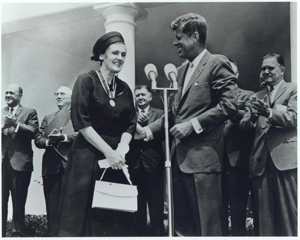
In August 1962, President John F. Kennedy awarded Kelsey the President’s Award for Distinguished Federal Civilian Service.
Kelsey’s steadfastness prompted significant reforms at the FDA, leading to stricter guidelines. For some time, she served as head of the newly established Division of Scientific Investigation, whose employees referred to themselves as “Kelsey’s police.”
This young woman, who once took that “special little course called pharmacology,” continued her work at the FDA until the age of ninety. She passed away at her daughter’s home in London, Ontario, at the age of 101, and is now interred in a cemetery in Pennsylvania alongside her husband.