
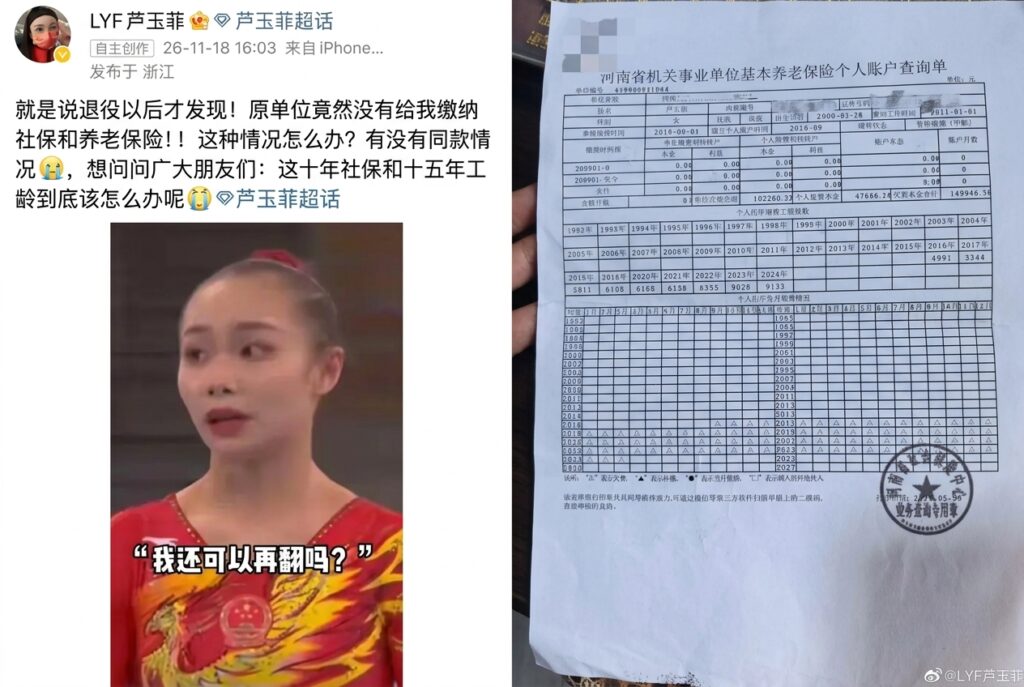
On November 21, 2026, a prominent former Chinese gymnast, Lu Yufei, whose career highlights include representing the national team in international competitions, found herself embroiled in a significant controversy regarding her social security payments. It was revealed that her former employer had neglected to contribute to her social insurance for a staggering 91 months, accumulating debts nearing 150,000 yuan. The quick public disclosure of this issue prompted a swift reaction from the relevant authorities and her previous organization, which managed to rectify the situation within just seven hours of exposure. This prompt action, however, ignited a wave of public skepticism. Many are now questioning why it took such high-profile attention to address her overdue payments, raising concerns about how everyday employees, without public visibility, can secure their rights.
On November 18, Lu Yufei, now 26, took to social media to seek help after discovering that her original employer had not been paying her pension insurance since she retired. A document she shared, detailing her personal account of social insurance in Henan Province, revealed that she had been delinquent in payments since September 2016 up until March 2024. The total outstanding amount included over 102,000 yuan owed by her former employer and nearly 48,000 yuan that she herself owed, bringing the total deficit to approximately 149,946.56 yuan.
Lu’s journey in gymnastics began when she was selected for the national team in 2014, and she even accomplished a commendable fourth-place finish on the balance beam at the Tokyo 2021 Olympics. Despite her illustrious career, Lu discovered that her pension insurance had lapsed for nearly five years. According to her, payroll records showed that contributions for social insurance had been deducted, and both medical insurance and housing funds were regularly accessible for verification, leading her to believe her pension payments were also being managed accurately.
Once the issue became public, relevant departments and her former organization acted quickly. On the morning of November 19, Lu updated her followers, stating that discussions were ongoing the night before, and all outstanding payments had been secured. Remarkably, the timeline from her initial plea for assistance to the resolution of the issue was summarized by media outlets and netizens to have taken about seven hours.
A local media outlet, Shanxi TV, raised pointed questions regarding the situation. They noted that while Lu Yufei enjoyed significant public attention from her championship and Olympic appearances, she was able to receive prompt resolutions for her issues. This starkly contrasts with lesser-known athletes based in provincial teams who may face similar problems with social insurance but lack the visibility to advocate for themselves effectively. If these ordinary athletes encounter similar lapses in their social security contributions, where can they turn for help?
Critiques indicate that compliance with social security obligations should not hinge on whether a case garners widespread attention. If oversight is reliant solely on users and social media identifying issues, it raises questions about the overall health of routine account monitoring practices.
A social media influencer posed a provocative question regarding the accountability of Lu Yufei’s former employer: records revealed that her former organization had deducted the required social security contributions from her earnings, but where had that money gone? Who bears the responsibility for this discrepancy? The influencer pointedly remarked on the unsettling reality that many individuals, like Lu, may have their incomes regularly deducted for social security contributions under the assumption that they were being paid, only to discover significant delinquencies upon checking their accounts. If a person were to only uncover such a lapse upon retirement, the challengers—such as changes in personnel and the loss of original documentation—could complicate the task of seeking redress significantly.
In discussions surrounding this incident, netizens shared their own experiences of social security neglect. One individual recounted how their former employer failed to make payments for three years, resulting in a lawsuit that was ultimately dismissed due to the expiration of the statute of limitations. Another individual mentioned discovering a gap in their social insurance coverage during their time in the military and after, receiving an apathetic response from the social security center about the status of their payments. They ultimately resorted to lodging complaints to the local government hotline to rectify the issue, which consumed significant effort.
In an interview with China Blue News, an attorney from the Beijing Hengdu (Hangzhou) Law Firm stated that employees experiencing similar issues should formally complain to social security agencies and demand rectification.
While Lu Yufei’s overdue social security payments have now been confirmed as resolved, the broader societal discussion has shifted to the regulatory framework regarding social insurance. Questions linger whether other athletes who have not received media attention and ordinary workers face similar dues. How effectively are relevant departments monitoring these contributions, and what measures are in place to protect individuals from enduring the same grievances?