
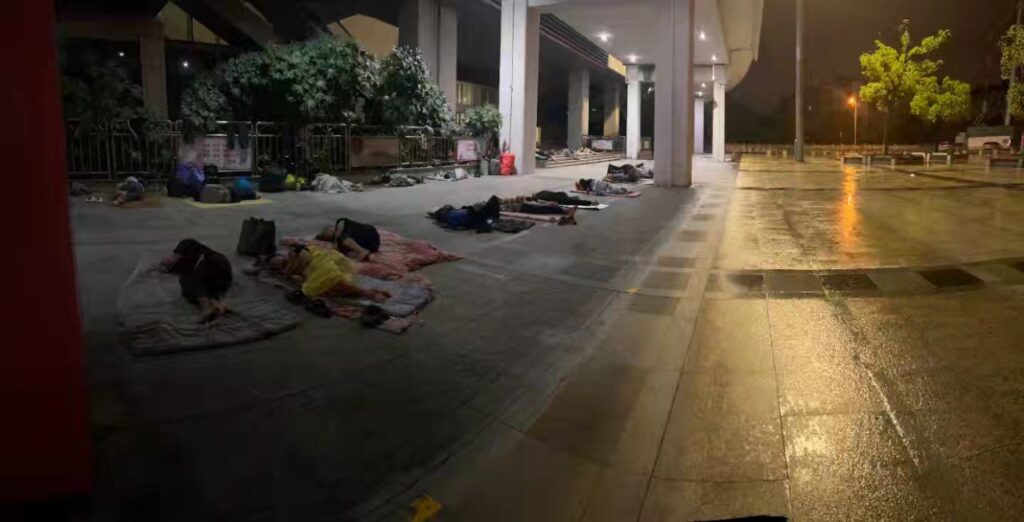
In recent years, the Chinese Communist Party has been aggressively organizing grand international conferences to project an image of prosperity and stability to the outside world. However, beneath this polished veneer lies a stark reality: increasing numbers of homeless individuals struggling to survive in the streets, exacerbated by widespread unemployment. Many locals, having lost their jobs, are finding refuge in underpasses and bridges, leading to heartbreaking stories of despair that echo throughout the nation.
In the bustling city of Hangzhou, a young job seeker named Xu Guang (a pseudonym) shared his grim experience with reporters. He revealed that he had gone nearly two days without food and was on the verge of giving up. Lacking even a proper coat to shield himself from the cold, his clothes were damp and moldy, forcing him to discard them. Covered only by a long-sleeve shirt, Xu lamented, “I’m shivering from the cold and I’m running a fever. It’s tough to find a job, especially with the New Year approaching—many stores aren’t hiring.”
Similarly, a 23-year-old man referred to as Xiao Min, who has been homeless on the streets of Wuhu in Anhui Province, expressed his desperation. After completing middle school, he entered the workforce but now finds himself struggling to secure a job as many places have halted their hiring process before the holidays. With no money for food and no place to stay, Xiao Min commented, “It’s getting colder every day, and I dread having to go back home. I wouldn’t be welcomed there since I haven’t earned much.”
Despite his desire to return home, financial constraints have made that option unfeasible for Xiao Min. “I need at least 50 yuan to go back.” He recounted how he endured the freezing temperatures of four degrees Celsius by seeking refuge in an internet café for two days, only to be kicked out for lack of purchases, with all of his belongings discarded after he left.
Xiao Min also noticed a significant number of homeless individuals near the train station but avoided that area due to frequent police checks. After his failed job hunt in Suzhou, he returned to Wuhu, only to end up sleeping in a park due to his lack of funds. While he considered seeking work in southern cities like Guangzhou, he found that his financial situation rendered such dreams impossible. “I’ve lost a lot of strength due to hunger,” he said, acknowledging the hardships of his present situation.
In recent years, videos have surfaced showing people scavenging for food and items on the streets to survive, and Xiao Min noted that such activities hardly suffice for a living. “Just look at how much you can earn from a bag full of trash,” he remarked.
Another individual, Yang Hua (a pseudonym), a 50-year-old nurse from Hebei, described her struggle to find employment in Beijing. After managing to secure a temporary job caring for a patient with a sprained ankle, she was uncertain about what to do afterward. “It’s hard to find work nowadays; I’ve been here for two weeks and after this job, I have no idea where I’ll go,” she confessed.
With little savings and unable to find affordable housing, Yang spent days homeless, narrowly escaping starvation and extreme cold until finally landing a live-in caregiver position.
In Wuhan, a young man named Xiao Jin (a pseudonym) shared that despite having searched for nearly a month in Shenzhen, he had yet to find a job. “It’s really hard to get employed now unless you have a very high education; even bachelor’s degrees are being disregarded by many companies,” he stated. The streets of Shenzhen are filled with those without homes. “Many are sleeping at places like Shenzhen North Station and Bao’an Airport; I’ve been spending the nights at the airport myself,” Xiao Jin added.
Having studied animation, Xiao Jin did not want to return to his hometown due to the more challenging job prospects. “I can’t return home; both my grandparents have passed, my parents are divorced and living separately, and I’m left all alone,” he concluded.
In Huizhou, a 27-year-old man named Dong Sheng (a pseudonym) revealed that he suffers from a lung condition requiring medication costing hundreds of yuan per visit. He has spent upwards of 30,000 yuan on treatment but has now run out of money, leading him to live under a bridge for nearly two months. “Living under the bridge saves me money,” he mentioned, citing the lack of affordable housing options.
Dong Sheng’s health issues arose last year while working at an electronics factory, where he was laid off due to safety concerns. “No one wants to hire someone with a health problem like mine,” he explained, referring to his pneumothorax condition.
Originally from Heyuan in Guangdong Province, Dong Sheng expressed feelings of isolation after losing his parents and lacking any siblings. Although he acknowledged no obligation to burden others with his illness, he also conveyed a sense of resignation to his fate. “Life is unpredictable; I believe in reincarnation, which keeps me from considering anything drastic, yet I find myself feeling lost in this world.”
During his time living on the streets, Dong Sheng noted that many homeless individuals can be found throughout Guangdong, particularly in cities like Dongguan and Shenzhen. He mentioned that the area where he resides is often neglected by law enforcement: “It’s desolate here; I’ve done nothing wrong, just fallen on hard times.”
Meanwhile, 31-year-old Ming Ping (a pseudonym) from Changde, Hunan, detailed his losses in the turtle farming industry that had pushed him to the streets of Guangzhou. After losing everything, he was attempting to find work in a factory but remained uncertain about his future. Reflecting on the farming experience, he stated that only about 20% of farmers make a profit, lamenting that “80% go bankrupt when the turtles get sick.”
He shared an insider’s secret regarding the turtle industry, explaining how turtles that are intentionally dosed with drugs to enhance their value are often sold to Zhejiang and Guangdong, even exported abroad. “In our local market, we wouldn’t eat our own turtles, but they fetch high prices outside,” he conveyed, illustrating the disparity between local and market values.
After accruing significant debt from his failed farming venture, Ming Ping felt he had no choice but to work in factories to repay his loans. “I never imagined I would be reduced to this level,” he voiced, reflecting on his financial struggles as credit cards and online loans left him with nothing.
Ming Ping expressed the harsh realities of dating and relationships post-divorce. “Who would want to be with someone drowning in debt?” he wondered, sharing how his child, still very young, has been left with his father due to his circumstances. Last month, after securing a job at a logistics company, he faced additional costs for housing and meals that left him barely making ends meet—a situation compounded by the risk of losing his job if he didn’t meet their demands.
After a fortnight of searching for employment while living on the streets, he recounted his experience of sleeping in parks and internet cafés, going days without a shower. “There are many like me sleeping in parks; they carry their belongings and blankets, making do in whatever way they can,” he said, adding that the majority of the homeless population he encountered seemed to be over forty.
In this sobering account of society’s challenges, Ming Ping despaired over the loss of family support in times of need, stating, “When you’re in such a dire situation, even relatives are unwilling to lend a penny.”
Yet amid the bleakness, he acknowledged that good-hearted individuals still exist. Despite his hopelessness, he shared that when he has nothing, there are instances where strangers have offered food. “Sometimes you have to lower your head and ask at a bun shop; they might help when you’re truly desperate,” he reflected, recounting a time in Guangzhou when a kind person treated him to a bowl of noodles after he had been searching for warmth in a nearby noodle shop.
Looking ahead, Ming Ping expressed his uncertainty about the future, noting that he is taking life one day at a time without any clear escape route.