
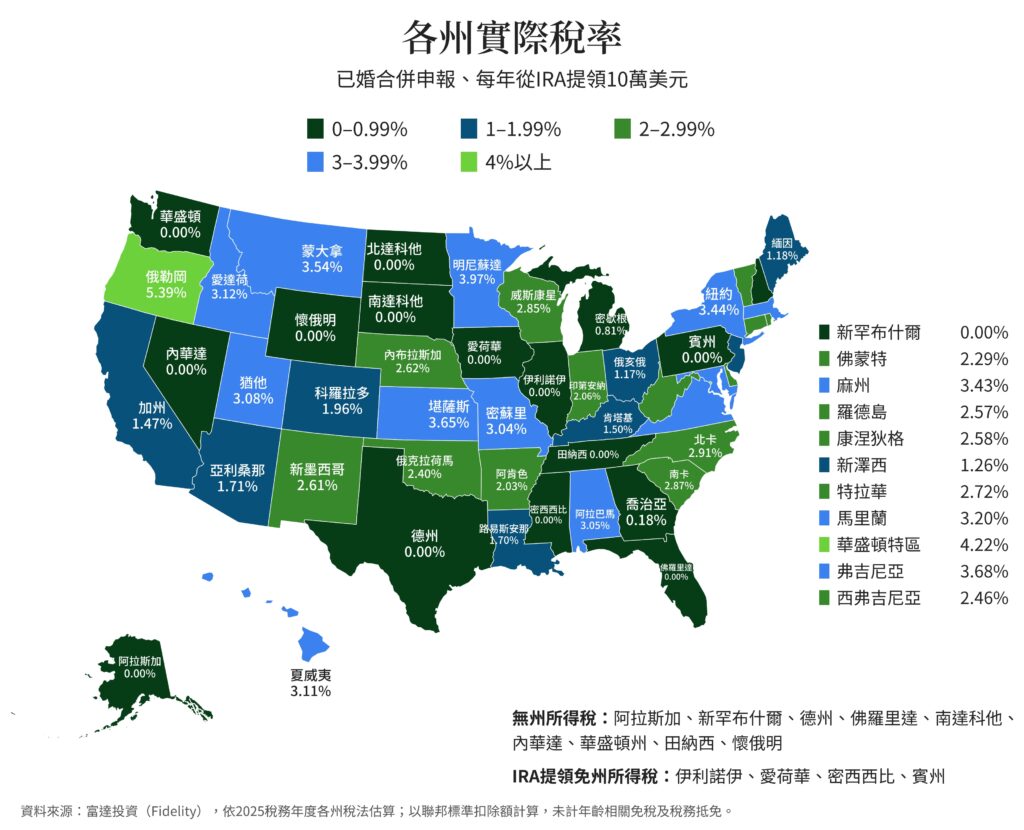
Recent analysis from Fidelity Investments reveals significant insights regarding state taxes on traditional retirement account withdrawals in the United States. The report indicates that retirees withdrawing $100,000 annually from their Individual Retirement Accounts (IRAs) face no state tax liability in 13 states, while Oregon holds the title for the highest tax burden.
Fidelity presented its findings in the “Fidelity Viewpoints” section, basing its calculations on state tax laws for the 2025 tax year. The analysis examined the effective tax rates associated with IRA withdrawals of $100,000 for both single filers and married couples filing jointly. Additionally, the report included a scenario for those withdrawing $250,000 annually to identify the states with the highest tax rates. Interestingly, the District of Columbia was also incorporated into this analysis.
According to Fidelity’s research, there are 13 states in the U.S. that do not impose state taxes on IRA withdrawals. Among these, nine states have no state income tax at all, including Alaska, Florida, Nevada, New Hampshire, South Dakota, Tennessee, Texas, Washington, and Wyoming.
Additionally, four states do have state income taxes but exempt IRA withdrawals from taxation. These states are Iowa, Illinois, Mississippi, and Pennsylvania.
Notably, Fidelity highlighted Iowa’s unique taxation rule, where withdrawals from IRAs, 401(k)s, and 403(b)s are exempt from taxes for individuals who turn 55 by the end of the tax year, or those who qualify due to disability or as a qualifying surviving spouse.
The analysis indicates that Oregon’s actual tax rates are consistently the highest across both filing statuses. For single filers withdrawing $100,000 annually, the effective tax rate is 6.90%, while for married couples filing jointly, it stands at 5.39%. When the withdrawal amount increases to $250,000, these rates rise to 8.50% and 7.41%, respectively, still placing Oregon at the top nationwide.
The District of Columbia ranks second in tax burdens in both withdrawal scenarios. The report also notes that in Kansas, married couples withdrawing $100,000 face an effective tax rate of 3.65%, while single filers are taxed at 4.5%, which is higher than rates in Massachusetts, Connecticut, and Maryland.
For New Mexico, the effective tax rates are 2.61% for married filers and 3.49% for single filers.
In the case of California, when individuals withdraw $250,000, both single and married filers find themselves among the highest taxed states. Vermont’s single filers also report a high effective tax rate, ranking sixth nationally. Delaware, while in the middle tax bracket for lower withdrawal amounts, still features prominently among states with higher rates for married couples.
Among single filers, North Dakota boasts the lowest tax rate at 0.66%. Fidelity explains that while the state typically taxes IRA withdrawals, it offers extensive income exemptions for many married filers, effectively reducing their tax burden to 0%. Georgia follows closely with a rate of 0.18%.
Interestingly, New Jersey, known for high sales and property taxes, reveals a relatively favorable tax situation for married filers withdrawing from their IRAs, with an effective tax rate of 1.26%—over twice that for single filers at 3.11%. In California, married couples face an effective tax rate of 1.47%, ranking as the sixth lowest in the nation. However, the single filers in California have a considerably higher burden, positioning them among the five states with the highest taxes.
The analysis by Fidelity suggests that married couples generally experience an effective tax rate about one percentage point lower than single filers, with discrepancies exceeding two percentage points in states like California and Hawaii.
Fidelity uses the example of a married couple considering a move from Oregon to Iowa, illustrating that they could save approximately $5,390 in state taxes annually. If this amount were invested with an assumed annual return of 7% over ten years, it could result in more than $74,000. It is important to note that the 7% return is only a hypothetical figure and not guaranteed.
Fidelity also cautions that individuals who have recently separated or lost a spouse may see their effective tax rates rise significantly. Under federal tax law, a widowed person can file as a qualifying surviving spouse for two years following their spouse’s death, allowing them to maintain the tax benefits associated with joint filing, provided they have dependent children and meet other eligibility criteria.
The analysis indicates that, as of the 2025 tax year, most states, except for nine, do not generally tax Social Security benefits. Fidelity also reminds retirees that other state taxes such as property taxes, sales taxes, estate taxes, and inheritance taxes can significantly affect retirement living costs, though these were not included in this specific analysis.
In terms of methodology, Fidelity replaced state-specific deductions with the federal standard deduction of $31,500 for married couples and $15,750 for single filers. The calculations did not assume any tax credits or age-related exemptions and did not factor in the phase-out limits for IRA tax exemptions based on adjusted gross income (AGI). Should there be variations in exemption limits due to filing status, they defaulted to the limit for single filers. Fidelity notes that utilizing state-standard deductions could yield different results, and changes may occur in state tax laws beyond 2025.
This information serves solely as a reference and should not be construed as legal or tax advice.