
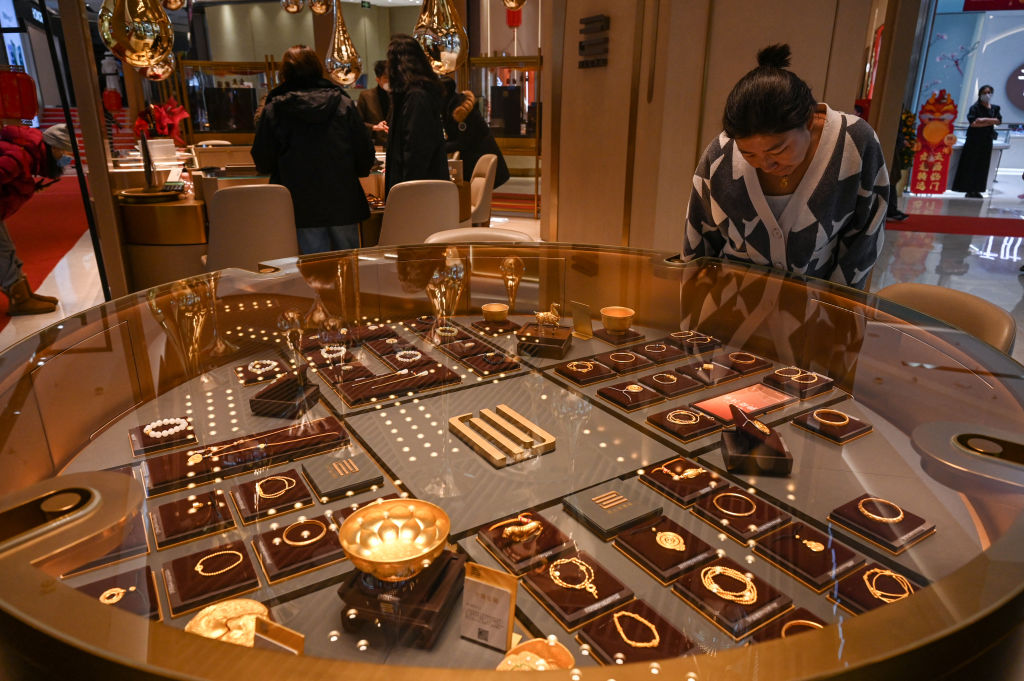
International gold prices have been experiencing a significant decline recently, reaching a new low not seen in over a year on November 19. This downturn has sparked concern among investors in China, many of whom have taken to social media platforms to share screenshots that reflect their losses from gold holdings. Some individuals report substantial unrealized losses, with figures in the tens of thousands of yuan and even claims of losses exceeding a million yuan.
The steep drop in gold prices has also negatively impacted the domestic gold jewelry market in China, with prices for local brands seeing a continuous decrease for eight consecutive trading days. On November 19, the price of 24K gold jewelry from Lao Miao reached 1,125 yuan per gram, while Chow Tai Fook and Lao Feng Xiang adjusted their prices to 1,132 yuan per gram. When compared to their respective highs earlier in the year, several brands have seen prices plummet by nearly 600 yuan.
On November 18, during Asian trading hours, spot gold dipped below $3,800 per ounce, hitting a low of $3,791.75. The downward trajectory continued as the price fell further in the US trading session, hitting approximately $3,719.55, marking a decline of over 3% on the day—the lowest level since September 2025.
The following day, gold prices continued to slide. According to reports, spot gold hit a low of $3,693.13 per ounce in the early session, only to experience a slight rebound later, closing at $3,733.76 at 6:30 AM GMT, a modest increase of about 0.3%. Market analysts view this rebound not as a sign of easing downward pressure on gold prices, but rather as a temporary profit-taking action by bearish traders.
As international gold prices fall, many investors in China are expressing their frustrations online, sharing evidence of significant losses. Several netizens mentioned that they had bought gold, gold storage, or related investment products when prices were high, only to now face paper losses amounting to tens of thousands of yuan. Some even reported losses in excess of one million yuan. It is essential to note that while these figures are shared by investors, they are not verified comprehensive data on overall investment losses.
Many investors lamented their belief that gold was a safer asset for hedging against economic uncertainty, only to be surprised by such a rapid price correction. Additional commentary indicates that the ongoing decline in gold prices has placed considerable strain on those who had previously entered the market at a high point.
In response to the declining international gold prices, domestic Chinese jewelry brands have witnessed continuous price adjustments over eight trading days. For instance, on November 18, Chow Tai Fook listed its gold jewelry at 1,151 yuan per gram, while Lao Feng Xiang was at 1,150 yuan per gram and Lao Miao at 1,145 yuan per gram. Compared to their highs for the year, these brands have experienced price drops exceeding 550 yuan per gram, with Lao Miao seeing a decline of 577 yuan from a high of 1,722 yuan per gram.
To illustrate the impact, consider a 50-gram gold bracelet purchased when Lao Feng Xiang’s price was at its peak of 1,713 yuan per gram; this bracelet would have been valued at approximately 85,650 yuan then. As of November 18, with the price listed at 1,150 yuan per gram, the current value would be around 57,500 yuan, indicating a substantial paper loss of 28,150 yuan, not accounting for processing fees or resale discounts.
As of November 19, the trend of decreasing prices for domestic brand gold jewelry persisted. Lao Miao’s gold jewelry was priced at 1,125 yuan per gram, representing a decline of 108 yuan over the past eight days and a staggering fall of 597 yuan from the year’s high of 1,722 yuan per gram. Similarly, Lao Feng Xiang and Chow Tai Fook also reported declines, with values dropping by 581 yuan and 574 yuan, respectively.
Currently, many brands in China have seen their prices retreat by over 30% from their earlier highs, with Lao Miao’s decline nearing 35%.
It is noteworthy that despite the significant drop in domestic gold jewelry prices from their year’s peak, there remains a distinct gap between retail prices and international raw gold prices. For instance, on November 18, the price of 24K gold on the Shanghai Gold Exchange fell to around 816 yuan per gram, while the retail prices for gold jewelry from brands like Chow Tai Fook and Lao Feng Xiang remained around 1,150 yuan per gram, creating a disparity of over 300 yuan.
This discrepancy can be attributed to various factors, including brand premiums, processing techniques, distribution, and sales costs. Therefore, the decrease in jewelry prices does not align perfectly with the fluctuations of international gold prices, necessitating caution for consumers who consider selling their purchases back to the market at retail prices.
Market analysts assert that the current drop in gold prices is largely driven by a shift in expectations regarding U.S. monetary policy towards a more hawkish stance. Recent reports highlight that U.S. inflation data and remarks from Federal Reserve officials have led the market to reevaluate future interest rate policies. Indications from Federal Reserve officials suggest potential for further interest rate hikes, which tends to strengthen the dollar and raise U.S. Treasury yields, thus diminishing gold’s appeal as it yields no interest income.
Specifically, Federal Reserve Governor Christopher Waller has indicated that the Federal Reserve may need to adopt a more aggressive approach in December, including a potential 50 basis point rate hike or accelerating the pace of increases into 2027. This has led the market to raise expectations for continued tightening of monetary policy by the Federal Reserve.
A stronger dollar and rising U.S. Treasury yields generally impose downward pressure on gold prices, which are denominated in dollars. As interest rate hike expectations rise, the opportunity cost of holding gold increases, which could further discourage investment in this traditionally safe-haven asset.