
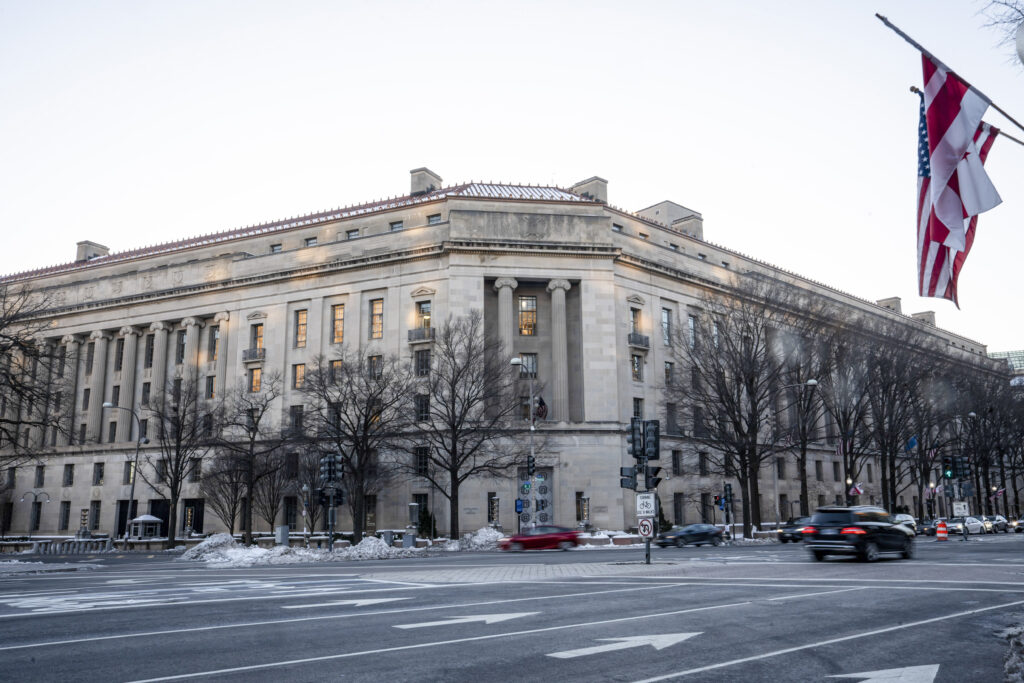
The U.S. Department of Justice (DOJ) has announced that a Russian citizen has been charged with acting as an agent for the Russian government by tracking and monitoring employees at a technology and defense company in Silicon Valley.
According to a 20-page criminal affidavit filed in the U.S. District Court for the Northern District of California, the accused, identified as Igor D’iu, faces multiple charges. These include conspiracy to act as an agent of a foreign government, acting as a foreign agent without notifying the Attorney General, interstate stalking, and a fraud charge related to identity documents.
D’iu has been in federal custody since his initial court appearance on November 2 and is scheduled to appear again on November 24.
In a press release, the DOJ stated that D’iu was recruited through the messaging platform Telegram and has engaged in intelligence operations supported by a foreign regime.
Roman Rozhavsky, an assistant director with the FBI who heads the counterespionage division, confirmed that D’iu had been recruited and funded by the Russian government to spy on employees of a technology firm.
Although the DOJ did not disclose the name of the targeted company, it highlighted that the firm, based in Northern California, was supplying weaponry for operations against Russia in Ukraine. This suggests that Russia may be attempting to utilize undercover operatives to gather intelligence and gain advantage amidst the ongoing conflict with Ukraine.
The allegations state that D’iu personally tracked individuals, installed surveillance equipment, and gathered information using false identities.
His federal public defender, Angela Chuang, did not respond to requests for comment regarding the case.
According to the charges, D’iu traveled from Istanbul to Mexico City in June, where he connected with an accomplice who helped him illegally cross the U.S.-Mexico border.
D’iu allegedly received instructions via Telegram to purchase a laptop, phone, and wireless equipment for his espionage mission.
A contact named Ian Morales on Telegram purportedly provided D’iu with photographs of at least four people along with their addresses and instructed him to disguise himself as a delivery person to verify if these individuals lived at the locations provided.
The press release indicated that FBI agents confirmed all four addresses belonged to employees of the targeted firm.
Furthermore, D’iu reportedly filmed an employee’s laptop screen from a café near the company’s office.
In another disturbing incident, he followed a female employee of the company for nearly 30 miles on September 3 as she drove from Palo Alto to San Francisco. During the pursuit, she attempted to evade D’iu by making irregular turns, taking back roads, and stopping in a grocery store parking lot.
Despite her efforts to shake off her pursuer, D’iu continued his stalking through illegal maneuvers, including U-turns, illegal left turns, and running red lights. It wasn’t until she contacted law enforcement that the stalking came to an end.
Following this incident, Palo Alto police reached out to D’iu. Subsequently, he changed vehicles and phone numbers, heading to Reno, Nevada, before returning to the Bay Area.
Law enforcement also intercepted two international packages that contained a counterfeit California identification card, a social security card, and a tampered U.S. passport showing his photo and using the alias Hugo Landry Johns.
A search warrant was executed at D’iu’s residence in East Palo Alto, where FBI agents seized approximately $18,000 in cash, two laptops, two iPhones, two Russian passports, and forged identification documents. Notably, agents also discovered a notebook containing a list of ten handwritten addresses in the Palo Alto area, many of which corresponded to the residences of company employees.
The FBI agents uncovered detailed profiles on at least three employees, including the names of their family members and evaluations of their strengths and weaknesses.
According to the press release, if convicted of conspiracy and interstate stalking, D’iu could face a maximum of five years in prison for each charge, alongside a potential fine of $250,000 and three years of supervised release.
For the charge of acting as an unregistered foreign agent, he may face up to ten years in prison along with similar fines and supervised release terms.
For the fraud charge related to the false identification documents, D’iu could receive a maximum sentence of one year in prison, a $100,000 fine, and one year of supervised release.
This case raises serious concerns regarding national security and highlights the ongoing threat posed by foreign espionage activities within the U.S. tech sector. The implications of such actions could significantly influence international relations and intelligence efforts related to the current geopolitical climate.