
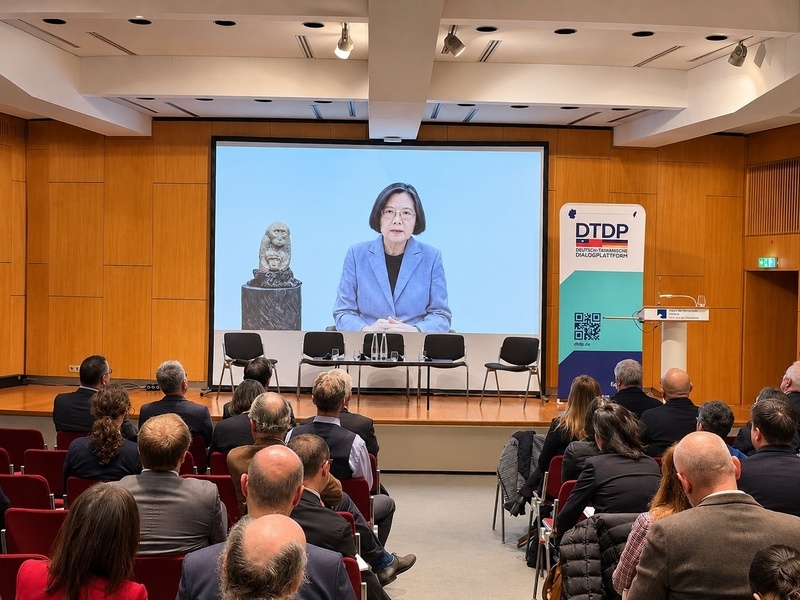
Former President Tsai Ing-wen of the Republic of China delivered a speech at the Berlin Freedom Week last year, where she shared Taiwan’s experience with democracy. A year later, she once again reached out to Berlin through a video message, using examples from Taiwan’s democratic journey, efforts to combat misinformation, and civic participation in post-disaster relief efforts to illustrate that civil society is a crucial pillar of democracy, both in Taiwan and globally.
Berlin Freedom Week is held annually in November to commemorate the fall of the Berlin Wall in 1989. The event includes international forums, exhibitions, and cultural activities that explore the challenges faced by freedom and democracy.
On November 10 of last year, Tsai attended the inaugural Berlin Freedom Conference, where she spoke about these themes. This year, she was invited to participate in the fifth edition of the Berlin Taiwan Conference as part of the Berlin Freedom Week series, delivering a message from Taiwan through a video presentation.
In her speech on the 12th, Tsai reflected on her visit to Germany and the deep connections she felt between Taiwan and Germany. She highlighted that this bond is not solely based on their shared confrontation of authoritarian threats but is also built upon a mutual commitment to democratic values. She used the example of TSMC’s investment in Dresden to illustrate how cooperation between the two sides extends from shared values to substantial economic and technological exchanges.
She emphasized that partnerships between governments and corporations must be based on connections with society and its people. Tsai expressed her hope to share Taiwan’s civil society experience through this opportunity.
“Democracy in Taiwan was not granted by anyone; it was established by the hands of the people of Taiwan,” Tsai recounted the Wild Lily Student Movement of 1990, where thousands of students took to the streets to demand political reforms. This movement led to a comprehensive re-election of the legislature and laid the groundwork for Taiwan’s first direct presidential election in 1996.
She noted that the role of civil society did not end with the establishment of a democratic system. During the 2018 elections in Taiwan, a significant influx of foreign misinformation occurred. In response, local fact-checking organizations developed tools to help the public verify rumors through messaging apps. Researchers also contributed by analyzing the propagation of false information, while the government collaborated with civil society to counter manipulation of facts.
Tsai also mentioned the widespread volunteer efforts following Typhoon damage in Hualien last September, where tens of thousands of volunteers traveled from across Taiwan to assist in recovery efforts. She stated that, despite fierce political competition and social opinions being divided, when fellow citizens need help, individuals are still willing to cross political lines to support each other.
Using Taiwan as an example, she noted that citizens often take action more swiftly than government institutions. When the government is willing to view civil society as a partner, democracy is made even more resilient.
Discussing the international significance of Taiwan’s democracy, Tsai remarked that authoritarian regimes often assert that democracy is a Western concept unsuitable for other societies. However, the 23 million people of Taiwan have proven otherwise through eight presidential elections and three peaceful transfers of power—that democracy can indeed take root in Asia.
She warned that if Taiwan were to be forced to relinquish its freedom under authoritarian pressure, it would send a message to other authoritarian leaders that “coercion is effective.” Conversely, a continually free and democratic Taiwan can demonstrate to the world that the will of the people cannot be easily overthrown by force. Upholding Taiwan’s freedom and democracy is crucial for the security of democratic nations around the globe.
In conclusion, Tsai cited the fall of the Berlin Wall as a reminder that the demolition of such barriers stems not only from political decisions but also from the determination of ordinary people to reject authoritarian rule. The democracy of Taiwan, too, has been fought for by its citizens and relies on that same resolve to endure.
The fifth Berlin Taiwan Conference, promoted by the German Foreign Ministry’s initiative “Germany-Taiwan Civil Forum,” was held in partnership with the Taiwan Association in Germany. The event featured seven roundtable discussions at the Berlin State Library during Berlin Freedom Week, bringing together German parliamentarians, diplomats, industry leaders, and international scholars to discuss Taiwan’s international role, Taiwan-Germany economic cooperation, technological development, and social resilience.