
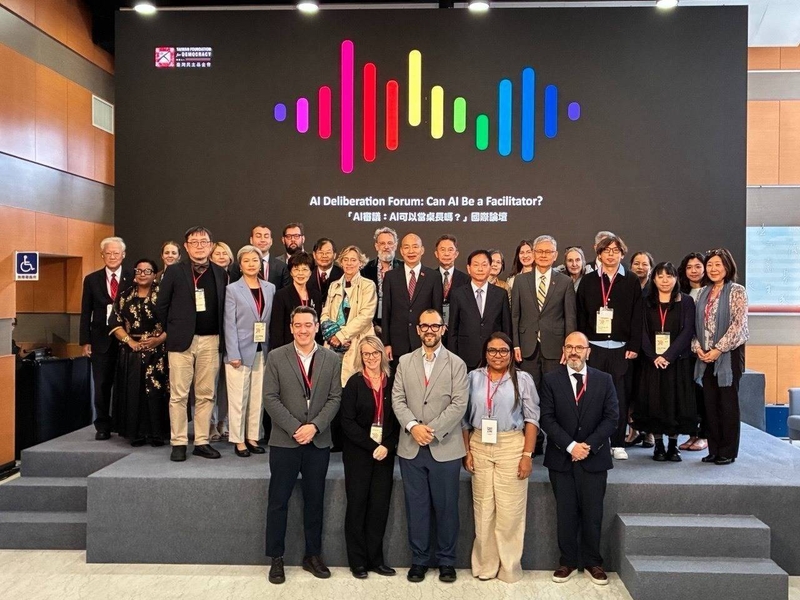
On November 10, Taiwan’s Deputy Minister of Foreign Affairs, Hsiao-Ping Ko, attended the opening ceremony of the “Second Preparatory Meeting of the Global Initiative for Local Democracy (GILD) and AI Deliberation International Forum.” During her address, she emphasized the event’s aim to integrate Taiwan’s advantages in artificial intelligence (AI) technology with democratic governance, creating fresh opportunities for exploring democratic processes and highlighting Taiwan’s role as a vital partner in the global democratic community.
This noteworthy forum, organized by the Taiwan Democracy Foundation (TDF), saw participation from local government organizations and alliances from 11 countries across Europe, Latin America, and Africa, as well as diplomats stationed in Taiwan and representatives from domestic non-governmental organizations (NGOs).
In her opening remarks, Deputy Minister Ko elaborated on the GILD initiative’s mission to connect local governments, parliaments, and city alliances worldwide. The goal is to construct an innovative network for democratic governance and establish a sustainable international governance platform. She expressed confidence that the discussions held during this preparatory meeting would lay a significant foundation for the GILD founding conference scheduled for next year.
Ko underlined that since taking office, Minister Joseph Wu has actively advanced a policy of “integrated diplomacy.” She pointed out that this forum seeks to meld Taiwan’s AI technology strengths with democratic governance, offering not only a new avenue for exploring democratic practices but also enhancing communication and collaborative problem-solving among transnational local governments. This endeavor clearly illustrates Taiwan’s emerging position as a crucial partner within the global democratic community.
The international forum centered on the theme, “AI Deliberation: Can AI Take the Chair?” and featured discussions led by esteemed scholars such as Associate Professor Yu-Sheng Lin from National Tsing Hua University, Associate Professor Hsin-Yi Yeh from National Taipei University, and Professor Dun-Yuan Chen from National Chengchi University. They engaged in deep dialogues alongside virtual AI characters like “Meow and” and “Meow Yin.”
Additionally, representatives from several nations, including Haiti, Eswatini, Palau, the United Kingdom, Lithuania, the Czech Republic, Slovakia, Poland, Sweden, Switzerland, and Canada, were present at the forum. Local government organizations and alliances from countries such as Estonia, Lithuania, Germany, the United States, Latvia, Panama, and Sweden also participated, joining in vibrant discussions about the innovative applications of AI technology in enhancing democracy and local governance.
This gathering not only showcased Taiwan’s commitment to integrating technological advancements with democratic principles but also reinforced its position as a leading player in the global discourse surrounding democracy and governance. The collaborative spirit evident at this forum reflects a shared commitment to employing AI in ways that can strengthen democratic processes and local governance worldwide.