
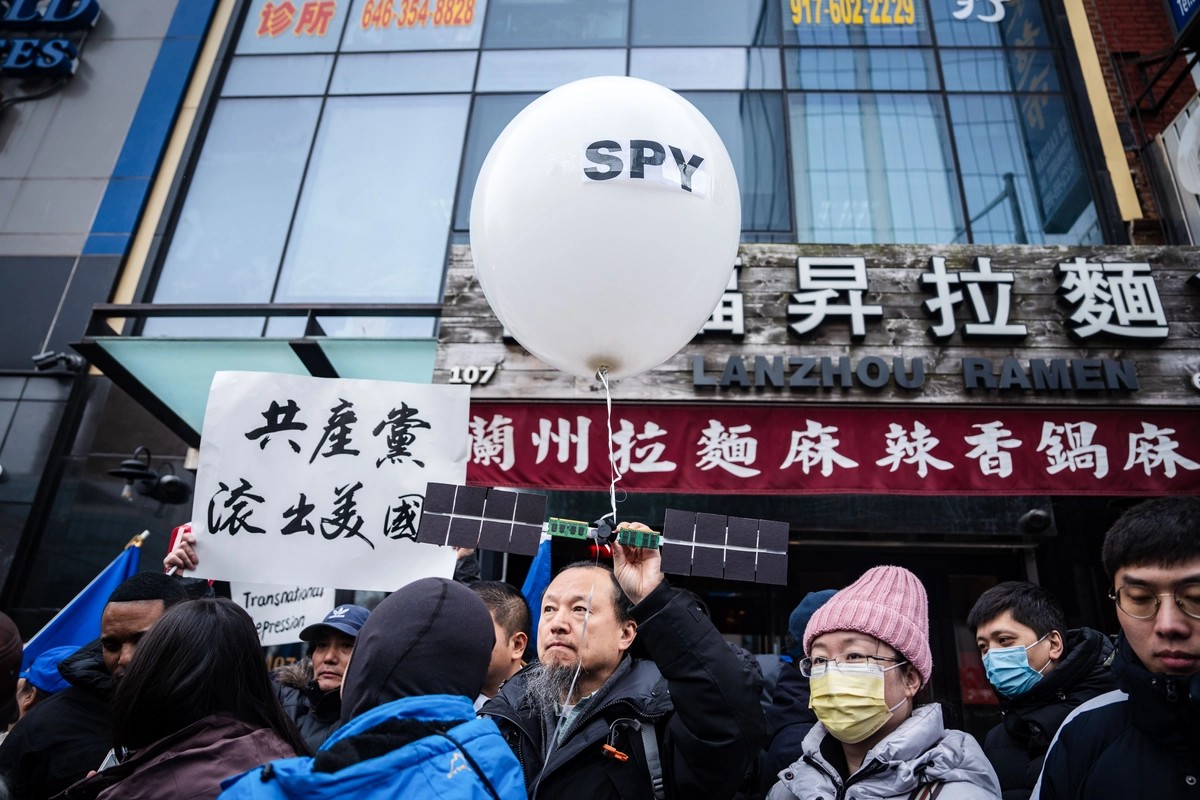
In 2026, a federal jury found a New York man guilty of acting as an illegal agent for the Chinese Communist Party (CCP) through an overseas police station located in Manhattan.
This operation was housed within a community organization called the America ChangLe Association, which has since been closed. It maintained direct connections with the Ministry of Public Security (MPS) of the People’s Republic of China. The MPS’s primary duty is to protect the regime rather than the citizens of China. They also oversee prisons that detain political dissidents across the country.
Federal prosecutors indicated that the case went beyond simply assisting Chinese citizens with everyday bureaucratic tasks. One individual involved in the operation was reportedly tasked with identifying a Chinese pro-democracy activist residing in the United States.
The term “overseas police station” should give Americans pause for thought.
Traditionally, foreign governments collaborate with U.S. law enforcement through established legal channels. They do not possess law enforcement authority within American borders. However, the broader issue at stake transcends the signs on office doors or whether CCP officials wear uniforms; the fundamental concern lies in the CCP’s attempts to extend political coercion beyond China’s borders and infiltrate the lives of those who believed they had escaped such threats.
The MPS is part of a comprehensive system, with the Ministry of State Security (MSS) constituting another crucial aspect. The MSS is infamous for its reliance on coercion, oppression, kidnapping, and managing extrajudicial detention facilities.
In a separate case, Shujun Wang, a Chinese American historian who helped establish a pro-democracy organization in New York, was convicted of secretly serving the MSS. Prosecutors presented evidence demonstrating that he provided information regarding dissidents and activists to Chinese intelligence officials.
Other federal cases have highlighted allegations of stalking, intimidation, threats against family members, and attempts to force individuals back to China.
These methods vary, yet the underlying principle merits close examination.
Historically, the United States has long addressed this fundamental issue.
In July 1868, Congress proclaimed that the right to “expatriation,” or the right to renounce one political allegiance in favor of another, is a “natural and inherent right of all people.” This is not a mere theoretical discussion. Even today, European governments sometimes regard immigrants who have become American citizens as subjects of their original country.
The day after Congress adopted this resolution, the United States signed the Burlingame Treaty with the Qing dynasty. The language of the treaty is astounding by today’s standards, as it recognized “the inherent and inalienable right of all men to change their home and allegiance.”
This principle was articulated in U.S.-China relations over 150 years ago.
While the Burlingame Treaty is not a modern human rights charter, the treatment of Chinese immigrants in the United States has often contradicted the generous principles announced in 1868. The Chinese Exclusion Era, which lasted from 1882 to 1943, is a stark reminder not to romanticize history.
However, the principle remains important.
An individual does not belong to his or her government.
While a state can legitimately impose obligations on its citizens, it does not own the people. Human dignity does not derive from passports, ruling parties, or the roles deemed acceptable by the state.
For those who believe humans are created in the image of the divine, this is the most fundamental issue preceding any political considerations. The state is not the creator of human dignity; therefore, it can never own its citizens. The state cannot replace God and His Law—the moral standards, teachings, and will issued by God as the Creator and Lord of all.
Totalitarianism faces numerous challenges in this regard. It does not merely strive for obedience to laws; it seeks to subordinate all institutions, organizations, beliefs, and loyalties under political order. The danger of religion lies in its advocacy for an authority that transcends the state’s power. The peril of family is that it fosters loyalties that the state has not bestowed. For similar reasons, independent education, autonomous legal systems, and a free civil society can also pose threats. The same applies to individuals outside these institutions.
Immigration is not merely about crossing borders. Immigrants may have effectively severed their home countries’ control over their speech, social interactions, religion, and conscience.
The nature of transnational repression rests on preventing individuals from escaping. This repression may occur directly or be exerted through relatives who remain in their home country. Individuals residing in Wisconsin, New York, or California may receive comprehensive protection under U.S. constitutional law, yet their relatives under CCP rule remain subject to the regime’s control. The threats posed by the CCP can take effect without requiring enforcement by U.S. courts. The CCP need not formally assert that their former citizens are still property of the state.
If the CCP can dictate what individuals dare to say, who they meet, which organizations they join, or whether they can express criticism of the party, it retains elements of political control previously thought to be shed.
This is why this issue is also a matter of American sovereignty.
The targets of such actions are not merely foreign residents living outside of U.S. jurisdiction. Some of these individuals are permanent residents, some are naturalized citizens, and others were born in the United States. Regardless of their origins, those living under U.S. laws should not be compelled to weigh whether exercising their American freedoms might invite retaliation from a foreign government.
Undoubtedly, having Chinese ancestry does not equate to allegiance to the CCP. In fact, Chinese Americans, religious individuals, dissidents, pro-democracy activists, Tibetans, Uyghurs, Hong Kong activists, and others have frequently been targeted by Beijing’s coercion. They are not the problem; rather, they are the group in need of protection.
There is another instance of failure on the part of the United States that merits attention.
The U.S. has not granted the CCP police formal authority to enforce laws in Manhattan. The operation was executed through individuals and organizations already present in the area. Federal agencies launched investigations, resulting in the operation’s closure and subsequent litigation.
The ability of such operations to commence should compel us to question the awareness of federal, state, and local agencies regarding transnational repression. Victims often hesitate to come forward for various reasons: they fear for the safety of their relatives overseas and distrust that U.S. law enforcement will comprehend the realities unfolding.
Thus, protecting them involves more than pursuing accountability after the actions have been exposed. It requires recognizing that acts of foreign coercion that occur on American soil are not merely private matters among members of immigrant communities.
This constitutes an infringement on American sovereignty. From a diplomatic standpoint, it resembles a form of electoral interference.
In 1868, the U.S. declared the act of changing one’s allegiance as a fundamental human right. This proclamation holds profound implications. A person protected by the United States should not find their former government continuing to dictate what they can say and do.
No government can possess its people.
Similarly, no foreign government should be permitted to act as though it owns individuals residing within the United States.