
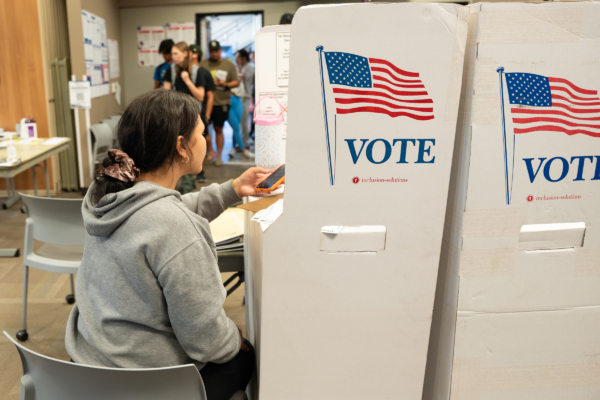
In the recent midterm elections held on November 3, significant outcomes have emerged in California, solidifying the Democratic Party’s dominance across various federal, state, and local positions. The results indicate that the Democratic candidates have successfully secured key legislative and governmental offices, further reinforcing their influence within the state.
Among the notable aspects of the election were 14 voter initiatives, particularly two housing-related bond measures that garnered support levels nearing or exceeding 60%. Additionally, the proposal to continue imposing an extra tax on high-income individuals also received strong backing from voters. However, two highly publicized proposals—the so-called “billionaire tax” and a requirement for voters to present identification—fell short, as their support levels remained below 45%.
Democratic candidate Xavier Becerra emerged victorious in the gubernatorial race, while his opponent, Republican Steve Hilton, conceded defeat. As of November 6, preliminary vote counts revealed that Becerra secured approximately 5.75 million votes, accounting for 64.7%, while Hilton obtained around 3.14 million votes, or 35.3%.
Becerra is set to take the oath of office on January 4, 2027, becoming California’s 41st governor and continuing a Democratic administration that has been in place since 2011.
Having previously served as California’s Attorney General, Becerra was nominated by President Biden to head the Department of Health and Human Services, marking him as the first Latino to hold that position in the United States. Now, he takes on the role of California’s first Latino governor.
In his campaign platform, Becerra pledged to issue an executive order on his first day in office, declaring a housing emergency in California. This declaration aims to expedite the approval of 40,000 affordable housing units currently awaiting funding for construction. He emphasized that the development of affordable housing is a top priority for his administration.
Becerra also indicated that on his first day, he would sign another executive order to ensure that California’s Medi-Cal beneficiaries, including undocumented immigrants, will continue to receive healthcare, shielding them from any potential exclusion by federal policies. He aims to ensure that immigrants who do not meet federal funding requirements will still have access to necessary services, such as contraception and abortion.
In responding to media inquiries, Becerra asserted that California has the financial capacity to handle these projects, although he did not specify where the multi-billion dollar funding would originate.
Aside from the gubernatorial race, California Democrats made significant gains, winning other key positions, including Attorney General, Treasurer, Controller, Secretary of State, and Superintendent of Public Instruction, all by large margins.
Though the role of Superintendent is officially nonpartisan, Richard Barrera, a Democrat and former president of the San Diego Unified School District Board, faced off against Sonja Shaw, a Republican and the current president of the Chino Valley Unified School District Board. Shaw declared her defeat on November 5, allowing Barrera to win the election with approximately 58% of the vote.
As of November 6, the race for California’s Insurance Commissioner is still too close to call, with Democratic candidates Ben Allen and Jane Kim vying for the position, and Kim currently leading by a narrow margin of 5 percentage points. The eventual winner will be confronted with addressing the escalating cost of insurance premiums in the state.
In the context of the previous elections, such important roles have consistently been held by Democratic candidates.
California operates within 52 congressional districts. Before the midterm elections, the Democrats held 43 seats compared to the Republicans’ 9. As of November 6, reports indicated that Democrats had flipped 5 Republican seats. The results of 4 districts remain unannounced, with 2 likely to remain Democratic and the other 2 leaning Republican. Thus, the final outcome could see Democrats maintaining 48 seats to the Republicans’ 4.
The Republican Party’s loss of 5 seats can be partly attributed to Proposition 50, which was passed in 2025, redrawing congressional districts in a manner that favored Democrats in five traditionally Republican-leaning areas. All these districts were won by Democrats in the current election.
In California’s 48th congressional district, located in San Diego County, incumbent Republican Darrell Issa opted not to run for re-election following district redistricting. The race was between Republican Jim Desmond and Democrat Marni von Wilpert, with reports confirming Wilpert’s victory.
Among the 14 propositions, two housing bond measures—Proposition 1 and Proposition 37—are predicted to pass based on ongoing tallies, each currently enjoying over 60% support.
Proposition 1 proposes the issuance of $11.25 billion in state government bonds targeted at affordable housing projects, which will be financed through government funds. Similarly, Proposition 37 seeks to issue $25 billion in bonds aimed at assisting middle-income families in purchasing homes, with repayment primarily coming from the buyers’ loan repayments.
Proposition 3, calling for the continued collection of an additional income tax from high earners, has also received nearly 60% support. This measure proposes the permanent extension of a tax set to expire in 2031 that levies an extra tax on high earners—defined as those with an annual income exceeding $371,479—adding an increment of 1% to 3% to the state’s basic income tax.
In contrast, the highly discussed billionaire tax, known as Proposition 40, garnered 3.99 million supporting votes as of November 6, equating to 45.5%. The proposal faced opposition from over 4.77 million voters, representing 54.6%. This initiative aimed to impose a one-time wealth tax of 5% on taxpayers with assets exceeding $1 billion.
In San Diego County, there is an ongoing measure to increase sales tax by 0.5%, Proposal B, which as of November 5 has accumulated nearly 400,000 supportive votes, accounting for 52%, while opposition votes totaled over 360,000 or 48%. The county’s election office indicated that around 470,000 votes are still being counted.
Should the tax increase proposal pass, San Diego County’s sales tax will rise by half a percentage point (equivalent to an additional 50 cents in sales tax for every $100 spent), potentially generating an annual revenue of $400 million to $500 million for the county. This added tax would be levied on top of existing sales taxes across various cities and unincorporated areas of the county, with the current sales tax rate in San Diego City being 7.75%, which would increase to 8.25%.