
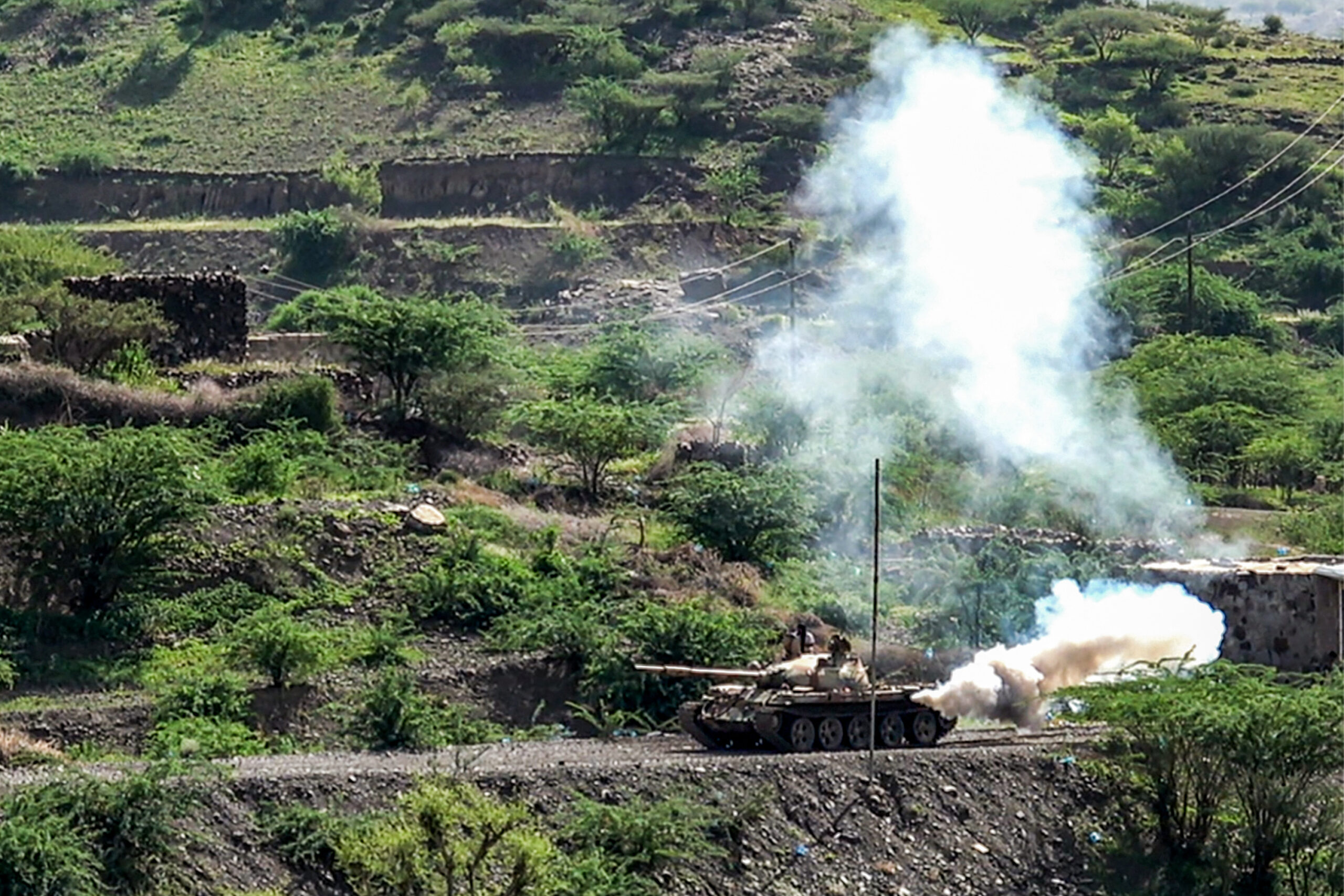
On Monday, October 19th, a government security training camp in Shabwa province in southern Yemen was attacked by Houthi ballistic missiles, resulting in a tragic toll. According to Governor Awad al-Wazir, the incident led to the death of 58 individuals, with over two hundred wounded and 14 reported missing.
This attack marks one of the deadliest since the resurgence of conflict in Yemen this summer. Following the collapse of the ceasefire agreement reached in 2022, the Saudi-backed Yemeni government forces have been engaged in continuous combat with the Iran-backed Houthi militants. In recent times, the Houthi rebels have escalated their attacks on Saudi airports and energy facilities.
According to military sources cited by AFP, three ballistic missiles struck the al-Alam camp in Shabwa province. Yemeni military spokesperson Majed al-Nuzaili stated that the camp targeted was a training center for security forces and new police recruits. The provincial government noted that the casualties were all newly enrolled members of the internal security forces undergoing training.
Verified footage from Reuters depicts injured individuals and bloodied bodies scattered on the ground at the scene.
Shabwa province’s deputy governor, Fahad al-Khalifi, informed AFP that local hospitals were overwhelmed by the influx of casualties and had to transfer severely injured individuals to nearby Hadramout and Aden.
“Some of them are in critical condition,” al-Khalifi remarked.
Chairman of the Yemeni Presidential Leadership Committee Rashad al-Alimi pledged a “firm response” to the attack. The Shabwa provincial government has requested an accelerated deployment of anti-aircraft and early warning systems.
The Houthi militants have claimed responsibility for the assault. Their military spokesperson alleged that the camp was operated by Saudi officers, some of whom perished in the attack, although no evidence was provided. The Saudi government did not immediately comment on the incident.
An anonymous military source cited by AFP expressed concerns that the missile attack could pave the way for a ground offensive, reminiscent of the Houthi rebels’ capture of the Red Sea port of Mokha last month.
The source further revealed that the Houthi rebels severed a road between Shabwa and Bayda provinces on Sunday. Bayda province is predominantly under the control of the Houthi militants.
This month, the Yemeni government forces have launched a counteroffensive in an attempt to reclaim territories held by the Houthi insurgents.
According to the Associated Press, the ongoing Houthi attacks on Saudi Arabia have disrupted local activities. The “Future Investment Initiative” (FII) summit, slated to be held in Riyadh from October 26 to 29 and dubbed the “Davos in the Desert,” has been postponed to 2027 by the organizers on Monday. Saudi Arabia has also extended distance learning measures for schools in Riyadh and its surrounding areas.
On the same day, the Houthi rebels claimed to have launched six attacks on Saudi oil facilities, airports, and military targets, without specifying precise timing. The Saudi Civil Defense issued a warning, with no immediate reports of casualties or losses.
In September, the Houthi rebels made advancements along the Red Sea coast towards the Bab el-Mandeb strait, seizing strategic positions, followed by a counteroffensive by the Yemeni government forces.
The Bab el-Mandeb strait connects the Red Sea to the Gulf of Aden, serving as a vital international shipping route. With disruptions in the Strait of Hormuz due to the conflict between the United States, Israel, and Iran in February, Saudi Arabia increasingly relies on the Mandeb Strait for oil exports. Further blockages in this waterway could escalate pressure on energy transportation and global trade.
Citing informed regional sources, The Wall Street Journal reported on October 17th that Iran is assisting the Houthi rebels in targeting missile and drone attacks and providing training, intelligence, and tactical guidance. The report stated that Iranian Revolutionary Guard officers had aided in deploying missiles and radars in Yemen and were involved in commanding the assaults.
Senior Houthi official Mohammed al-Bukhaiti denied accusations of Iranian military involvement. Iranian Foreign Ministry spokesperson Esmail Baghaei had previously stated, “Iran does not interfere in Yemen’s affairs.”
The internal conflict in Yemen began in 2014 when the Houthi militants seized the capital, Sanaa. A Saudi-led coalition intervened in 2015, with both sides engaging in warfare until a ceasefire agreement was reached in 2022, only to witness a resurgence of hostilities this year.