
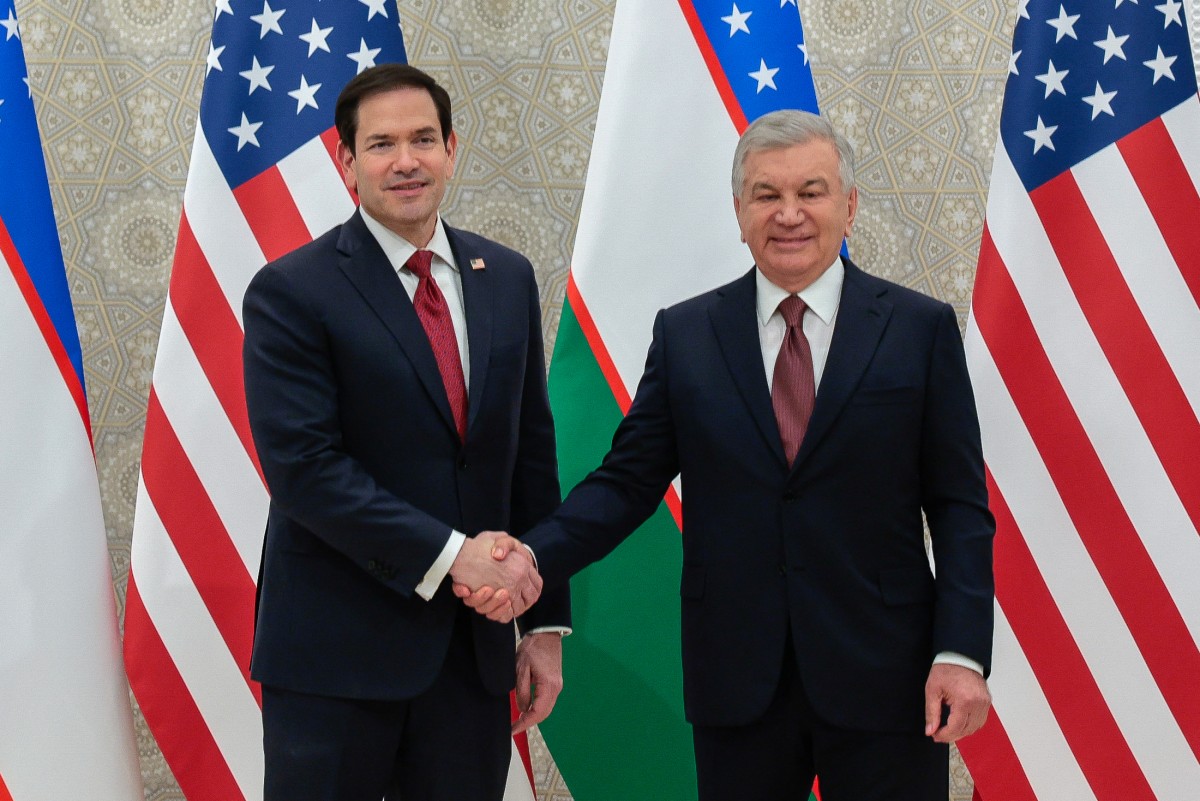
The United States is accelerating its involvement in Central Asia, expanding its economic and strategic influence in the Eurasian heartland that has long been cultivated by the Chinese Communist Party. United States Secretary of State Marco Rubio arrived in Samarkand, Uzbekistan on October 18, and on the 19th, he held a “C5+1” meeting with foreign ministers from the five Central Asian countries including Kazakhstan, Uzbekistan, Kyrgyzstan, Tajikistan, and Turkmenistan. Accompanying Rubio were more than 200 American businesses and commercial professionals, primarily engaging in cooperation with Central Asian countries in trade, investment, and critical mineral resources sectors.
For China, the Central Asian region is not only a crucial gateway for the Belt and Road Initiative to extend towards Europe, but also a region where China expands its energy supply, gains strategic resources, deepens economic and trade ties in the western periphery, and enhances military cooperation. If the United States can integrate diplomacy, finance, corporate investment, and security cooperation, significant changes in the geopolitical situation in Central Asia will ensue.
Under Chinese Communist Party leader Xi Jinping’s initiative of the Belt and Road Initiative, Central Asian countries hold pivotal geographic positions. Kazakhstan, Uzbekistan, Kyrgyzstan, Tajikistan, and Turkmenistan serve as strategic corridors for China’s access to the Caspian Sea, the Caucasus, and Europe.
Firstly, Central Asia is a vital land connection for China to reach Europe. Through railways, highways, logistics centers, and cross-border ports, China can expand its Eurasian freight network, increasing the volume of international trade transportation.
Secondly, Central Asia possesses significant energy and mineral resources. Natural gas, oil, uranium, and other key minerals are not only crucial for China’s energy security but are also closely related to the supply of raw materials for new energy, electronics industry, and advanced manufacturing.
The five Central Asian countries have abundant energy and mineral resources. For example, Kazakhstan has approximately 30 billion barrels of oil, about 2.3 trillion cubic meters of natural gas, as well as plentiful coal, uranium, chromium, copper, and manganese. In 2024, Kazakhstan’s uranium production amounted to approximately 23,300 tons, ranking first globally. Turkmenistan focuses on natural gas, with proven reserves of around 14 trillion cubic meters, making it an essential global natural gas resource country. Uzbekistan is renowned for gold, uranium, copper, and natural gas; in 2024, gold production was approximately 113 tons, and uranium production was about 4,000 tons. Kyrgyzstan’s main resources include gold, coal, and hydropower, while Tajikistan has significant hydropower potential and produces strategic metals like gold, silver, and antimony.
Thirdly, the economic connection between Central Asia and China’s Xinjiang and western regions contributes to the expansion of China’s foreign trade, improvement of regional infrastructure, and deepening cooperation with neighboring countries.
Therefore, the significance of Central Asia to China surpasses the realm of ordinary overseas investment markets, involving transportation, energy, industrial chains, and Eurasian geopolitical economic layout.
The key to the United States’ current actions lies in strengthening diplomatic relations while initiating comprehensive economic cooperation. With over 200 top executives from American enterprises in tow and emphasizing critical minerals, Washington is evidently pushing for direct economic ties between businesses and Central Asian countries.
If American companies secure mining rights, long-term procurement contracts, and investment opportunities, they will compete with Chinese companies in resource supply, investment projects, and market shares. The real challenge for China lies not only in whether mineral resources flow to other countries but also in the creation of new supply chains in mining, processing, financing, and sales networks. This approach reinforces economic cooperation with Central Asia while excluding China from strategic resource supply chains.
Economic cooperation often leads to deeper diplomatic relations.
If American companies establish long-term investments, technical services, and procurement networks in Central Asia, economic ties between the United States and relevant countries may become stronger, expanding America’s involvement in regional affairs. Central Asian countries will have more options in terms of economy, external relations, and regional security, rather than solely relying on Russia for regional security or depending on China economically.
The European Union is also promoting cooperation with Central Asia in transportation, energy, and key raw materials. Russia has historical, linguistic, economic, and security connections with Central Asian countries. Turkey, Gulf countries, and other investors are also seeking opportunities to participate in regional markets.
These efforts collectively increase the external choices for Central Asian countries. Whereas China previously relied on its proximity, massive market, infrastructure investments, and energy demands, for its economic and trade cooperation in Central Asia.
Now, with other countries increasing their investments, Central Asian governments can compare financing conditions, technical capabilities, procurement prices, and market access of different partners.
The Belt and Road Initiative in Central Asia is facing significant challenges from the United States, the European Union, and other countries. Among these challenges, the most crucial one is the new U.S. strategy in Central Asia that will determine the future of the Belt and Road Initiative in the region.