
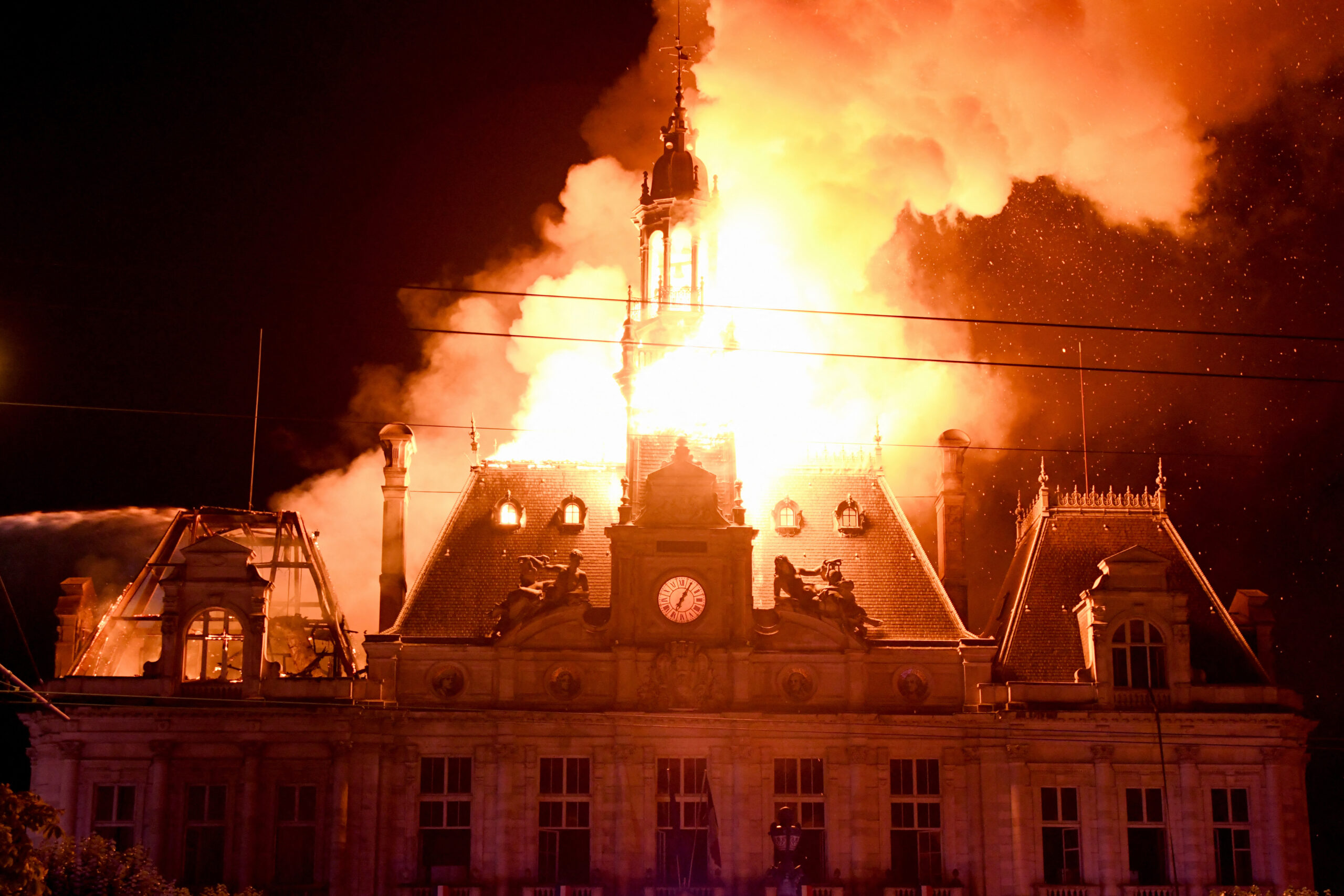
In mid-October 2026, France witnessed large-scale student protests against high living costs, which quickly escalated into nationwide violent unrest. From setting fires in the streets, looting shops to attacking public buildings, the social order faced severe disruptions.
According to a report by Fox News Digital, the turmoil was influenced by a political ecosystem involving communist organizations, leftist revolutionary groups, and a global network of radical activists.
The current state of the French education system, including severe teacher shortages, dilapidated school facilities, and controversy surrounding the selection process of the French higher education admissions platform Parcoursup, sparked dissatisfaction among students and triggered protests. However, as the protests spread nationwide, various communist and far-left organizations intervened, shifting the demands towards opposing capitalism, government austerity policies, and military spending.
Communist leader and scholar Vijay Prashad publicly praised the unrest on social media platform X, and shared a message linking protests across three continents: “Paris—New Delhi—Buenos Aires,” quoting lyrics from the British punk band “The Clash”: “Let fury have the hour, anger can be power.”
This message highlighted how the French unrest was incorporated into a broader international narrative of rebellion and amplified by transnational communist and socialist organization networks.
Investigation points out that this unrest is no longer a spontaneous event in a single region. There is a transnational far-left capital and political organization operating network called “Chaos Inc.,” which uses international media propaganda and political mobilization to spread the unrest globally.
Prashad is the executive director of the Tricontinental: Institute for Social Research, named after the 1966 Tricontinental Conference for the Peoples of Asia, Africa, and Latin America held in Havana, Cuba, promoting Marxist and revolutionary ideologies.
Behind the organization is Neville Roy Singham, a Marxist tech tycoon residing in Shanghai and born in the United States, also known as “羅一” in Chinese. Singham utilized his funds to establish a propaganda and radical organization network spanning across Europe, Asia, Africa, and the Americas, spreading the reports of the French unrest globally.
Singham’s wife and co-founder of the leftist group “CodePink,” Jodie Evans, explicitly referenced youth protests in France, Spain, and India in an interview with New York media “BreakThrough News,” urging American citizens to take to the streets.
Evans actively promotes an anti-military spending movement, scheduled to launch in Washington in November, stating: “I hope people look at France, Spain, and India.” This demonstrates how related organizations coordinate internationally, using social conflicts in various regions to advance their global political agenda.
According to Fox News investigation, among the 54 organizations identified in the October protest ecosystem, only about one-third (16) were genuine student or youth groups. The remaining 38 were adult-led communist parties, revolutionary leftist organizations, unions, and international propaganda institutions:
– Student and youth groups (16): Including the Communist Youth of Greece, Communist Youth Union (UJC), Raised Fist (Le Poing Levé), National Union of French Students (UNEF), High School Union Alliance (USL), and Muslim Students Association in France (EMF) among others.
– Communists, Marxists, and revolutionary left (11): Including “Insubmissive France” (LFI), French Communist Party (PCF), New Anticapitalist Party (NPA), International Communist Union, Revolutionary Communist Group, and World Socialist Website among others.
– Unions, teacher federations, and farmer organizations (12): Including the General Confederation of Labor in France (CGT), Workers’ Force (FO), Confederation of Peasant Farmers, and SUD Education Union among others.
– Human rights, parents, and environmental organizations (11): Including “Yellow Vests” (Gilets jaunes), Uprisings of the Earth (Les Soulèvements de la Terre), ATTAC France, and United Federation of Parents and Students (FCPE) among others.
– Muslim students, pro-Palestine, and international media (4): Including BreakThrough News, Paris Indian Alliance, Jewish Peace Union of France (UJFP), and Urgent Palestine among others.
During the protests, elected officials from the far-left party “Insubmissive France,” like National Assembly member Louis Boyard, were present at the scene waving the Palestinian national flag with students; the leader of the French Communist Party, Fabien Roussel, openly supported the demonstrators, and numerous flags with sickle and hammer symbols were visible on-site.
According to several international media and commentary reports, such radical movements led by revolutionary far-left elements have multi-faceted impacts on societal functioning:
– Security and law enforcement impacts: Violent activities during the protests led to shops being looted, public buildings attacked and burned. According to AFP and PowerLine reports, the violence has resulted in hundreds of police and gendarmes injuries, with over 2,400 arrests in France as of October 18.
– Politicization of livelihood demands: Fox News analysis indicates that the students’ initial demands regarding school facilities, teachers, and living costs were quickly replaced by abstract political slogans like “Revolution is the only way” and “Against capitalism and military spending,” removing the rational space for dialogue on livelihood issues that could be addressed through policies.
– Replication of transnational unrest: According to Fox, “International Youth Strike Alliance” and 28 other communist and socialist youth organizations have issued calls to replicate such strikes and blockades in 12 European countries and launch a multinational coordinated strike on November 20.
– Instrumentalization of youth mobilization: The report shows that two-thirds of the 54 organizations involved in the unrest were led by adults. Leftist political forces directed the enthusiasm of young students towards street confrontations, making student groups frontline tools for political maneuvering.
Political commentator John Hinderaker in PowerLine pointed out that although these unrests may find pretext in gasoline prices and living costs, they are essentially incited and led by far-left and communist elements: “As people often say: the focus is never on the specific issues themselves, but always on ‘revolution’.”