
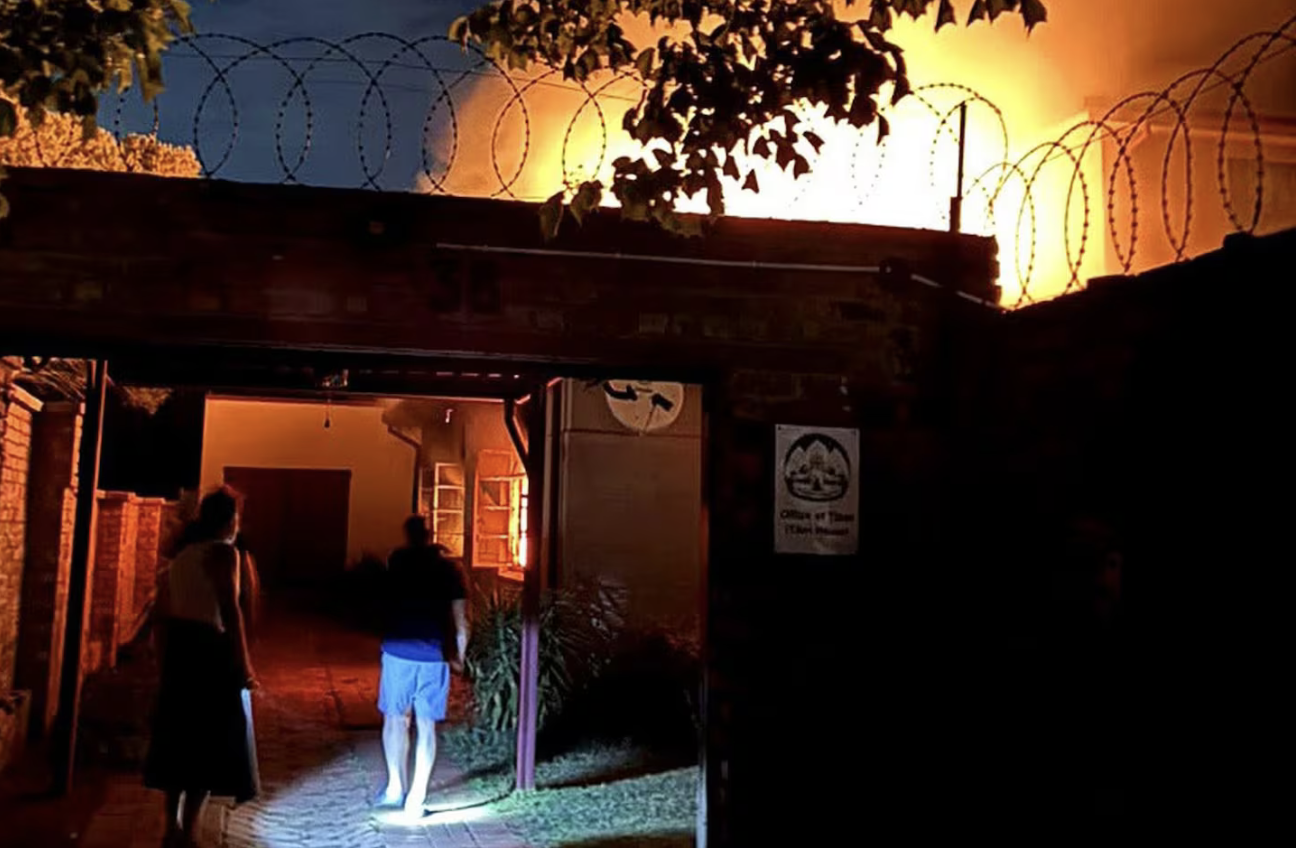
The South African police are investigating the arson attack on the residence and office of Dhondup Gyalpo, the representative of the Dalai Lama in South Africa. Tibetan human rights groups suspect political motives behind the incident and are urging authorities to thoroughly investigate any potential foreign interference.
The incident took place around 11 p.m. on October 14 in Lyttelton Manor, Centurion, near the administrative capital of Pretoria in South Africa, as reported by Radio Free Asia (RFA) on October 16.
Dhondup Gyalpo recounted hearing the sound of breaking glass that night and then noticing smoke engulfing the building. Realizing the urgency of the situation, he broke a window to escape. He said, “There was an unexploded incendiary device above the window. I sustained some cuts from broken glass.”
He described how thick smoke filled the entire building, causing severe damage to the house, furniture, and office documents. Another staff member in the office was unharmed.
The spokesperson for the South African police, BM Muridili, informed RFA that after the fire was extinguished by firefighters, forensic experts and investigators were on the scene for investigation, although no arrests had been made at the time of reporting.
Dhondup Gyalpo mentioned that this was not the first time this year that their office had been targeted in an arson attack.
On July 6 of this year, on the evening of the 91st birthday of the Dalai Lama, three petrol bombs were thrown at the same location, with one of them exploding but causing no significant damage. He had reported the incident to the police at that time, requesting that it be kept confidential. However, in light of this latest attack, he decided to make it public, stating, “I cannot keep this a secret anymore.”
In comparison to the July attack, Dhondup Gyalpo pointed out that this time the attackers entered the office premises and deliberately threw petrol bombs at the windows, aiming for the incendiary devices to land inside the rooms. He believed that the intent was not theft or robbery but deliberate harm.
He suspected that the attack might be intended to convey a political message and intimidate the Tibetan exile community. He affirmed that he would not cease his work in the face of such threats.
“This seems to be a warning to intimidate us, but we are not afraid,” he said. He explained that he harbored no ill will towards the South African people; while awareness of the situation in Tibet among the locals might be limited, most informed individuals held sympathy.
Nevertheless, he acknowledged that the South African police had initiated an investigation, and they would await the findings.
In a statement, the non-profit organization “Students for a Free Tibet” in New York expressed that the attack on the Dalai Lama’s office was part of the Chinese Communist Party’s “global crackdown on Tibetans.”
The organization urged the South African law enforcement and government authorities to immediately conduct a thorough independent investigation, emphasizing that these attacks should not be regarded as ordinary local crimes but should be probed for their political motives and potential involvement of foreign powers.
The Desmond & Leah Tutu Legacy Foundation condemned the attack on October 14 and called for stronger protection of freedom of speech, religion, and association.
Desmond Tutu and the Dalai Lama have both been Nobel Peace Prize laureates for their non-violent struggles. The foundation highlighted their long-standing friendship and solidarity.
“We stand with the Tibetan community in South Africa and all residents and workers in the area. No community in South Africa should lose sleep or fear for their homes being set ablaze due to their identities, origins, or beliefs.”