
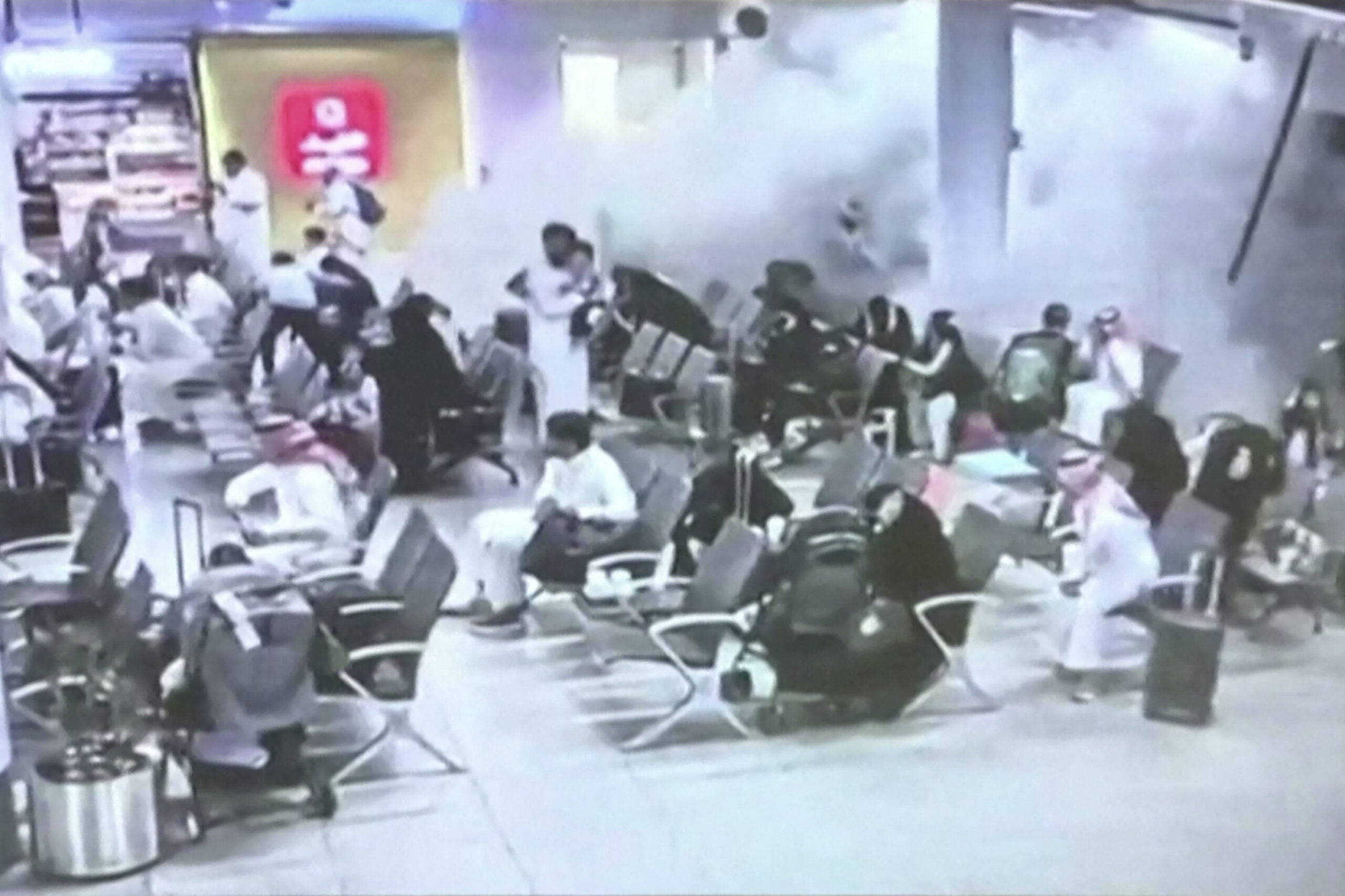
Yemen’s Houthi rebels launched an attack on the presidential palace complex in the southern city of Aden on Thursday (October 15), resulting in 5 deaths and 16 injuries. On the same day, Saudi Arabia revealed that the capital’s international airport had been attacked 20 times this month. A senior Saudi diplomat accused Iran of encouraging the Houthi rebels to escalate their offensive, claiming that some of the related military capabilities or intelligence come from China and Russia.
After intensifying conflict last month, the Houthi rebels continued to target Saudi airports, ports, and oil facilities, while the Saudi-backed Yemeni government forces counterattacked along the Red Sea coast. The conflict has become another battlefield in the Middle East region following the US and Israel’s strikes against Iran in February, impacting aviation transportation and crucial maritime security.
According to Reuters, on Thursday, the Houthi rebels attacked the Al-Maashiq Presidential Palace in Aden with missiles and drones. Yemen’s Minister of Health, Qasim Buhaibeh, stated that the casualties included security guards and civilian personnel, while Information Minister Moammar al-Eryani mentioned that the Prime Minister and Cabinet members were unharmed.
Witnesses reported at least 6 explosions near the presidential palace; security officials indicated that some blasts occurred near the palace’s mountaintop and security checkpoint. Local residents fled in panic, and a video analyzed by Reuters showed thick smoke rising from the presidential palace area.
Houthi military spokesperson Yahya Saree claimed that the target of the attack was the Saudi military operations headquarters in Aden. The group-controlled news agency also mentioned the presence of an arsenal on-site. However, Reuters stated that the claims could not be independently verified.
The coalition led by Saudi Arabia spoke on Thursday, stating that the King Khalid International Airport in Riyadh had been attacked by Houthi rebels 20 times this month, resulting in 17 deaths and 333 injuries.
Near the Yemeni border, Abha Airport witnessed 3 deaths and 28 injuries. The Council of the International Civil Aviation Organization of the United Nations has condemned recent attacks on Saudi civil aviation facilities.
The coalition reported that they destroyed 127 Houthi rebel weapons storage facilities and launch pads in Yemen’s mountainous regions. Saudi authorities intercepted and destroyed incoming drones on the same day.
Furthermore, the coalition intercepted a cruise missile over Medina Province but did not specify the source of the launch. The Houthi rebels denied launching the attack.
Saudi Deputy Minister of Public Diplomacy at the Foreign Ministry, Rayed Krimly, stated in an interview with the Associated Press on Thursday, “We believe that as the conflict evolves to this later stage, the Houthi rebels’ escalation is encouraged by Iran.”
Krimly accused Iran of continuing to provide weapons, training, and support to the Houthi rebels, in violation of relevant UN Security Council resolutions and the Riyadh Agreement to restore diplomatic relations. He labeled the attacks on civilian facilities as war crimes.
Iran had previously denied violating the UN arms embargo and supplying weapons to the Houthi rebels.
Krimly also mentioned that Saudi Arabia believes that some of the capabilities or intelligence shared between Iran and the Houthi rebels “at least in part do come from individuals or entities in Russia or China, sometimes even from commercial entities.”
He stated that Saudi Arabia regularly discusses these issues with China and Russia and will continue to do so in the future. However, he did not provide specific evidence or directly accuse the governments of China and Russia of involvement in the Aden attacks.
On another note, the Wall Street Journal reported on Wednesday (October 14) that a new report from Conflict Armament Research (CAR) indicated that Yemeni authorities discovered missile engine components, warhead structures, and other parts in four containers back in July, pointing to a Chinese precision metal manufacturer. These parts could potentially be used to replicate Iran’s “Kheibar Shekan” medium-range ballistic missile.
If successfully developed, this new type of missile by the Houthi rebels could have a range of about 1,200 miles, enough to target objectives across Saudi Arabia and Israel. However, Fabian Hinz, a senior analyst at CAR, mentioned that Houthi rebel weapon facilities are heavily camouflaged, making it difficult to ascertain the progress of their manufacturing.
China stated that it abides by the UN’s arms embargo on the Houthi rebels.
The Houthi rebels had advanced along the southern Red Sea coast, seizing parts of the Bab el-Mandeb Strait. This month, the Saudi-backed government forces launched a counteroffensive, reclaiming some territory. The Bab el-Mandeb Strait is a vital international shipping channel connecting the Red Sea with the Arabian Sea.
Krimly revealed that Saudi Arabia proposed talks between Oman and the Houthi rebels in July, but the latter refused to participate. Despite the escalating conflict, both sides maintain direct communication, facilitated by Oman to promote dialogue.
He pointed out that Saudi Arabia and Iran also continue to maintain diplomatic contacts.
The third-largest city in Yemen, Taiz, remains besieged by the Houthi rebels, facing shortages of food, fuel, and rising prices. The World Food Programme stated that it was unable to provide supplies to over 600,000 people who rely on aid in the area.
A resident told the Associated Press, “The Houthi rebels have surrounded us from all sides.”
On Thursday, the Yemeni Ministry of Health reported that as of October 5, the conflict had resulted in 120 deaths and 307 injuries, with most fatalities occurring in Taiz, Saada, and Jawf.